Showing posts with label Nature; Birds. Show all posts

Saturday, 6 May 2017

Unwanted or unexpected guests

Every so often we find some strange things in the garden or around the house.

Lost and found
Sometimes these are droppings or pellets we cannot determine, or it is a splat of bird poo which is often difficult to scrub off, or we find a piece of snake skin which some snake abandoned somewhere.
Often one finds out only after some time what sort of animal was the culprit, but not always. And since we have no cameras around the house it is more by good luck than good management that one finds out what animal was the guilty one.

Fox
One morning we saw, whilst doing the washing up, a grown up fox wondering around the garden. And before it spotted us and could make a run for it, we managed to take some pictures of the fox.

A cow between the fruit trees
At another occasion we found some cow pats in the garden. It was quite obvious who was or were guilty, however, how one or more cows ended up in the garden stayed a mystery. During a second invasion we found out that there had been, for a while, a broken piece of fencing between meadow and garden, nicely hidden by bramble bushes. The cows just barged in and ended up in our garden.

Stork
When the château in Cormatin had two storks nesting on one of the chimneys (that was before the chatelain chased them away after having put up with them for several years) they often made a pit stop at the pond in our meadow.

Wild boar (stuffed, at the market in Louhans)
Although wild boar lives in the woods around us, we hardly ever see them. Sometimes, late in the evening, we have seen a sow with young piglets wandering along the soft shoulder of the paths through the woods, but a) one does not always have a camera at hand, b) it is often too dark to take a picture and c) I am enough of a scaredy-cat (in itself a protected species) not wanting to disturb a possibly aggressive sow.

Roe deer at the gate
Roe deer are also not uncommon, but they are wise enough to stay put during the hunting season. The only roe we managed to "shoot" we saw eating leaves on the path at our gate on a cold winter morning (within the hunting season, by the way).

Dead badger
There must be quite some badgers around here. Proof are the dead badgers we have seen laying along the roadside, obviously hit by cars during the night whilst crossing the road.

Green whip snake
And the snakeskins? We find them in the weirdest places. This area knows some quite big (about 5 feet long) snakes, non-poisonous, who feed on mice and other small vermin. The species is called the green whip snake. We have never found enough skin to turn it into a purse or handbag, though.

For our own website click here.

Saturday, 19 November 2016

The hummingbird hawk-moth


When, on a summer's afternoon, we sit and relax in the garden near where a lavender plant is growing, we often see a lot of activity around the lavender flowers.

Hummingbird hawk-moth in action
Bumble bees are busy doing whatever bumble bees are doing, but a few weeks before the bumble bees become very active we notice some insects we had never seen before we moved to France.

Hummingbird hawk-moth
The insects I am talking about look like moths, and have brown wings with an orange edge. The animals hang stationary in mid-air in front of a lavender flower, and it seems like they are sucking some fluid from the plant. We are not equipped with any knowledge on the subject, and since we had observed that the thing could hang still by moving its wings with tremendous speed, we happily called it a humming-bird moth.

Hummingbird hawk-moth in action
Wikipedia, as in many cases, put us on the right track. The animal is called hummingbird hawk-moth (Macroglossum stellatarum), a small moth with a wing span of 2 inches and a very long tongue with which it sucks nectar from plants. Only after I started to experiment a bit with the shutter speed of my camera I managed to take some interesting pictures of the animal.

For our own website click here.

Saturday, 3 November 2012

A distorted picture

Gregorius
As a child I was a great fan of Jean Dulieu, a writer and illustrator who was the spiritual father of Paulus the Gnome, a character who lived in the woods and had various animal friends. One of those friends was Gregorius the Badger, a rather stupid animal who spoke dyslexic. This writer later read his stories on radio, in a weekly broadcast, where he was doing a different voice for every character in his stories; Paulus, Gregorius, Salomo the Raven, Uhuburu the Owl, Eucalypta the witch, etc.


Apart from Paulus, I occasionally read the Dutch translation of Rupert Bear, where Bill Badger was playing a role as one of Rupert's friends. However, I never really got the hang of Rupert, and stuck with Paulus.
When comparing both badgers not the likeness is striking, but the difference.

Bill Badger
As a great believer in Dulieu's knowledge on the subjest of gnomes, witches and badgers, I discarded Bill Badger as a phony character; real badgers should look like Gregorius.
Until .... we saw a dead animal on the soft shoulder whilst driving down the road . We often find dead copyus or river rats alongside that stretch of road. Not entirely convinced it was a river rat, we stopped on the way back to have a good look. And lo and behold, it was a dead young badger. Unnecessary to say that my trust and belief in Dulieu has suffered a severe blow...


Een echte das
For our own website click here.

Saturday, 12 May 2012

Birds of a feather?

Regularly, throughout the season, we notice campers as well as gîte guests going for a walk, armed with a pair of binoculars. Others are staying on the premises, pointing their binoculars at trees and listen very attentively to the surrounding sounds. No doubt these people are bird watchers, who keep an eye and an ear out for everything that warbles and flies or flutters.
I am a total nitwit when it comes to nature, and I have asked some of these people what exactly they were looking for, and what they found. Bird names like red-backed shrike, a tiny little bird, several types of woodpeckers that hammer our trees, red kites and a variety of song birds were mentioned. I think I myself might have spotted a golden oriole, I certainly have been woken up by nightingales, and I had a number of brief encounters with hoopoes.
However, I am more excited about encounters with in my eyes more exotic species. In winter, and only then, I have seen a white heron around here. It stands in various fields around here, flies off very elegantly, and I assume it is every time the same bird I have seen around here. Last winter I drove through Chazelle, and there it stood, on a weir in the Grosne, close to the lavoir. Fortunately I had my camera ready, hence I could have a good picture of him before he flew off. An internet search revealed that it might have been a great egret, but having said that, an expert could come up wit a better determination.
Last summer a pair of storks took residence in Cormatin. We spotted them for the first time in a field near Cormatin, pecking the ground in search of, I believe, worms or frogs. They build a nest on a chimney of the Cormatin château. I know that storks are not exactly rare; in the Alsace, but also in Southern France and in Spain almost every bell tower is crowned with a stork’s nest. But the whole population of Cormatin, all 503 of them, find the storks a fascinating phenomenon.
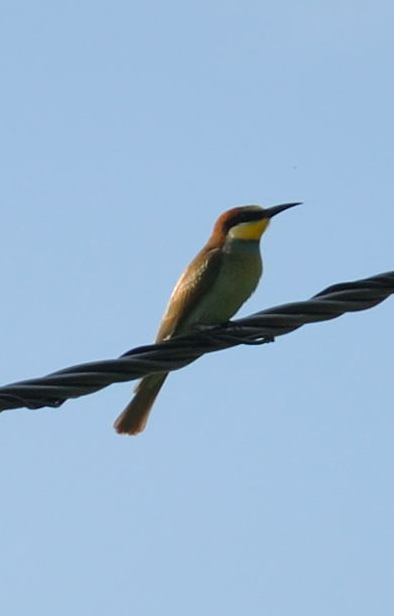
My last spotting was a rather strange one. Towards one September evening I was looking out over the fields from our sitting room, when I noticed a swarm of birds landing on the telephone cable running to our house. I saw them with the sun aslant behind them, hence I could not see them very clearly; still they did not seem ordinary birds. When I looked at them through a pair of binoculars, I noticed they were beautifully coloured birds. I managed to catch one with my camera just before the swarm took off again. With the help of a small bird book for laymen and some internet research, I suspected these had been European bee-eaters. Checking this with a birdwatcher confirmed this suspicion. The swarm was migrating, and obviously landed in Chazelle for a short break.
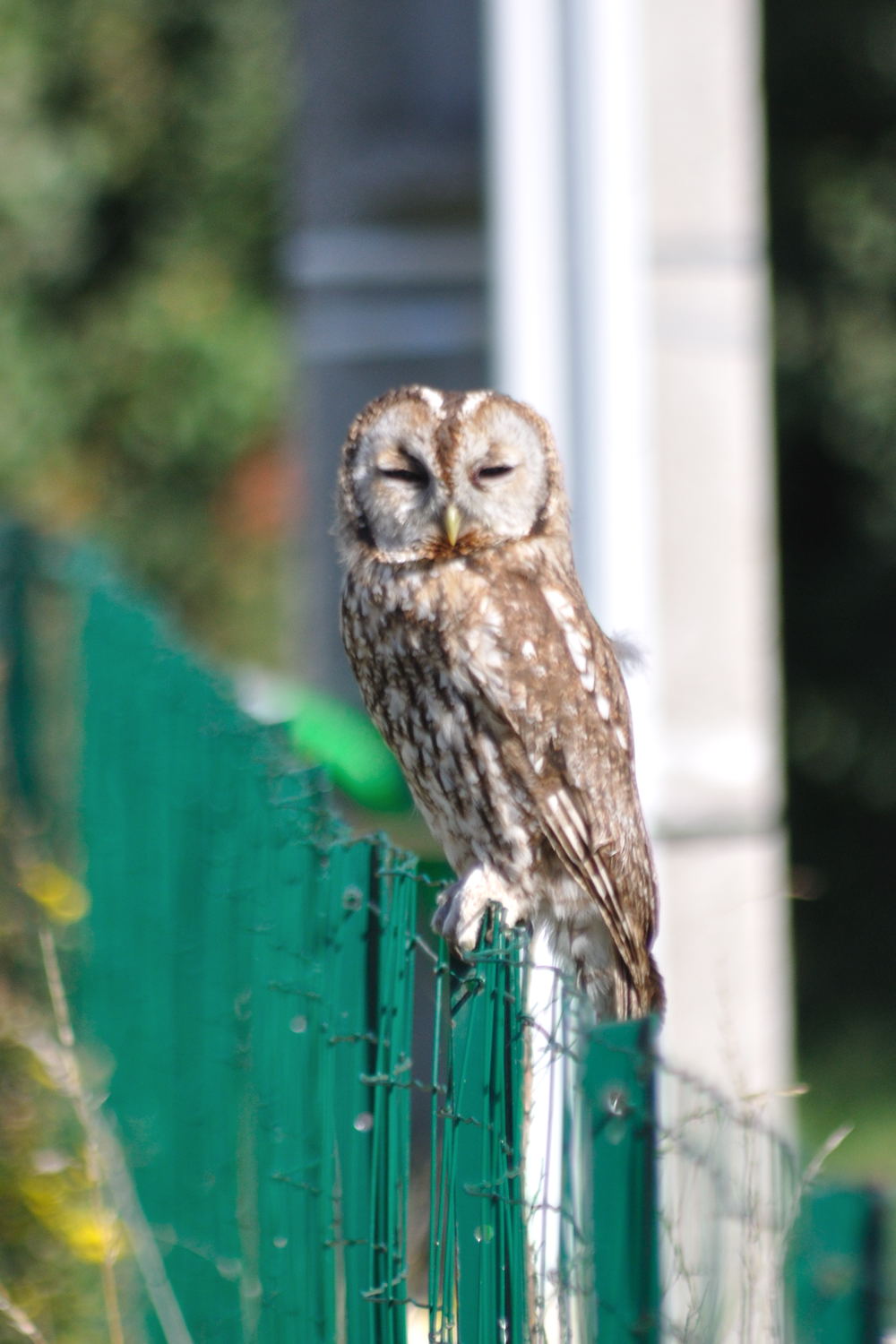
And then I thought how to close off this blog? The answer came the same day. We drove through Saint-Gengoux on our way to the local cave to get some wine, when we saw, sitting on a gate post in the middle of the day, a tawny owl. They normally live in the woods, and although Saint-Gengoux is not exactly a metropolis, it is also not that rural that tawny owls would nest in the town itself. The owl looked a bit sleepy, and I suspect it somehow got lost and mistook the gate post for a tree.
The moral of this story: to see interesting birds, it pays off to keep your eyes open in stead of investing in expensive equipment!

For our own website click here.