Saturday, 26 March 2016

Bureaucracy, or Liberté, Egalité, Fraternité (part 4 of 6)

The French are notorious for their bureaucracy, certainly with the Brits and the Dutch.

A French civil servant
In my view the Dutch should not moan too much about bureaucracy, because Dutch civil servants can be far worse than French ones. The main difference between the two is in the approach of a problem. The French can be (depending on their mood) either absurdly strict when it comes to applying rules, or waive them. The waiving attitude is quite common in rural areas.

His Dutch counterpart
In the Netherlands rules are rules, and when an exception is made it has to be turned into a new rule first.
That makes French bureaucracy often unpredictable, and its Dutch counterpart sometimes frighteningly efficient. The latter comes in very handy when one requires official documents from authorities: requesting can be done through internet, paying uses internet as well, and normally the requested document lands within a week on your doorstep.

Paying online
However, there appears to be one exception: Dutch Courts of Law. For my application for French citizenship I needed an official court ruling concerning my divorce. After having explained to a French civil servant in Mâcon that I had no such piece of paper, and did not know how to get hold of it, but that the required information could be found on another official document issued by my place of birth, she waived the request as being fulfilled. Somehow I was not entirely happy with this solution: given Dutch efficiency it must be easy to get hold of something trivial like that?

Préfecture - Mâcon
Internet provided a solution. I downloaded (18 May 2015) a form from the Courts' website, filled it in and posted it to the Hague. Pretty quickly afterwards (26 May 2015) I received a letter that they could not find the ruling, could I provide them with a case number? After starting digging through my archives once more, I found a photo copy of a piece of paper concerning the ruling (that looked like it had been torn out of a scrapbook), which also mentioned a case number. There was no letterhead, nor anything else indicating this might be an official piece of paper, but it was all I had. I filled in the form once more, sent it off and waited.

Court of Law - The Hague
When, towards the end of the year I still had no news from the courts, I decided to phone them (we are writing 4 November 2015). They told me that they most likely had lost my application, because these things should not take longer than a month. Could I fill in a new form and submit it? The form was posted the same day.

Ministry of the Interior - Paris
A month later (4 December 2015) I received a photo copy of the same piece of scrap paper I had found in my archives, however, this time it was stamped and dated by the Courts in The Hague. And that was all, or so I thought.
Until… on 15 January 2016 I received a letter from a civil servant in the French Ministry of the Interior in Paris, who disagreed with her colleague of the Préfecture in Mâcon: could I please provide them with a the court ruling and a sworn translation, to be submitted at the latest two months after the dateline of the letter?

A warmly recommanded sworn translator
So I had not persued this document for nothing!

The translation was quickly organised, and the document was posted 4 February 2016 to Paris. And how will this story continue?
God, this time impersonated by a French civil servant, only knows….

Note : Most pictures are copied from the internet.

Saturday, 5 March 2016

From old to new

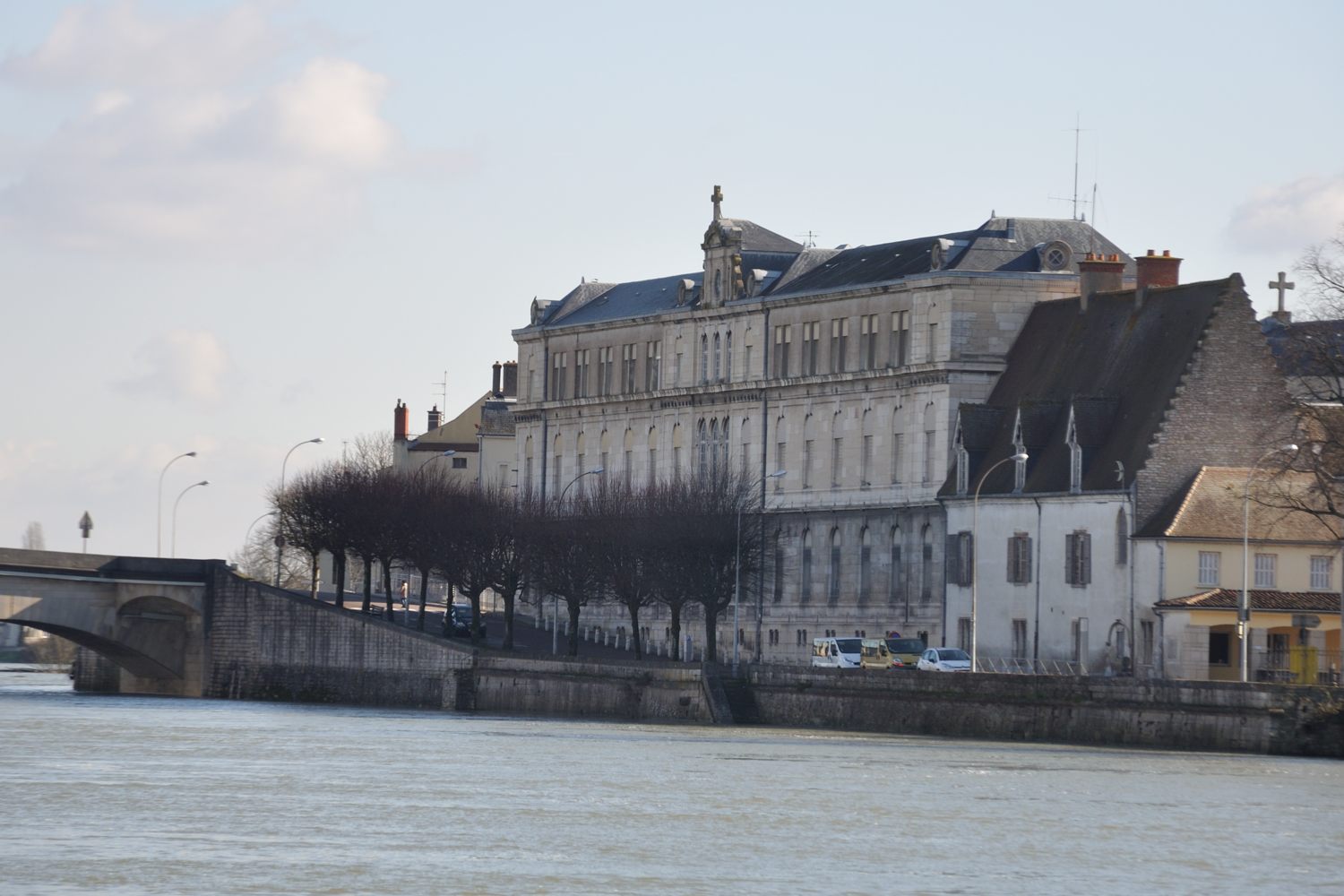
In 2008 and 2009 I had the dubious honour to spend some time in hospital. That hospital was the Centre Hospitalier William Morey in Chalon-sur-Saône, in those days located in an old building on a small island in the Saône.

The old hospital
The care I received was excellent, but the building was old and rickety and the Intensive Care Unit, where I stayed twice, had rooms for one or two patients. Once one was released from Intensive Care one ended up in the normal wards for, if I remember correctly, 6 to 8 patients per ward.

The new hospital
When I recently had to go to hospital again for two nights, the old hospital had ceased to exist and I ended up in the brand new hospital of Chalon at the edge of town near the station. Fortunately there was no need to go to the Intensive Care again, and I was pleasantly surprised to find out that I ended up in a single room (with - at a price! – a radio, TV and internet connection). The nurse told me that the new hospital only had single and double rooms.

Single room (picture from a brochure of the hospital)
That was of course very nice for the patients, but the nursing staff was not so happy about it, for the simple reason that there were not only more, but also bigger rooms which increased the amount of walking they had to do day in day out. However, the care was excellent again, and, though I would have preferred to stay at home, one can think of a worse place to spend a few nights.

View from the old hospital
The only thing I missed in this new building was the view. In the old hospital I had a stunning view over the Saône on the two towers of the Cathedral Saint-Vincent. The new hospital offered me a view on an inner courtyard of the building; not exactly very inspiring. However, to be honest: no matter what the view is, what the quality of the care is and how comfortable the rooms are, it is always better to avoid hospital if one can!

However, I prefer this view!

Saturday, 27 February 2016

The community of Taizé

The bells of Taizé
I am woken up every morning by the bells of Taizé, the single bell for the monks rings out at 07.45 for about 5 minutes, calling the monks to their morning prayer then the bells start in earnest at 08.15 and ring until 08.30, letting all the pilgrims at Taizé know that the service is about to start. When the bells stop I know I really must get up. The bells ring from 12.15 to 12.30, so I know lunch should be on the table and if dinner is not ready when the evening bells go at 20.15, I know I am very late. And that was what Taizé was to me when I arrived here in 2005.

After Easter in 2006 we went to Taizé to have a look around and we were amazed at the number of young people milling around. We didn’t go to a service as that seemed inappropriate, with all these kids around it seemed like a young person’s thing. I wanted to go to a service, but I didn’t know how it worked, so I didn’t dare go alone. In July some campers (Ans and Simon) arrived, she had been to Taizé for the first time that spring and wanted to camp nearby to take in a few services and tempt her husband to go too. He however wasn’t interested and she didn’t dare go alone. At last my chance to go to a service, so on a Friday evening Ans and I went up the hill to Taizé.

A service in Taizé (Photo © Arnd Waidelich)
The services are made up of singing and silence. The songs are mesmerising. With pilgrims from all over the world the songs need to be simple to enable everyone to sing. There are a mixture of languages, Latin, German and some sort of Slavonic language are the most popular with French, English and Spanish there too. Each song has two lines and these are sung over and over again. The songs are a mixture of four voices, rounds and solo singing with the congregation singing the chorus. It is not to everyone’s taste, but I absolutely love them. In every service there is silence, five minutes of it. Five minutes is a very long time and it is quite amazing that a church full of people can be so quiet for so long. The singing continues after the monks have left and on a Friday and Saturday night this can go on into the early hours of the morning I have been told.


Pottery made by the brothers
The peace that pervades in a service is tangible and I can quite understand why some people come back year after year, just to regain that and to take a little bit of serenity back home with them. It is definitely not just a young person’s thing at all. Everyone is welcome to the services. Many, many of the visitors in our gîtes or on the campsite come for Taizé, to take part in a couple of services while being on holiday and enjoying other things that this area has to offer. Something not to be missed is a look at the stunning pottery the monks make to pay for their upkeep.

Special service - 5 years ago: Frère Roger killed; 70 years ago: he arrived in Taizé (2010)


We get many questions about how to walk or cycle to Taizé from here, so we have made some maps of the various routes and posted them in a photo album. Click here for those routes.

Text Sue Nixon

For our own website click here.

Saturday, 20 February 2016

The Golden Hour

Years ago, in February 2007 to be precise, we made a picture of the Romanesque church of Ameugny, using a small Olympus point-and-shoot camera. The colours of this picture were quite superb; it seemed like the church was bathing in a golden glow.

The church of Ameugny, 15 February 2007 17h20
However, the quality of the picture was quite low (72 dpi, good enough for internet use, but too poor to make prints), and since we got a request of an acquaintance to deliver some pictures of Cormatin and surroundings to be blown up and framed, I decided to dig in my archives in search of higher quality pictures. That turned out to be not too difficult; most of the more recent pictures were taken with a Nikon D50 or D90, they were sufficiently big and had a 300 dpi value.

The church of Ameugny, 2 December 2012 15h54
Only, the golden glow was missing. Since my better half has been heavily involved in photography last year, the term "The Golden Hour" has been discussed quite frequently. Not that I really believed in the rather euphoric description of pictures taken during that magic hour, but one never knows. The picture taken in February 2007 was indeed from around 17h00, an hour the sun is really low in the sky.

The church of Ameugny, 21 January 2016 15h10
According to her the sun is very low in January anyway, hence she saw no reason why it would not be possible to reproduce that picture around 15h00. That was just as easily said as it was done. However, even though the colours were marginally less dull than those of the older pictures taken with the D50 and D90 (most of them taken in the summer, during the day), I was not really impressed with the result.

The church of Ameugny, 21 January 2016 16h44
So, on one of the few sunny days in January around 17h00 we went back to Ameugny, and took again some pictures. After comparing the photographs, it looked like the golden hour certainly exists: the picture from early February 2007 and from late January 2016 were, in terms of colour, almost identical.
For those who are like a doubting Thomas: look, compare and be convinced!

Saturday, 13 February 2016

Walking along the Balades Vertes

Quite recently Saône-et-Loire, South Burgundy has completed the Balades Vertes which are a large number of signposted walking routes throughout the whole of the département (71). Together with the Voie Verte (check out the article) these routes make this area a Mecca for walkers.

In the capital of our canton, St Gengoux le National, the tourist information office has a little book with details of the walks that are in the area between the rivers Grosne and Guye, rather unsurprising called "Guide les Balades Vertes entre Grosne et Guye". The book contains 26 signposted walks and costs €8.00, a little map and description of each walk can be bought separately and they cost € 2.00 each. All the signposts or markings on trees and fence posts are in yellow and are very clear.

A large number of communes along the Voie Verte have a starting point for their walks. The routes to these starting points are clearly marked with large signposts “Randonnée - Balade Verte” on the main roads. By each start point there is a carpark and a map with an overview of the routes that start and finish at that point and the route reference number, for instance the routes from Cormatin are CO1 and CO2, from Taizé TA1 etc. Click here for an album with some more pictures of the Balades Vertes.

Taking a break along the Balades Vertes
For those who want to be a bit more adventurous and make their own way around here, there are very well detailed maps from IGN in their Série Bleue (1:25000) which you can use to find all the footpaths in the area. One of the Grande Randonnées passes close to Cormatin (GR76) and Cluny is one of the starting points for the road to Santiago de Compostella.

Over and above all this, from early in the spring until late in autumn, there are organised randonnées most weekends. The routes are marked by different coloured spray paint arrows on the road or wooden arrows on temporary posts and the walks usually range from 5 to 30 km. At strategic points on the way there are refreshment stalls where wine, water, French bread, cheese and sausage are distributed. The prices vary by distance and range from €3.00 to €10.00.

We get many questions about how to walk or cycle to Taizé from here, so we have made some maps of the various routes and posted them in a photo album. Click here for those routes.

Monday, 8 February 2016

Gong Xi Fa Cai!

Chinese New Year in Mâcon

I can't say "Pardon my French", because the title of this blog is not in French at all. It is in Chinese, or more accurately Mandarin and stands for "Happy New Year". France does not host huge groups of Chinese, most likely because the French never had a big influx of cheap Asian labour like the USA during the laying of the railroads, nor did many Chinese sailors get stuck in the thirties in France during the big recession because their shipping company went bankrupt (like in the Netherlands in Rotterdam).

Chinese buffet - Palais d'Asie Mâcon
Only in some big cities like Paris, Lyon and Marseille one can find decent Chinese restaurants, something that is difficult to find in Burgundy. Most restaurant owners (but not all) here are of Vietnamese extraction (Vietnam being a former French colony).
Hence it was quite a surprise when our taichi group was invited to give a demo during the Chines New Year's Celebration in Mâcon.

The Group Hong Teck sets off
That resulted in a couple of weeks frantic training and a day out in Mâcon, a town we normally only visit to visit the prefecture or the tax office. The festivities were planned in the middle of town, with as a highlight a Chinese lion dance performance. Lion dances are not excactly a novelty for me. Whilst I was working and living in Singapore I did experience three Chinese New Years, and often when a new shopping centre was opened the festivities included lion or dragon dances.

The woman on the left can't stand the noise
The organisers had engaged the Hong Teck lion dance group from Lyon, and that turned out to be a great success. The group consisted of three (Southern) lions, a laughing Buddha and five percussionists, who made noise for at least ten. Most spectators had never seen anything like this, and quite a few of them covered their ears to block the noise at least a bit, and one little girl started to cry uncontrollably when a lion came too close to her for comfort. Fortunately the group distributed a leaflet called "Lion dance for Dummies" among the crowd!

Lion Dance for Dummies
The group set off from a square in the centre of town, "danced" its way through a busy shopping street and gave their proper show on the Place Saint-Pierre, not far from the place of departure. There they performed their show culminating in "cai qing = plucking the green", where a lion has to find and "eat" a lettuce hanging from a stick. All in all it was an excellent show, in my case bringing back sweet memories; it was certainly worth the trip. After the lion dance hundreds of red and gold coloured balloons were released, and the inevitable "vin d'honneur" was served. And then it was time for the lunch break.

The lion plucks the green
After which our group had to do our demonstration. That was (fortunately) a success; public as well as the performers of "La Spirale d'Or" were very content with the way we did the Yang and Chen 24-forms and the fan- and stick forms. This was the very first time we performed in public using music, which simplified the synchronisation of the movements considerably. The taichi pictures in this blog however were taken during other occasions, for the simple reason that my camera was used to make videos of our show.

La Spirale d'Or (fan form) in Cluny
And what about a Chinese meal? Well, that will have to wait a couple of weeks, when we visit Paris. We know near Place d'Italie there an excellent Chinese restaurant!

Click here for the link to one of the videos of our performance in Mâcon (Yang 24-form).

Saturday, 30 January 2016

Les Oiseaux Rares

Each year, in December, a group of artisans from Cormatin and surroundings organises a two-day exhibition.

Les Oiseaux Rares 2015
Even though Cormatin itself has a rich reservoir of people with creative talents, the members of this group seem to have as their motto "The more the merrier", because each year they invite a number of guest artisans from nearby places. This year the hard core of Les Oiseaux Rares (Rare birds) shared their workshops with these migrant birds. The idea is quite simple: in Cormatin a trail of bird footsteps has been set out, and following this trail one passes all the participating artisans. To make sure that not even one artisan is accidentally not spotted, in front of each workshop a wooden bird (a caricature of the artisan in residence) is placed.

Iris Griot jewelry - Cormatin
Just like the year before one of Cormatin's potters had made 300 unique soup bowls, which could be purchased at € 6 each from each of the participating artists. Again, the hard core of these birds had made a big cauldron of soup, which was simmering away throughout the day. The soup was free of charge, and varied from a simple tomato soup to soups made of slightly more unconventional ingredients.

Pascale Ponsard - Cormatin
To keep a long story short, there is a lot to be admired during those days. The articles on offer were as varying as the soups; they ranged from ceramic, rattan, paintings, felt clothing to hand painted silken shawls. And this is just a random selection from everything on offer. The first day we did not get much further than the workshop of one of our friends (Pascale Ponsard, a silk decorator, who makes not only shawls, but she also decorates material meant for wedding gowns – an extravaganza financially only affordable for Saudi Princes and the like), and the workshop of potter Pierre Arnoud, where it was so hectically busy that we could only view one of the three available rooms.

Tracking
The second day we had planned our outing a bit more careful. We decided to start our round along the bird's nests around noon. That is the time most French are having their warm meal at home, which gave us the chance to have a good, undisturbed look around. Besides we could have our light lunch trying out the soup made by the various cooks. This set-up worked perfectly. When we had seen enough at around 2 o'clock, both we and our fellow villagers had eaten enough, and while we were leaving the workshops others streamed in.

Soup bowls - Pierre Arnoud - Cormatin
Some soups were a bit strange, though, in terms of ingredients: what to think of a soup made of carrot, curry powder and oranges, or of celeriac, hazelnuts and apple, or of peas, lentils and turnips? What is wrong with chicken soup?
That most likely did not appear on the menu out of solidarity with the less rare birds….

paintings by Jean-Louis Schoffel - Cormatin

Saturday, 23 January 2016

World music : Toumani & Sidiki Diabaté Chalon-sur-Saône

September 2016 the new brochures for the concert series season 2015-2016 became available. In the Netherlands we were kind of spoilt, as we have found out now; Rotterdam, Amsterdam and The Hague have all more or less prestigious concert halls, offering each year e relatively big number of classical, jazz or world music concerts.

Vader en zoon Diabaté - Internet
Of course scale is an important factor when comparing the cultural volume of Burgundy and the Western part of the Netherlands. Rotterdam has a population of approx. 600 000, and the biggest town around here, Chalon-sur-Saône, boasts only 50 000. Not to mention places like Mâcon (35 000), Montceau-les-Mines (20 000), Le Creusot (25 000) or the centre of our universe Cluny (5 000).
Series like "Great Masters of the Piano" with e.g. Brendel are not likely to take place around here. And for the equivalent of the North Sea Jazz Festival one has to travel to Antibes Juan Les Pins or Montreux.
In order to find something interesting one must look for it. In the Chalon brochure I found a concert by 2 Malinese kora players, who had some very interesting Youtube files on the internet once I started looking for it.

Vader en zoon Diabaté - Internet
Hence we decided to give it a try; we bought tickets and were expecting some sort of folk music concert in one of the small halls of the theatre. But also this time we were pleasantly surprised. Not only was the (big) hall chock-a-block full (we estimated about 800 man), but the two African gentlemen (father and son) turned out to be a pair of excellent musicians. The kora happens to be an African harp with a peculiar sound; its body is made of half a calabash, and all other parts making up the kora (strings, pegs, etc.) were originally made of parts (bones, teeth, skin) of the gazelle. It turned out to be a very interesting concert, where I could easily suppress my built-in aversion against the (classical) harp as a solo-instrument.

Michael Palin's Sahara - Internet
Only once we reached home I found out that we had not been watching some obscure African musicians, but that both men had actually won their spurs at big international festivals (Glastonbury, Roskilde, Brighton) where they managed to draw huge crowds. That might also explain the use of a wah-wah pedal in the last tune they played. Over and above that, my son, who has an amazing memory, neatly explained that we had seen Toumani Diabaté in 2002 in an episode of Michael Palin's "Sahara". Remark noted….

Saturday, 9 January 2016

Jazz concert John Scofield / Joe Lovano Mâcon

After the modest concert of the Carla Bley Trio in Chalon it was hard to imagine a concert so contrary to the previous one than the one the John Scofield / Joe Lovano Quartet gave in Mâcon.

Joe Lovano & John Scofield - Internet 2015
I had heard both of them ages ago at a.o. North Sea Jazz and though grown a bit older (haven’t we all?) those two played like they did when they were still in their prime. The concert in Mâcon was organised in collaboration with the Crescent Jazz Club, which celebrated its 20th birthday this year and got the golden opportunity to have a full house, slightly differing from the max. 50 man which will fit with great difficulty in the club.

John Scofield / Joe Lovano Quartet - Internet 2015
As I said earlier, the musicians were enjoying themselves, they played a number of pieces from their latest CD "Past Present" and the rhythm section of Ben Street – bass and Bill Stewart – drums were laying a thoroughly swinging foundation for the frontline. One interesting thing was (apart from the music) that albeit tickets had been sold the seating was free during the concert. This partially solved a typically French problem, where people turn up 15 minutes late without blinking an eye, and then worming their way to their seats somewhere in the middle of a row. And the musicians will have to wait…

CD's signeren
The hall was chock-a-block full and a rough count clocked up approx. 800 seats. The Crescent Jazz Club can only in its wildest dreams imagine these numbers; it is most likely a multiple of their yearly number of visitors.

Afterwards one could purchase CD's, signed on the spot by the two masters themselves; who would say no to a chance like that?

Saturday, 26 December 2015

Jazz concert Carla Bley Chalon-sur-Saône

Jazz concerts featuring "big" names are not very common in this area. The amount of musicians we have had her in the last 10 years with an international reputation can be counted on the fingers of one hand: Jazz Et Caetera and Jazz in Trivy have featured René Urtreger (L'Ascenseur sur l'échafaud with Miles Davis), Rodha Scott has played here once and Biréli Lagrène has played here a number of tims, the last concert together with Didier Lockwood.

Espace des Arts - Chalon-sur-Saône
When not long ago the brochures for Chalon (Espace des Arts) and Mâcon (Le Théâtre) landed in our letterbox we were pleasantly surprised to see that the Carla Bley trio with Steve Swallow – bass and Andy Shephard – tenor and soprano were playing in Chalon.
Carla Bley and Steve Swallow I knew by name although I had never heard them play, not even on record. Paul Bley (Carla's ex) however I had seen and heard live, and I was expecting music along those lines. Tickets were ordered quickly, and I was really looking forward to find out what sort of music this group was playing.

Carla Bley - Internet ca. 2015
Carla Bley, clocking up 80, made a very fragile impression (not so strange at her age) and played surprisingly modest. Something I had difficulty coming to grips with was the fact that all musicians were playing from sheet music, something one does not see very often with jazz groups this size. The music was very calm and quiet, almost docile, and while it is with "normal" jazz concerts not unusual that people are tapping their feet to the beat, the public here was as quiet and calm as the music they were listening to. despite this,

Carla Bley Trio - Internet ca. 2015
I still found it an interesting concert, if only to add Carla Bley to my list of "I have heard him/her live" musicians.
And after this concert it was waiting for another one, this time by John Scofield!

Saturday, 12 December 2015

Will the real Mr. Brickmaker please stand up?

We have always thought that Noël Marembeaud, no matter how the name is spelled, has been the founder of La Tuilerie de Chazelle. All clues were pointing in that direction: dozens of bricks we found around the house, a number of floor tiles, some roof tiles, all with his name printed on them, the memorial plaque which I have mentioned earlier, with his name, birth year and year of death chiselled in….

The well known stamp
Whenever we found another broken or damaged brick with his name printed within its distinctive cadre, we hardly looked at them, convinced as we were it was another Marembeaud brick.
Until Sue decided to protect the roots of a plant with some old roof tiles and broken bricks she had found somewhere.

La Tuilerie (sketch Michel Bouillot)
Without any apparent reason I picked up one of the bricks and noticed that the name I was expecting was not that of Marembeaud, but a totally unknown name to me of which most likely the first letter was missing.
Without too much fantasy one might draw the following conclusion: the name on the brick was "(B)OURGEON ANTOINE", with under it the text "(A CHA)ZELLE". The letters between brackets are my guess.

The odd one out
Bourgeon is not an uncommon name around here, and based on the length of the cadre around the name it seemed unlikely that there had been more than one letter in front of OURGEON. The question boils down to the following: who was the founder (or the successor) of La Tuilerie de Chazelle? The name Marembeaud occurs most frequently; Bourgeon we have only encountered once. And maybe Bourgeon was someone who ordered a load of bricks and wanted his name engraved in them.

To tell the truth (Saint Nicholas) Dutch version
To paraphrase the old game show "To tell the truth": "Will the real Mr. Brickmaker please stand up?". However, that would be a resurrection from the grave, I am afraid….

Click here for the website of La Tuilerie de Chazelle.