Showing posts with label Campsite; Apartment; Gite. Show all posts

Wednesday, 19 July 2017

Staff announcement

I will have to disappoint those who follow this blog and have the idea to come here one day and stay on our campsite:
Since May 1st 2017, at the beginning of our season, we have decided to close the campsite permanently.
The reason is, that having family and friends pitching a tent in our back garden is one thing; however having strangers occupying the same space is something different, reason why we have decided to give our own privacy a slightly higer priority.

Once upon a time
The campsite should have disappeared from our own website as well as from websites we have been advertising on, and even on Google Maps Camping à la Ferme La Tuilerie ceased to exist.

Our gîtes
However, there is some good news as well: we still open our doors for guests of our two gîtes. We are still very happy to welcome those who would like to stay in one of our gîtes for one or more weeks, preferably from Saturday to Saturday.

For our own website click here.

Saturday, 27 February 2016

The community of Taizé

The bells of Taizé
I am woken up every morning by the bells of Taizé, the single bell for the monks rings out at 07.45 for about 5 minutes, calling the monks to their morning prayer then the bells start in earnest at 08.15 and ring until 08.30, letting all the pilgrims at Taizé know that the service is about to start. When the bells stop I know I really must get up. The bells ring from 12.15 to 12.30, so I know lunch should be on the table and if dinner is not ready when the evening bells go at 20.15, I know I am very late. And that was what Taizé was to me when I arrived here in 2005.

After Easter in 2006 we went to Taizé to have a look around and we were amazed at the number of young people milling around. We didn’t go to a service as that seemed inappropriate, with all these kids around it seemed like a young person’s thing. I wanted to go to a service, but I didn’t know how it worked, so I didn’t dare go alone. In July some campers (Ans and Simon) arrived, she had been to Taizé for the first time that spring and wanted to camp nearby to take in a few services and tempt her husband to go too. He however wasn’t interested and she didn’t dare go alone. At last my chance to go to a service, so on a Friday evening Ans and I went up the hill to Taizé.

A service in Taizé (Photo © Arnd Waidelich)
The services are made up of singing and silence. The songs are mesmerising. With pilgrims from all over the world the songs need to be simple to enable everyone to sing. There are a mixture of languages, Latin, German and some sort of Slavonic language are the most popular with French, English and Spanish there too. Each song has two lines and these are sung over and over again. The songs are a mixture of four voices, rounds and solo singing with the congregation singing the chorus. It is not to everyone’s taste, but I absolutely love them. In every service there is silence, five minutes of it. Five minutes is a very long time and it is quite amazing that a church full of people can be so quiet for so long. The singing continues after the monks have left and on a Friday and Saturday night this can go on into the early hours of the morning I have been told.


Pottery made by the brothers
The peace that pervades in a service is tangible and I can quite understand why some people come back year after year, just to regain that and to take a little bit of serenity back home with them. It is definitely not just a young person’s thing at all. Everyone is welcome to the services. Many, many of the visitors in our gîtes or on the campsite come for Taizé, to take part in a couple of services while being on holiday and enjoying other things that this area has to offer. Something not to be missed is a look at the stunning pottery the monks make to pay for their upkeep.

Special service - 5 years ago: Frère Roger killed; 70 years ago: he arrived in Taizé (2010)


We get many questions about how to walk or cycle to Taizé from here, so we have made some maps of the various routes and posted them in a photo album. Click here for those routes.

Text Sue Nixon

For our own website click here.

Saturday, 13 February 2016

Walking along the Balades Vertes

Quite recently Saône-et-Loire, South Burgundy has completed the Balades Vertes which are a large number of signposted walking routes throughout the whole of the département (71). Together with the Voie Verte (check out the article) these routes make this area a Mecca for walkers.

In the capital of our canton, St Gengoux le National, the tourist information office has a little book with details of the walks that are in the area between the rivers Grosne and Guye, rather unsurprising called "Guide les Balades Vertes entre Grosne et Guye". The book contains 26 signposted walks and costs €8.00, a little map and description of each walk can be bought separately and they cost € 2.00 each. All the signposts or markings on trees and fence posts are in yellow and are very clear.

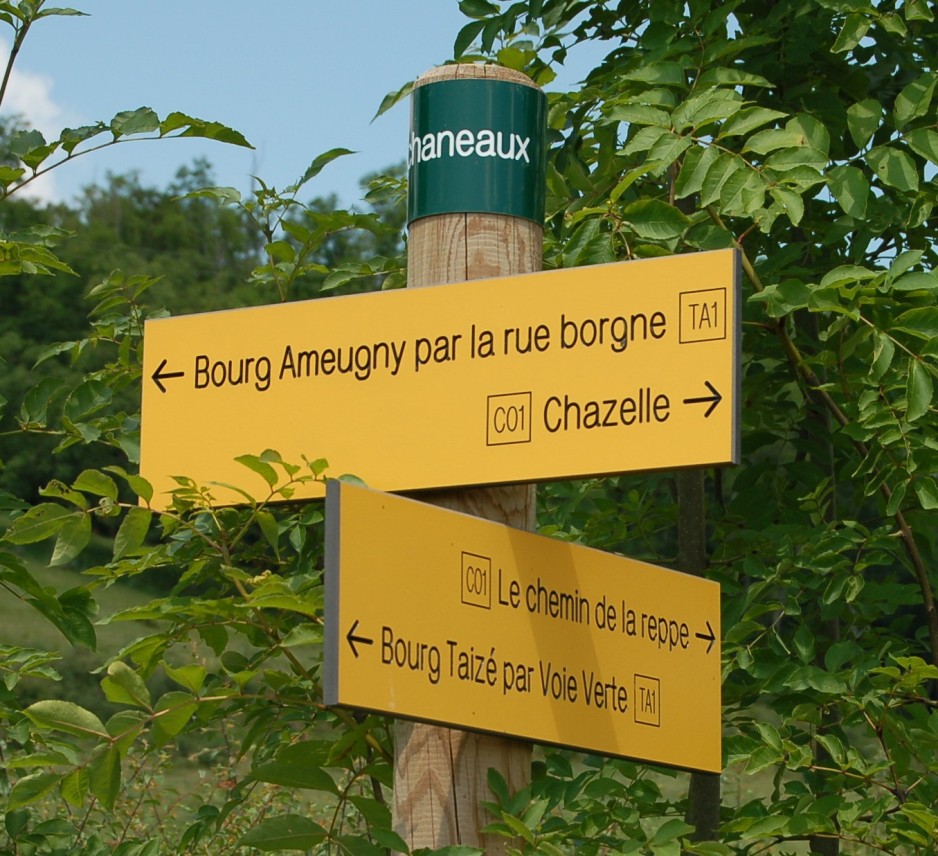
A large number of communes along the Voie Verte have a starting point for their walks. The routes to these starting points are clearly marked with large signposts “Randonnée - Balade Verte” on the main roads. By each start point there is a carpark and a map with an overview of the routes that start and finish at that point and the route reference number, for instance the routes from Cormatin are CO1 and CO2, from Taizé TA1 etc. Click here for an album with some more pictures of the Balades Vertes.

Taking a break along the Balades Vertes
For those who want to be a bit more adventurous and make their own way around here, there are very well detailed maps from IGN in their Série Bleue (1:25000) which you can use to find all the footpaths in the area. One of the Grande Randonnées passes close to Cormatin (GR76) and Cluny is one of the starting points for the road to Santiago de Compostella.

Over and above all this, from early in the spring until late in autumn, there are organised randonnées most weekends. The routes are marked by different coloured spray paint arrows on the road or wooden arrows on temporary posts and the walks usually range from 5 to 30 km. At strategic points on the way there are refreshment stalls where wine, water, French bread, cheese and sausage are distributed. The prices vary by distance and range from €3.00 to €10.00.

We get many questions about how to walk or cycle to Taizé from here, so we have made some maps of the various routes and posted them in a photo album. Click here for those routes.

Saturday, 9 May 2015

Closed for renovation

There have been quite e few changes in Cormatin , on the shopping front.

Aux Délices de Cormatin old style
A number of shops has changed hands, like the épicerie of Berger (now called Epis & Riz) but of which the range of goods is still the same. Apart from shops which have been mentioned earlier, such as the butcher La Renaissance and the bio market cum organic bakery cum exposition area for a local potters collective in the former Musée du Vélo/Poilu a number of shops have combined anticipating the more severe rules for wheelchair access with a renovation of the interior of the shop.

Aux Délices de Cormatin after renovation
One of the shops that recently has undergone a face lift is the bakery Aux Délices de Cormatin. The shop has been, as long as we remember, a typical village bakery where one could hardly move during peak hours. And peak hour it was, the whole day through. The baker, Laurent, does not only produce the best French breads in the area, but he is also an excellent pastrycook.

Aux Délices de Cormatin new style
And I can vouch for the fact that the renovation of the shop has not the slightest bit influenced the quality of his assortment!
Aux Délice de Cormatin is a shop where the guests of La Tuilerie de Chazelle regularly buy their bread and/or pastry.

Saturday, 30 August 2014

Climate change

When in 2006 we started a campsite in South-Burgundy, we did not exactly know what the ins and outs were of the terrain and of the local climate. And what sort of camping we wanted was also not entirely clear.

2008
Of course we had some idea: small scale, no electricity on the camp site itself, decent toilet facilities with a fridge and freezer for general use, and something we had encountered on one of our favourite campsites in the Netherlands (Camping Zegenoord): if possible no cars next to the tent. That sounded simpler than it was. Outside the camp site there was only limited space available. This idea was dropped almost as soon as it came up, also because we thought it quite handy to use the car as a mobile storage space next to the tent.
The first couple of years we had lovely, hot weather throughout the summer, and well into November. After that we occasionally had quite a wet spring, but when finally the summer holidays started the soil was often rock hard, making it very difficult to even drive a tent peg into the ground.

leaving one’s traces (August 2014)
However, this year, and also the year before that, the weather was considerably different from previous years. Not only did we have a wet and cold summer, but the amount of rain was far too high according to statistics ever since 2012(!), and it was also, to quote the weathermen on TV, during the summer far too cold for the time of year. And what we did during the previous summer, closing the camp site for vehicles during a short period, became a standard rule at the end of the season of 2014. Camping was no problem, nobody got wet feet, but, depending on the style of driving of the various campers we have been praying every so often that nobody was going to dig his wheels so far in that we needed a tractor to bail him or her out, simply by using the accelerator as if he was driving a formula 1 car. We had seen that once, and we hope to never witness that again.

This was not what we had in mind! (August 2014)
Hence we asked our campers, before they arrived, to park outside the gate, at an angle, and parallel to each other. At first that did not work out as we thought it would (see picture), but after a while people cracked the system. When everyone parks parallel it is possible to get 4 cars (with 5 as an absolute maximum) outside the gate. If one parks less carefully the number reduces to 2 à 3. But anyway, after giving instructions, and begging people to obey to the rules, we ended the last 2 weeks of the season of 2014 without cars on the campsite and with 4 cars outside.
Those cars however need to be of what we consider to be “normal” size. It further means that the maximum number of tents we can accommodate reduces from 6 to 5, a number with which we are not really unhappy. We seldom have had a full site with 6 tents. And there are a few more things one does realise than only after some more thought: we are not longer able to accommodate trailers. And how to transport the camping gear from the car to the tent space? That can be arranged with a wheel barrow, as we have found out, until we can come up with something better.

Ah, that way! (August 2014)
For cyclist nothing really changes; they can always take up a 5th or 6th space.
The last days we have been busy to measure the available space, to determine the maximum length of a car (approx. 4.25 m or 14 feet), to find the required width of a space (approx. 2.3 m or 7’6”) and to figure out how to mark the spaces on a piece of grass. All in all, it looks like we will have a car-free campsite next year. The main question remains of course how our campers will react to those changes. Turning up unexpectedly with a big Volvo Station Waggon is not longer an option. Booking in advance seems to be the only possibility to be assured of a space on the camp site …

The future? (August 2014)
More information (telling you how we managed the camp site up to now) can be found on the website of La Tuilerie de Chazelle.

Saturday, 3 August 2013

Q&A

Q
Why would one not, when addressing someone else orally or in writing, restrict oneself to the absolute minimum?
I would not go as far as speaking and writing in SMS (texting) format, but superfluous phrases like "Dear Sir", a rather tiring body of the message and closing off with unnecessary words like "Best regards" or trivial things like that, are totally unneccessary.
No, we have to go back to the essence of the language. Down with all polite phrases! What we need is something like a haiku, but without this rather boring restriction of the number of syllables!
Recently we received the following email:
"Hello,
Do you have any camp sites available August 8, 9, 10?
Thanks,
Nancy"
A
Most people would elaborate bit, giving at least a name and address, with how many people and tents they want to come, etc., but lo and behold, we are now living in the fast lane.
Some people pick up new tricks really easily. This is the avant-garde haiku Sue wrote as a reply:
"Hi
Full
Rgds
Sue"
Afterwards she only regreted using "Rgds"....

This proves by the way, that when you approach "La Tuilerie de Chazelle" you will receive an answer, no matter how concise!

Saturday, 21 January 2012

Des chiffres et des lettres

We are now finally part of the real world; we have an address and a house number. This must be a relief for the Dutch tourists who call us with the question whether there is no betterbetter address available than “La Tuilerie de Chazelle - Cormatin”, because not having a street name, let alone not hsving a house number is for a Dutchman more or less a blasphemy. So for those who cannot cope, as of yesterday we live at 10, Rue de Chazeux.
Irrespective of this Great Leap Forward, instigated by our Great Helmsman, we will stick to our “old” address. The reason is quite simple: most people in Chazelle and Cormatin know exactly where La Tuilerie is; whether they can imagine where 10, rue de Chazeux lies is questionable.
The rue de Chazeux starts at the D881, and runs through Chazelle until it ends on the boundary of Cormatin between the hamlets Chazelle and Chazeux, in the middle of a forest. The agricultural path we live on, well outside Chazelle has been designated as a cul de sac of rue de Chazeux by the officials involved in naming roads and giving numbers.
The distance between no. 8 and 10 is approx. 1 km (slightly over half a mile).
Had these officials taken their job a bit more seriously, and better, had they sought our valuable advise, we possibly would have ended up with a slightly more poetic or romantic road name.
We knew that street names were about to be dished out, hence we had given this matter some thought, as one does.
What about “Boulevard Noël Marembeaud”? That would have been a nice tribute to the man who started the tuilerie or tile factory here in the second half of the 19th century.
A French play on words always goes down quite well with the local warlords, hence the link between “Avenue des Champs Elysées” and “Avenue de chez Sue et Cées” would be quickly established.
The house number 10 has strong associations with Downing street, certainly when one thinks of the British owner and of the recent film “The Iron Lady”.
We would have been quite happy with something simple like “Les Tuileries” or even with “Rue de la Tuilerie”, but no, the authorities knew better...
To summarize this complaint: the mairie has chosen the line of least resistance, and again we are the victims of this lax attitude.
But of course this is not the end of this nasty affair: I have already send a letter in high dudgeon to the mairie, including the relevant photos. And knowing our mayor, this will no doubt be part of the agenda in the next council meeting!

For our own website click here.

Saturday, 6 August 2011

Saving Private Fifi

Often people staying in our gîtes or campers ask us what these two huge barrels are for, the ones that stand next to the staircase leading up to our front door. The answer is simple: these two containers catch the rain water running off two small canopies above them. The water is used to water the plants.
The next question is normally, what these two wooden concoctions are, which stand in the water and have a little platform protruding outside the wall of the barrels.
To explain the purpose of these “ladders”, we have to go back in time. One morning I went out onto the balcony in front of our front door, when I heard a big racket going on. The noise came from downstairs, and when I came down I saw what had happened. Our cat Fifi had climbed into the bin, and because it had a peculiar lid she could not get out. I liberated her straight away, and since then the lid is unopenable for cats because it is held closed by a heavy brick. But we certainly started to think then, what would happen if Fifi ever ended up in one of the barrels, which might be filled up to a quarter with water.
The most logical and simple solution would be to build a little ladder, starting at the bottom of the barrel, and ending in a little platform. If the cat ever ended up in the water, at least then she could climb out. Making the ladders was a piece of cake, testing them turned out to be a bit tricky.
The barrels were empty, the ladder was inserted, the cat was deposited at the bottom; all we had to do was wait. With one big leap she sat on the edge of the barrel, with a second she stood on all fours on the ground.
But the second test did the trick: Fifi got onto the ladder, slowly walked up, and parked herself in the sun on the little platform. Mission accomplished! At least now we can leave the house, with the barrels wide open, and we do not have to worry that we might find a drowned cat by the time we get home!

For our own website click here.

Saturday, 26 March 2011

Put on your green shoes

Wherever you drive round around here, you are bound to bump into signs towards parking areas, either for the Voie Verte, or for the Balades Vertes. The first ones are normally located at or nearby the road that runs parallel and next to the old railroad (e.g. the D981), the latter ones one also finds in villages a bit further away from the main road. The Balades Vertes form a network of walks, laid out in the countryside, and signposted with either small yellow signs or the standard (yellow) arrows and crosses the French walker’s association employs. There are books available with a description of all the walks of a certain area, but A4- descriptions of the single walks are also for sale, both at the local Tourist Offices. These walks are very attractive. Not only do they go through many picturesque villages, but most of them follow paths through woods and vineyards.
The winter time menus in the many restaurants around here often have game on it. It may be clear, that game is not only to be admired in restaurants; deer are not uncommon here, and wild boar is also roaming the forests. La Tuilerie is again located on several Balades Vertes. One of the two walks starting in Cormatin almost passes along our gate, and the second one goes through Chazelle.
As said earlier, the walks are marked, and each walk also has its own number. De walks that start in Cormatin are marked CO1 and CO2, those from Taizé TA1, TA2, etc. The project itself, and the maintenance of it, are partially paid from the revenues of the taxe de séjour, a tourist tax for each of our guests which we have to pay at the end of the season. Not only do our guests (indirectly) pay for the Ballades Vertes, they also profit from it directly!

This blog in 3 episodes is of course far from complete. For more information about this region I like to refer to the tourist page on our own website and to an extensive blog about tourism and activities around here.

Saturday, 19 March 2011

How green is my valley

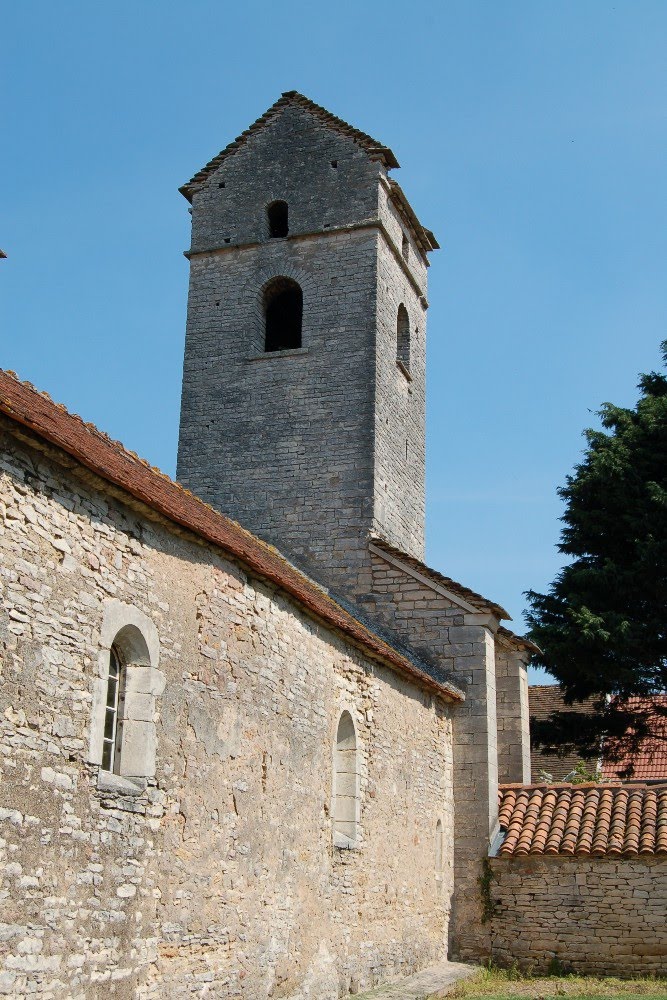
The first boucle I did was no. 10, with difficulty 1 (made for me!), distance 15 km and estimated time 1h30. The route comes almost past our house, and hence I joined the route at the end of our path. As the name of the boucle indicated, this circuit passes by some nice Romanesque churches, like the very small church of Lys (with remains of some medieval wall paintings), and the beautiful church of Chapaize. Lys also boasts an amazing amount of artisans, and Chapaize has facilities to sit on a terrace with a drink, or to stop for a meal. From Chapaize the road goes via Bissy-sous-Uxelles through Bessuge to Cormatin. And also Cormatin has ample opportunities to drink a cold glass of bear or enjoy a meal. Indeed, if you feast your eyes on the things you can see underway, you will be back at la Tuilerie roughly one and a half hour later.
Another plus point of these boucles is, that they are fairly well signposted, and that it is possible to link some boucles together to create a bigger circuit.
As boucle no. 10, some boucles are thematic. Boucle no. 11 for example takes you past a number of lavoirs or public washhouses. These are small open, covered structures, with a stone basin in the middle, where until the seventies the village women were doing their washing. The basin was provided with fresh streaming water by a nearby river or a brook. No. 11, difficulty 2, length 17 miles can be perfectly combined with e.g. no. 10. The route starts in La Tuilerie, and passes through Lys, Bissy-sous-Uxelles, Bessuge, and Cormatin. It continues via the Voie Verte to Savigny-sur-Grosne, carries on via Boucle 11 to Bonnay, Cortevaix, Flagy and Massilly where it joins the Voie Verte, which takes you underneath Taizé direction Cormatin until the road to Chazelle.
Other thematic boucles bring you past potters, through vineyards, etc. One of the frequently asked questions is whether it is safe to cycle along the roads. The answer is: yes. The boucles are generally following quiet roads and hardly “main” roads. Further, the French are sticking very well to their traffic rules. One of those rules is, that when overtaking an bicycle with a car, the driver has to leave a distance of 1 m (approx. 3’4”) in villages or 1.5 m (approx. 5’) outside villages between car and bicycle.
For more weathered cyclists there is also the possibility to test their stamina around here. Some of the boucles with difficulty 4 contain really vicious climbs; the real die-hards amongst our cycling guests have expressed their pleasant surprise about the possibilities to exercise their muscles.
In my next and last blog in this series I will elaborate a bit on the concept of the Balades Vertes.

This blog in 3 episodes is of course far from complete. For more information about this region I like to refer to the tourist page on our own website and to an extensive blog about tourism and activities around here.

Saturday, 12 March 2011

Green, green grass of home

Those familiar with this blog and this region should know by now that a cycling or walking holiday in Burgundy more has to offer then just wine and good food. For those not familiar with the area however, this blog might be an eye opener.
For years I have cycled day in day out the 10 miles between house and work and vice versa. After having moved, in September 2005, to France, this daily routine was one of the things I missed most. Of course, certainly in the beginning, we were too busy getting the gîtes and the campsite up and running, organising the enormous amount of stuff we had brought over, etc. to have much exercise. During that time I cycled regularly into Cormatin, to buy bread and a newspaper, but 2 x 2 miles a day is not the same as 2 x 10 miles. To make up for the difference I cycled the 8 miles up and down to Cluny as often as was needed to buy a book or something else which was not readily available in Cormatin. Only after the big renovation was over, time came to concentrate on finding out what would people attract to this part of the world for a holiday. One way of finding out was to get on my bicycle and cycle into Cluny, where the Tourist Office not only has an excellent staff, but also a good collection of brochures. And because I had cycled through Taizé and Massilly along the Voie Verte, it seemed logical to pick up some information about this cycle path.
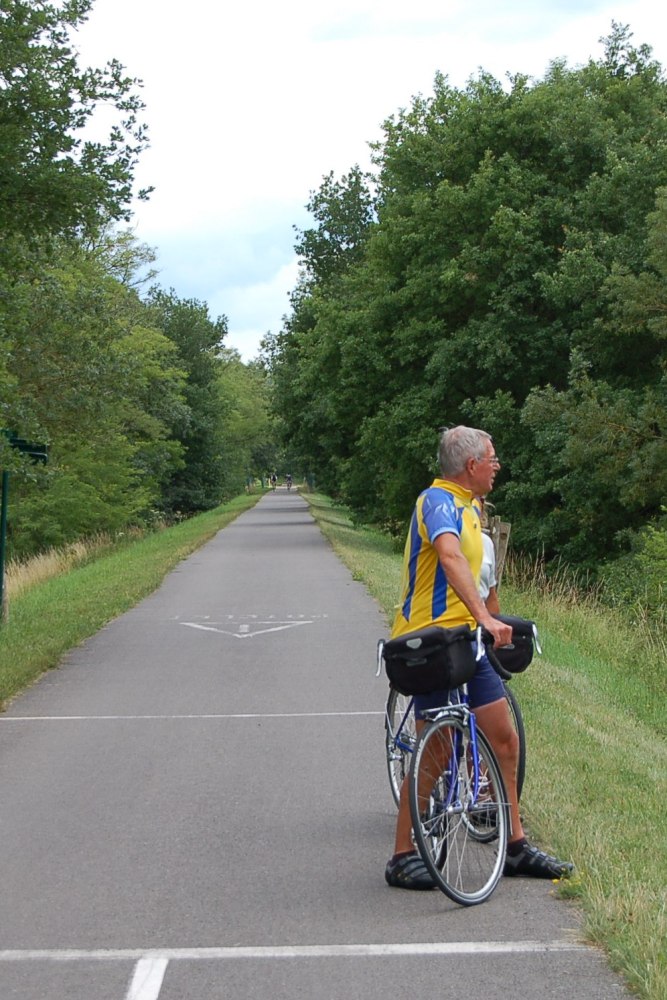
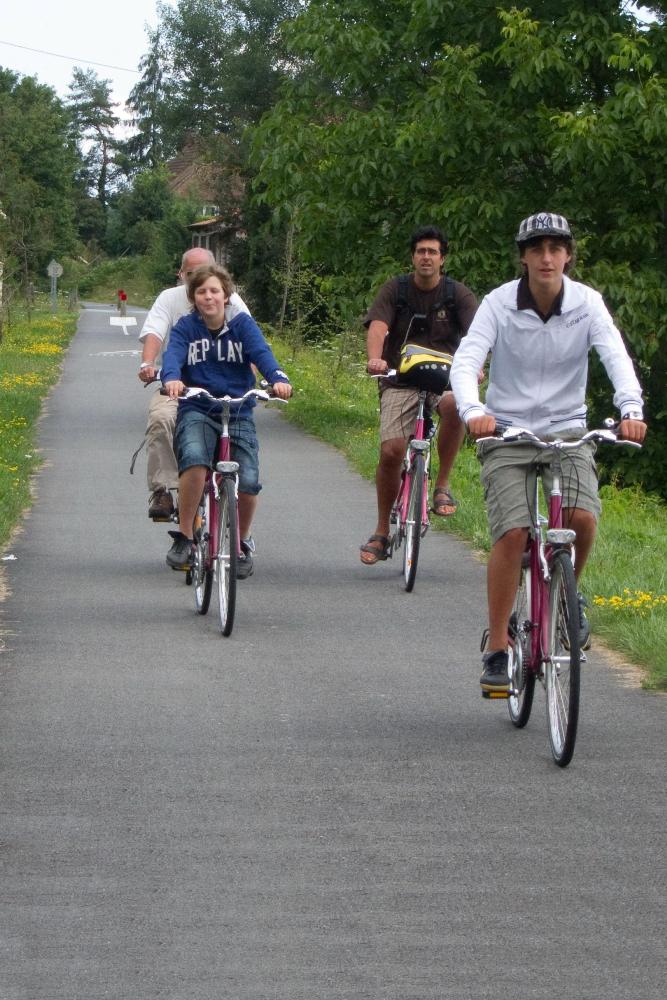
I found out very quickly, that the Voie Verte more had to offer but just cycling along an old flat piece of converted railway (approx. 44 miles) between Givry and Charnay-lès-Mâcon. The tourist offices around here have free maps of the Voie Verte available, where one can see which round trips (boucles) there can be made from various spots along the Voie Verte. All these circuits are signposted with little shields along the roadside.
Very soon I spotted near our house some of those signs. It appeared that the Romanesque (Norman) church route almost passed by La Tuilerie. All boucles start and end at the Voie Verte, normally by a parking area for those who want to leave their car somewhere and carry on by bicycle. Boucles 10 and 10bis start from the parking area at Cormatin-Bois Dernier, but of course one is free to start wherever one wants. All boucles have a degree of difficulty ranging from 1 (easy-peasy) to 4 (why on earth am I doing this???), a distance, an estimated time (sufficient time to visit the tourist attractions underway), and they all start where they end. About the various boucles I will write in my next blog.

This blog in 3 episodes is of course far from complete. For more information about this region I like to refer to the tourist page on our own website and to an extensive blog about tourism and activities around here.

Saturday, 12 February 2011

And the winner is.....

Yesterday it was finally the big day; we had to play loto or bingo for those living outside Cormatin who had bought a number of cards.
Around five in the afternoon the Salle Saint-Roch started to fill up with villagers who came to play bingo in loco parentis. Quite some cards had been sold, so every player was in charge of a generous amount of loto cards. We both played on 12 cards each; the cards had been distributed randomly, so in theory nobody was playing the cards he or she had sold. After half an hour the first prize (a flat screen TV) fell. The card had been sold by one of our council workers to his father in law. The game continued, and the next prize fell on a card that had been bought by someone from Cormatin. The card was checked by one of the officials, and yes, it contained all the correct numbers. The game was just about to continue, when somebody else rather sheepishly shouted “Bingo”. And this card turned out to be a winning card as well. When more then one card wins at the same time, each potential winner grabs a bingo ball from a bag; the highest number wins the prize, and the lowest number gets a consolation prize (often a small pot of paté from the supermarket). In this case the late comer had won. The winning card was confiscated by an official, and she looked in her paperwork which person had sold the card with no. 354 and to whom.
The poor woman than had to announce the name: after several tries she came out with the name of a certain Pocahontas from Luxemburg, who had bought the card through Sue Nixon. It quickly dawned on us that the winner was one of our last year’s campers, who follows this blog regularly. His Lithuanian surname starts wit P., and slightly resembles Pocahontas.... He contacted us immediately after he read my blog about the loto for the Amicale and forwarded money to buy some cards straight away. However, winner or not, I have to disappoint him a bit: he did not win the espresso machine which he wanted, but a brand new cordless hoover; no misunderstanding, this is NOT an old hoover whereby someone has cut off the cable!
The other members of our network who have bought cards will receive an email from us telling them that they did NOT win. But we are 100 % convinced that everybody has bought cards for the good cause, and the Amicale de Cormatin will certainly see to it that the money is put to good use!

For our own website click here.

Saturday, 1 January 2011

Should auld acquaintance be forgot

Burns’s words sprang to mind when I received a “Merry Christmas and Happy New Year” card via e-mail. The sender was a woman, who stayed on our campsite early July this year. Earlier that year Fifi had given birth to 4 kittens, was sterilised (a bit too late!) and had an accident with most likely a car on our track. Fortunately, the kittens were ready to go when the accident happened, so Fifi could rest in piece, as far as a young cat contained in a 1 x 1 m cage can rest in peace in order to recuperate. But until then we had kept the kittens in Fifi’s apartment, a cave under the staircase to our front door. The kittens were still sleeping most of the day, but when awake they caused total havoc in the apartment. Fortunately the weather was fine, we spent a lot of time sitting in the garden near the campsite, and to give them some freedom they could wonder around our table, drink and sleep at our feet. Some campers were very keen on stopping by our table, not necessarily for a chat with us, but to play with the kittens. Of course the situation became a bit more pressing when Fifi was no longer capable of feeding them. We had placed adverts at the local baker, newspaper saleswoman, butcher, etc., and verbally advertised the kittens to our campers.
However no one took the bait, until Ina L. popped in to pay for their stay with us. Casually she mentioned, that she did not mind to take “little light stripy” with her. With some regret we said goodbye to the little one, and soon after this first departure the other three were picked up by some people of the surrounding villages. So far our orphanage for cats; who the father had been we could only guess. Anyway, the Christmas card we received was not one with the obligatory Christmas tree on it, at least not in full glory. The card showed, sitting under the branch of a real Christmas tree, a cat strongly resembling our own Fifi. Being a habitual cataloguer, it took me only seconds to dig up a photograph of “little light stripy”, AKA “Dopey”, and nowadays roaming around a Frisian village under the name of “Sue”. Whether one should be happy and grateful to be immortalised by having a cat named after oneself, is debatable....

The website of La Tuilerie de Chazelle

Saturday, 18 December 2010

Steam

We (almost) live along the old local railway between Chalon-sur-Saône and Mâcon (nowadays a cycle and walking track, the Voie Verte). The heavy duty railroad between those two towns is still in use, and follows more or less the Saône. Further, luckily outside earshot, there is the TGV line between Le Creusot and Mâcon. Whenever one wants to hear the sound of trains, one has to travel. One of the tourist attraction around here is the Parc des Combes in Le Creusot. Le Creusot is a former industrial town, in its heyday heavily involved in coal and steel industries. The Parc is mainly aimed at children, but it also hosts steam events every so often. Besides it offers home to one of the fastest steam locomotives ever built, the 241P17 .
It is not only here where the locomotive was restored and is maintained; throughout the year Le Creusot is the starting point for trips, often made in double traction with the Mistral - the name of the 241P17, to places like Mulhouse, Aix-en-Provence, Lyon, Dijon or Marseille, using the SNCF network. The loc was designed by the French engineer André Chapelon, the inventor of the Compound loc. I quote a friend of mine, an expert on steam and trains: “Compound machines are machines with small high pressure and big low pressure cylinders. The steam expands in two steps from boiler pressure to atmospheric pressure. When starting up all steam goes full on the cylinders; once at speed the compound cylinders are utilised. The machines are not easy to handle, but the French were experts at it.”
One can see the Mistral regularly in the neighbourhood, because quite a number of the train’s trips are coming past or through Chalon, Chagny, Tournus and Mâcon. In Chalon, Tournus and Mâcon there is normally a long stop to enable the Anoraks to shoot their films, photos or sound bites. The picture with this Blog was taken while the train came towards a viaduct near Chagny with a speed of approx. 100 km/h. What is more thrilling than seeing this piece of technical ingenuity ploughing through the beautiful Burgundian landscape?

The website of La Tuilerie de Chazelle

Saturday, 25 September 2010

Camping Championship Results 2010

Our company statistic cum bookkeepster cum housewife cum cook has been cooking the books again. As she did last year, she made a stunningly sharp analysis of all those people who made our campsite a success.
And in stead of copying it in, I challenge all interested to click on this link.


For our own website click here.

Saturday, 17 July 2010

Say cheese, please

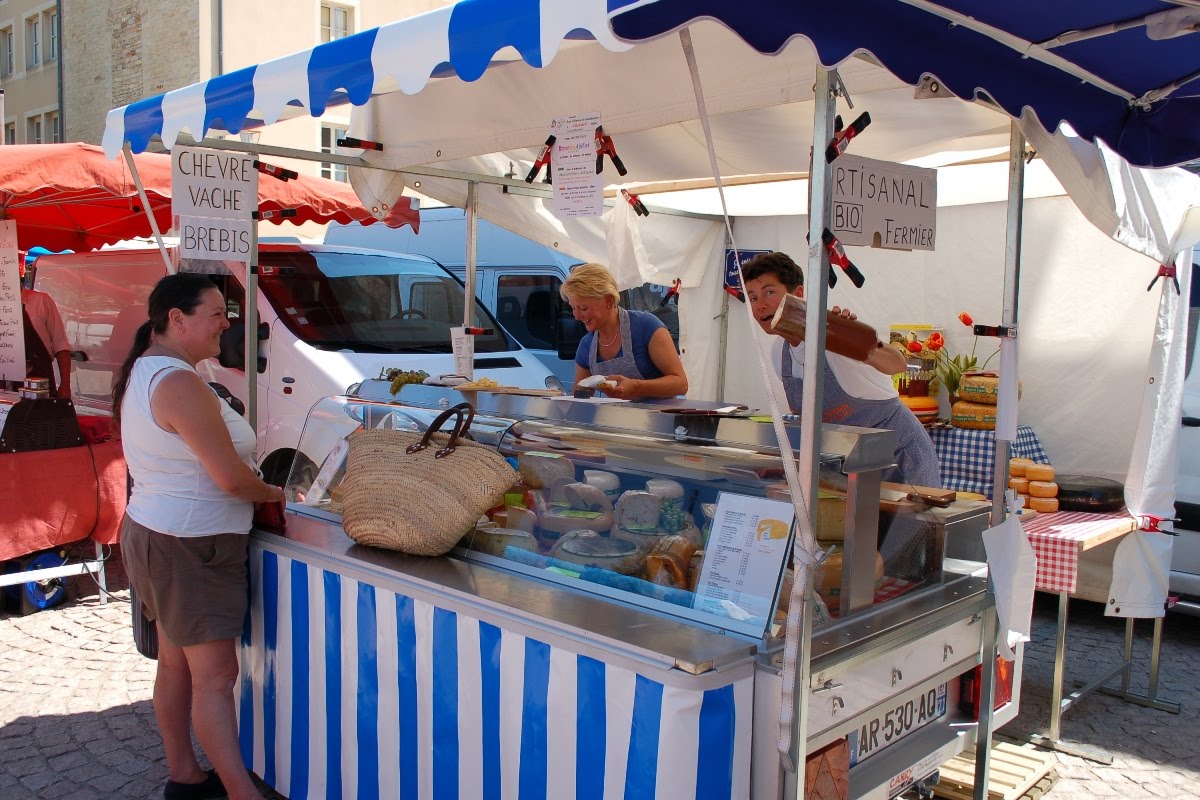
What could possibly be wrong with French cheese, to invoke me to write a Blog about Dutch cheese? There is certainly nothing wrong with French cheese, even better, I love it, but what they sell in the supermarkets as Dutch cheese here (Gouda, Edam, Leerdam) resembles putty, or at best plastic. Everybody has sometimes, all of a sudden, a craving for a good strong cheese, in case of the British a nice hard cheddar.
One day we were having lunch in Cluny, in our favourite hang-out, when the lady who ran the show came to us, told us about two Dutch women who had set up shop in Cluny’s Saturday market, and gave us a flyer.
The next Saturday, not 100 % convinced yet, we went looking for these two women. Opposite the ticket office for the abbey, on a little square, we found them.
Suus en Paula van der Linden are living in France for some time now, sell on various markets around here, sell cheese from their place as well, and from the look of it, they are doing quite well. Their cheeses are selling like hot buns, and even the Brits are impressed with the variety of cheeses they are selling. And the sell not only cow’s cheese, no, they also sell sheep’s and goat’s cheeses.
Not just to support Suus and Paula, but also to help our French, Dutch and Anglophone friends, we have picked up a handful of flyers from Suus and Paula, and we are distributing those among them. We have also put flyers in the information folders we use for the gîtes and the campsite. That this sort of publicity works, may be deduced from the piece of cheese we got off them the other day when we went to buy some cheese. And really, believe me or not, that is not why we are doing it!

For our own website click here.

Saturday, 12 June 2010

Repeated offenders

My better half has already published a Blog dedicated to guests who not only are regularly coming back to La Tuilerie, but who also (on a voluntary basis!) help out in making the vegetable plot ready for the summer and by splitting big logs which are to big to fit in the wood burner.
Fortunately they are not the only ones who seem to like it so much here. We have a number of guests, campers as well as gîte lodgers, whom we can welcome on a regular basis over a number of years. And what is better than discussing the state of affairs in Cormatin as well as in their home country over a nice glass of whine in a sunny patch in our garden?
People come here for a number of reasons. Part of our clientèle are very much attracted by the vicinity of Taizé, where they can follow the services whenever they wish, but where they are not submerged in the hubbub of 6000 youngsters; others come here with bicycles, skeelers or good walking shoes in order to do reconnaissance of the many possibilities the Voie Verte has to offer; some people come to indulge in the over abundance of romanesque (norman) architecture; and of course there are those who like to chill out for a week after having been in the rat race for a year.
Recently we had a couple here for the third year, who came here the first time after in depth investigations. Their son in law, an acquaintance of ours, popped in one day in 2008 on his way to a different holiday destination in the South of France, seemingly for a cup of coffee. however, he was told by his in laws to take pictures, inspect the place thoroughly and find an answer to the question of questions “Is everything clean there?”.
Obvioulsly his reconnaissance satisfied his in laws, because that same autumn Hermann and Carla became our guests. We got on very well, and when they left they booked straight away for 2009. That year they ordered a meal, a service we render, if convenient for both parties, on their arrival day. Our guests share our table, and we as well as they find it a pleasant way to getting to know each other a bit better. Sue always tries to come up with something local, and her boeuf Bourgignon can compete with the same dish pepared at La Terrasse in Cormatin (which we find the best within a radius of 50 miles). And although Hermann and Carla could not give us a definite date for 2010, it was quite obvious that they would come back again.
And lo and behold, by the end of 2009 they made another reservation for two weeks, under the “condition” that we would feed them again a boeuf Bourgignon. But that was not all. A couple of days before they arrived, another e-mail came in with the question whether we would appreciate it if Carla brought an Indonesian meal over for the second evening.
There are few things in this part of the world that I miss every so often, and one of them is a genuine Indonsian meal, in the Netherlands, and certainly around the Hague, readily available everywhere. So the second night the tables were turned, as a matter of speech, and we sat at their table and enjoyed a wonderful meal with nassi putih (white rice), sajur lodeh (vegetables in coconut milk), babi ketjap (pork in sweet soy sauce), rendang (spicy beef) and ajam semoor (well simmered chicken).
And that is, irrespective of the quality of French cooking, one of the few things I miss every so often; a simple, good Indonesian meal.

For our own website click here.

Saturday, 13 March 2010

Tour de France 2010

Cycle-racing in France is, like in Belgium and the Netherlands, a big thing. As soon as there is talk of a cycling event, no matter how big or small, they are omni-present; men, and sometimes women, dressed in brightly-coloured lycra, bent over their handle bars, whereby the first guy often shouts out loud and inarticulate words, or raise a hand or an arm to warn the crowd behind him for a pothole in the road, a walker, a parked car, or an aged person crossing the road.
And events there are plenty in France. In June, when the Tour de France fever hits France once again, many cyclists throughout the country start their own modest Tour de Village, Tour de Département, Tour de Région or even Tour d’Environnement. And each of these lycra-clad people has his own hero to project himself onto: Alberto Contador, Lance Armstrong, Jan Ullrich, Indurain, LeMond, or for the older ones Hinault, Mercx, Anquetil, Bahamontes...
Also Cormatin is not spared this ordeal. Last year, 2009, the Route de Saône-et-Loire (a race of four stages) passed through Cormatin. Hours before hand the roads were closed, in order to ensure free passage for the breakaway or for the peloton thus reducing the chance of nasty accidents. But this race is nothing compared to the real French classic, the Tour de France.
In 2006 the Tour did not (yet) pass through Cormatin, however the finish of the eighteenth stage was in Mâcon. Reason for some of our fanatic cycling fans to get on their bikes and cycle to Mâcon to experience the spectacle. They have been regular returnees to our campsite ever since! The next day the Tour continued starting in Le Creusot and finishing this time trial in Montceau-les-Mines. No doubt the cyclists were brought to Le Creusot by bus or train.
In 2007 the sixth stage (between Semur-en-Auxois and Bourg-en-Bresse, approx. 200 km) passed throug our village, Cormatin. From well before lunch until approx. 17h00 quite a number of roads were closed, amongst them the main road D981 from Cluny direction Givry vv., thus making space for the passing of the caravan followed by the cyclists. The circus certainly was in full swing; an endless row of hooting cars “decorated” with adverts, driving through the village at neck breaking speed, in the meantime throwing promotion material into the crowd; hundreds of spectators of whom several threw themselves almost in front of the cars in order to obtain that wonderful cardboard sunshade....
And then finally the climax, a coloured band travelling so fast that the faces of the racers were no more than a vague blur. That particular year we had quite a few campers on the site who had chosen to stay with us especially for this occasion. A couple of them were very keen to see an intermediate sprint at Brancion. Unfortunately they never made it, partially because of road closures and partially because they did not have a detailed enough map to avoid the main roads....
In 2010 anothe stage starts nearby Cormatin. The seventh stage starts on Saturday 10 July 2010 from Tournus (25 km) for a stage of 161 km to Station les Rousses. We are really curious which of our cycling die-hards will be staying with us again!

The website of La Tuilerie de Chazelle

Saturday, 17 October 2009

Pidgin German

Ever tried to translate some English prose into a language one hardly masters? Based on one’s education (in my case 1 year + 2 years German in various schools) and experience (none) this is not necessarily a doddle. When I was young, having a C or D for German was still seen as a belated act of resistance, hence why bother working hard to boost your knowledge of the German language?
Anyway, recently I wanted to post something in German on the Internet. A friend of mine, an ex-teacher (in German) agreed to take out the blatant errors, on the condition that this was going to be a one-off. This was my first encounter with German since the sixties. Was it sheer arrogance that made me revive the idea to have our website in English, Dutch, French and …. German?
I will not bore my readers with a detailed run down on my struggle with declinations, three genders, conjugations, four grammatical cases, uppercase for nouns, etc. What I would like to make clear is that some obsolete dictionaries and an ancient grammar book are not really sufficient for a smooth, quick and adequate translation, no matter how one simplifies the original text. Luckily there is a vast array of tools available on the Internet, and cross referencing with Wikipedia in Dutch, English, French and German, using Google to search for a word one assumes exists, and using the German Wiktionary helps tremendously. Still, it is a heavy task to produce something that does not automatically results in a declaration of war, as soon as a German reads the final product.
After three days of hard and concentrated work we now have a German website. Someone might actually remark that there are free translation programs available, such as Babelfish. To show the “quality” of those programs, I will translate the previous sentence from English to German and back to English again, using Babelfish.
1. Someone might actually remark that there are free translation programs available, such as Babelfish.
2. Jemand konnte, dass es die vorhandenen Programme der freien Übersetzung gibt, wie Babelfish wirklich erwähnen.
3. Someone could that there are the existing programs of the free translation, how Babelfish really mention.

Of course this a fictitious, and not completely fair test; however it certainly shows that free translators do not produce much more than pidgin German. I am convinced, that my translation is full of errors. However, read out aloud, with the right Prussian accent, it certainly sounds like German!
Mit freundlichen Grüßen, Käse aus Holland.

The website of La Tuilerie de Chazelle

Wednesday, 19 August 2009

Campsite contest

This is going to be one of my shortest Blogs. My learned assistant, Mrs. Nixon Phd etc. (Oxbridge) has done some statistics, and there is nothing I can add to this. For those who like to know:
Click here