Showing posts with label Tourism in Burgundy; Bourgogne. Show all posts

Saturday, 4 August 2018

Picnics

La Boulaye
The summer is an ideal time for tourist outings, and how can one better break a long ride in order to stop somewhere for a picnic. We often do that, just the two of us, but we do it also when we have family or friends over. The day starts with a fixed ritual: the car is loaded with camping tables and chairs, e tablecloth, sometimes a picnic blanket, the cool box is filled with drinks, sandwich fillings and salads, and then we are on the move to our first stop. However, stopping at the baker for a fresh baguette is also a must.

Perrecy-les-Forges
Throughout the years we have built up a nice collection of picnic spots. When we travel direction La Boulaye to visit the Temple of 1000 Buddhas, we often eat in the shadow of the church of Perrecy-les-Forges, which on its own is certainly also worth a visit.
On our way to the Brionnais for the cattle market in St-Christophe or for some beautiful Romanesque churches we often stop at the Butte de Suin or by the war memorial in Beauberry. Both locations are high up and offer beautiful views.

Suin
However, we are also quite happy to skip our favourites and trade them in for a spot along a canal, by a lake or a river, or somewhere in the middle of the vineyards. They may not offer wide views, but one can enjoy peace and quiet there.
Besides, the word "Picnic" has an added value as well: when my better half is not so keen to visit another church again, the "P"-word makes her eyes light up, and it certainly softens the blow of visiting churches.

Ladoix-Serrigny

Saturday, 17 March 2018

The community of Taizé

The bells of Taizé
I am woken up every morning by the bells of Taizé, the single bell for the monks rings out at 07.45 for about 5 minutes, calling the monks to their morning prayer then the bells start in earnest at 08.15 and ring until 08.30, letting all the pilgrims at Taizé know that the service is about to start. When the bells stop I know I really must get up. The bells ring from 12.15 to 12.30, so I know lunch should be on the table and if dinner is not ready when the evening bells go at 20.15, I know I am very late. And that was what Taizé was to me when I arrived here in 2005.

After Easter in 2006 we went to Taizé to have a look around and we were amazed at the number of young people milling around. We didn’t go to a service as that seemed inappropriate, with all these kids around it seemed like a young person’s thing. I wanted to go to a service, but I didn’t know how it worked, so I didn’t dare go alone. In July some campers (Ans and Simon) arrived, she had been to Taizé for the first time that spring and wanted to camp nearby to take in a few services and tempt her husband to go too. He however wasn’t interested and she didn’t dare go alone. At last my chance to go to a service, so on a Friday evening Ans and I went up the hill to Taizé.

A service in Taizé (Photo © Arnd Waidelich)
The services are made up of singing and silence. The songs are mesmerising. With pilgrims from all over the world the songs need to be simple to enable everyone to sing. There are a mixture of languages, Latin, German and some sort of Slavonic language are the most popular with French, English and Spanish there too. Each song has two lines and these are sung over and over again. The songs are a mixture of four voices, rounds and solo singing with the congregation singing the chorus. It is not to everyone’s taste, but I absolutely love them. In every service there is silence, five minutes of it. Five minutes is a very long time and it is quite amazing that a church full of people can be so quiet for so long. The singing continues after the monks have left and on a Friday and Saturday night this can go on into the early hours of the morning I have been told.


Pottery made by the brothers
The peace that pervades in a service is tangible and I can quite understand why some people come back year after year, just to regain that and to take a little bit of serenity back home with them. It is definitely not just a young person’s thing at all. Everyone is welcome to the services. Many, many of the visitors in our gîtes or on the campsite come for Taizé, to take part in a couple of services while being on holiday and enjoying other things that this area has to offer. Something not to be missed is a look at the stunning pottery the monks make to pay for their upkeep.

Special service - 5 years ago: Frère Roger killed; 70 years ago: he arrived in Taizé (2010)


We get many questions about how to walk or cycle to Taizé from here, so we have made some maps of the various routes and posted them in a photo album. Click here for those routes.

Text Sue Nixon

For our own website click here.

Saturday, 10 March 2018

Walking along the Balades Vertes

Quite recently Saône-et-Loire, South Burgundy has completed the Balades Vertes which are a large number of signposted walking routes throughout the whole of the département (71). Together with the Voie Verte (check out the article) these routes make this area a Mecca for walkers.

In the capital of our canton, St Gengoux le National, the tourist information office has a little book with details of the walks that are in the area between the rivers Grosne and Guye, rather unsurprising called "Guide les Balades Vertes entre Grosne et Guye". The book contains 26 signposted walks and costs €8.00, a little map and description of each walk can be bought separately and they cost € 2.00 each. All the signposts or markings on trees and fence posts are in yellow and are very clear.

A large number of communes along the Voie Verte have a starting point for their walks. The routes to these starting points are clearly marked with large signposts “Randonnée - Balade Verte” on the main roads. By each start point there is a carpark and a map with an overview of the routes that start and finish at that point and the route reference number, for instance the routes from Cormatin are CO1 and CO2, from Taizé TA1 etc. Click here for an album with some more pictures of the Balades Vertes.

Taking a break along the Balades Vertes
For those who want to be a bit more adventurous and make their own way around here, there are very well detailed maps from IGN in their Série Bleue (1:25000) which you can use to find all the footpaths in the area. One of the Grande Randonnées passes close to Cormatin (GR76) and Cluny is one of the starting points for the road to Santiago de Compostella.

Over and above all this, from early in the spring until late in autumn, there are organised randonnées most weekends. The routes are marked by different coloured spray paint arrows on the road or wooden arrows on temporary posts and the walks usually range from 5 to 30 km. At strategic points on the way there are refreshment stalls where wine, water, French bread, cheese and sausage are distributed. The prices vary by distance and range from €3.00 to €10.00.

We get many questions about how to walk or cycle to Taizé from here, so we have made some maps of the various routes and posted them in a photo album. Click here for those routes.

Saturday, 24 February 2018

Cycling down the Voie Verte

The Voie Verte (the Green Pathway) is a walking/cycle path that runs from north to south through Saône-et-Loire (71), South Burgundy. In the nineties, the local governing bodies decided to tarmac the old railway track from Chalon-sur-Saône to Mâcon as a leisure facility. Many of the old stations have been turned into “service stations”. This concept was so successful that the original 80km of cycle path has been extended to cover 320 km and extra circuits (boucles) that go off into the surrounding countryside have been created, giving in total approximately 730 km of marked out cycle routes. La Voie Verte runs not only over the old railway tracks, it now runs over canal tow paths and also specially created cycle paths have been built to link the various sections of Voie Verte together.

A special map on the subject shows the complete Voie Verte Saône-et-Loire (71) and its boucles. The boucles all begin and end on the Voie Verte and are signposted. Each boucle is graded for difficulty from 1 being easy up to 4 which is very hard work.

At some places near Cormatin and at the campsite in Cormatin, you can rent bicycles, by the hour, day or week. Prices in Cormatin are approximately €20 per day or approximately €65 per week. Click here for an album with a few more pictures of the Voie Verte.

The Voie Verte near Chazelle

The whole Voie Verte concept has extended beyond Saône-et-Loire and there are now plans to link all the paths in Burgundy (approximately 600km) and extend them by a further 200km by linking them into the paths in Rhône giving a total of about 800km of cycle paths near here.

La Voie Verte is about 2km from La Tuilerie and boucles 10 and 10bis (the Romanesque church route) almost pass the door (200m).

The Voie Verte between Cormatin and Cluny
You don’t have to just stick to the cycle paths for safe cycling. The secondary roads around here are very quiet and the French really stick to the rules when it comes to giving cyclists plenty of room, they overtake at a safe distance of about 1.5m. When Cees cycles into Cormatin to get the bread and newspaper on the main road, no one will overtake if he cannot be given enough room. It won’t be the first time that he has entered town with a long queue of cars behind him.

At weekends there are regular “randonnées” for VTTs (mountain bikes) where routes are laid out for you to follow. They tend to be from 30 to 50km and cost between €5.00 and €10.00. For that you get regular pit-stops where water, wine, French bread and sausage amongst other goodies are available to fortify you for the rest of the journey.

For those “passive” cyclists, the Tour de France comes to a town near here almost every year. In 2007 it came to Cormatin itself, in 2006 Mâcon saw the finish of an étape, in 2010 Tournus saw the start of an étape as did Mâcon in 2012.


We get many questions about how to walk or cycle to Taizé from here, so we have made some maps of the various routes and posted them in a photo album. Click here for those routes.

Whilst this item is about cycling, we do get asked from time to time if it possible to go horseriding near here. So just because I can't think of a better place to put the information here it is! In Saint-Martin-du-Tartre, at “Le Ranch des Jacinthes” horses can be rented for trekking in the hills.

Saturday, 18 November 2017

A hill with a view

Panorama - Brancion
Even though our department Saône-et-Loire is not really famous for its viewing points, when one is traveling through the vineyards or along castles, churches etc. there certainly are some places in the vicinity offering stunning views of the surrounding landscape.
To start near home: Brancion is built on a hill which, when the Tour de France visits the area, is part of the Mountains Classification.

Roche de Vergisson (left) and Solutré (right)
The village has been totally restored recently, the medieval castle ruins can be visited and the Romanesque church also merits a visit. The open area in front of the church offers stunning views of the Grosne Valley.
At the other side of the valley one finds Mont-Saint-Vincent, one of the highest point in the department. It also boasts an interesting Romanesque church, a small museum housing a Merovingian sarcophagus and lovely views over the surrounding landscape.

Roche de Solutré
The Roche de Solutré is a well-known place in the Mâconnais (bordering the Beaujolais area). The rocks towers high above its surroundings, and hosted, when he was still alive, the yearly pilgrimage of François Mitterand and his family. The rock is easy to negotiate via a path to the top, has an archaeological museum and lovely views of the Roche de Vergisson (another plateau in the vicinity) and of the vineyards of the Mâconnais.

Panorama with "Le guetteur" (left) - Suin
The Butte de Suin is located not far from Cluny. The hill has a Madonna towering over the surroundings, the plateau offers ample space for picnics, and the Romanesque church on the plateau is certainly worth a visit. The picnic area is guarded by a metal sculpture, "Le guetteur" (the sentry) van Laure Frankinet, keeping guard over the Butte.

Towards twilight - Beaubery
And finally, direction Brionnais, one can visit Beaubery, where a hill houses a monument for the resistance fighters from the surrounding villages who gave their life fighting the Germans. The monument itself consists of a Cross of Lorraine (a symbol adopted by General de Gaulle) flanked by two cannons. This hill also offers stunning views of its surroundings.

For our own website click here.

Saturday, 20 May 2017

The Bresse savoyarde

The Bresse is an area which traditionally has been split up per region in three different parts; The Bresse bourgignonne (Bourgogne), the Bresse jurassienne (Jura) and the Bresse savoyarde (Ain, which historically was part of Savoy). The flat countryside as well as the typical Bressane architecture characterize the Bresse bourgignonne the Bresse savoyarde.

Typical Bressane farm house with chimney (Courtes)
The Bresse savoyarde, just across the Saône east of Mâcon is well known for its cheminées sarrasines. These are oddly shaped chimneys, adorning the typical old fashioned Bressane farmhouses. Often these chimneys carry a cross on top, sometimes the shape resembles a bell tower, minaret or mausoleum.

Typical Bressane farm house with chimney (St-Cyr-sur-Menthon)
The name however has got nothing to do with the Saracens (an Arab people; the word is often used to describe the Turkish invaders); sarrasin was used in French to indicate something strange or weird. The Bresse houses some open-air museums, like the ones in Courtes and Saint-Cyr-sur-Menthon, where a brochure is available containing a map showing where these chimneys can be found.

The cattle market in St-Denis-lès-Bourg (Sue Nixon)
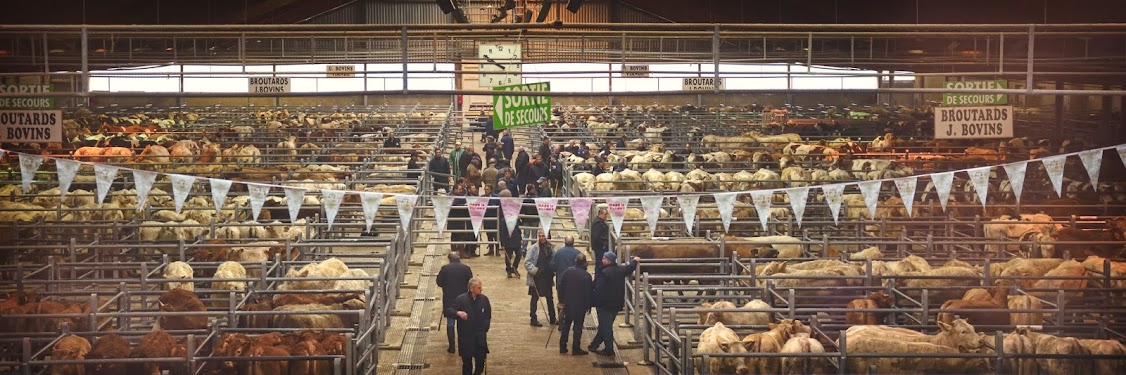
Bourg-en-Bresse (an hour's drive from here), the capital of the department Ain (01) and the centre of the Bresse boasts the biggest cattle market in France. Because as a child I really liked to roam around the cattle market in my home town I decided for old time's sake to have a go at this (morning) market. The market is located in the outskirts of Bourg, in Saint-Denis-lès-Bourg, and it really lives up to its reputation. The cows, calves and bulls are neatly organized within pens for each sort (hefters, milk cows, cows and bulls for reproduction, etc.).

Monastère Royal de Brou - Bourg-en-Bresse
The sales are bargained upon and settled by handshake between the farmers. The smell, the mooing, the noise of the farmers, it all brought back sweet memories of the weekly cattle market in Delft (the Netherlands). And, strangely enough, the aisles between pens may not have been spotless, they were certainly clean, something I would not expect on a cattle market.
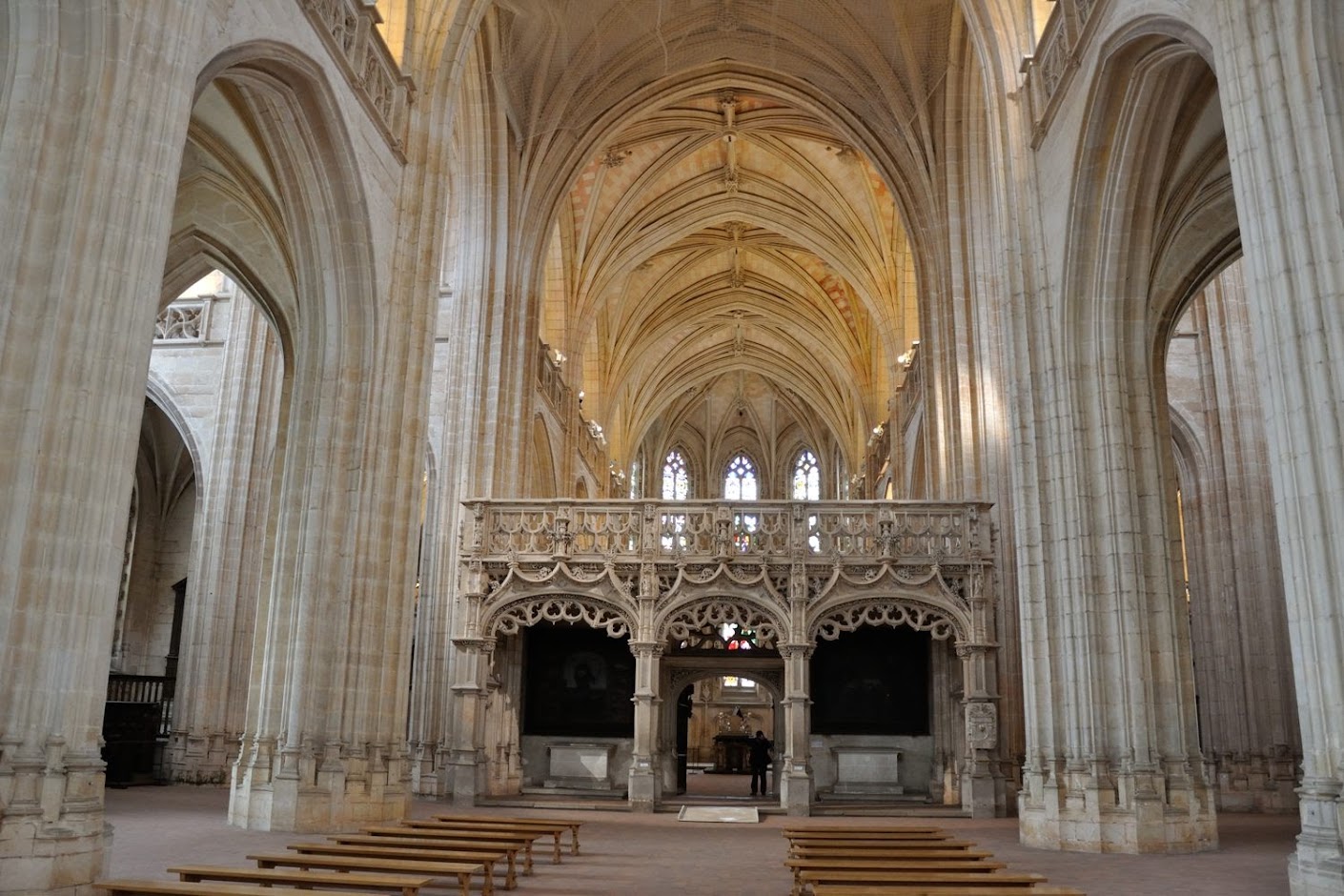
However, one should not leave Bourg without having paid a visit to the Royal Monastery of Brou. The early 16th century monastery was built by Margaret of Austria, in those days governess of the Spanish Netherlands.

Monastère Royal de Brou - Bourg-en-Bresse
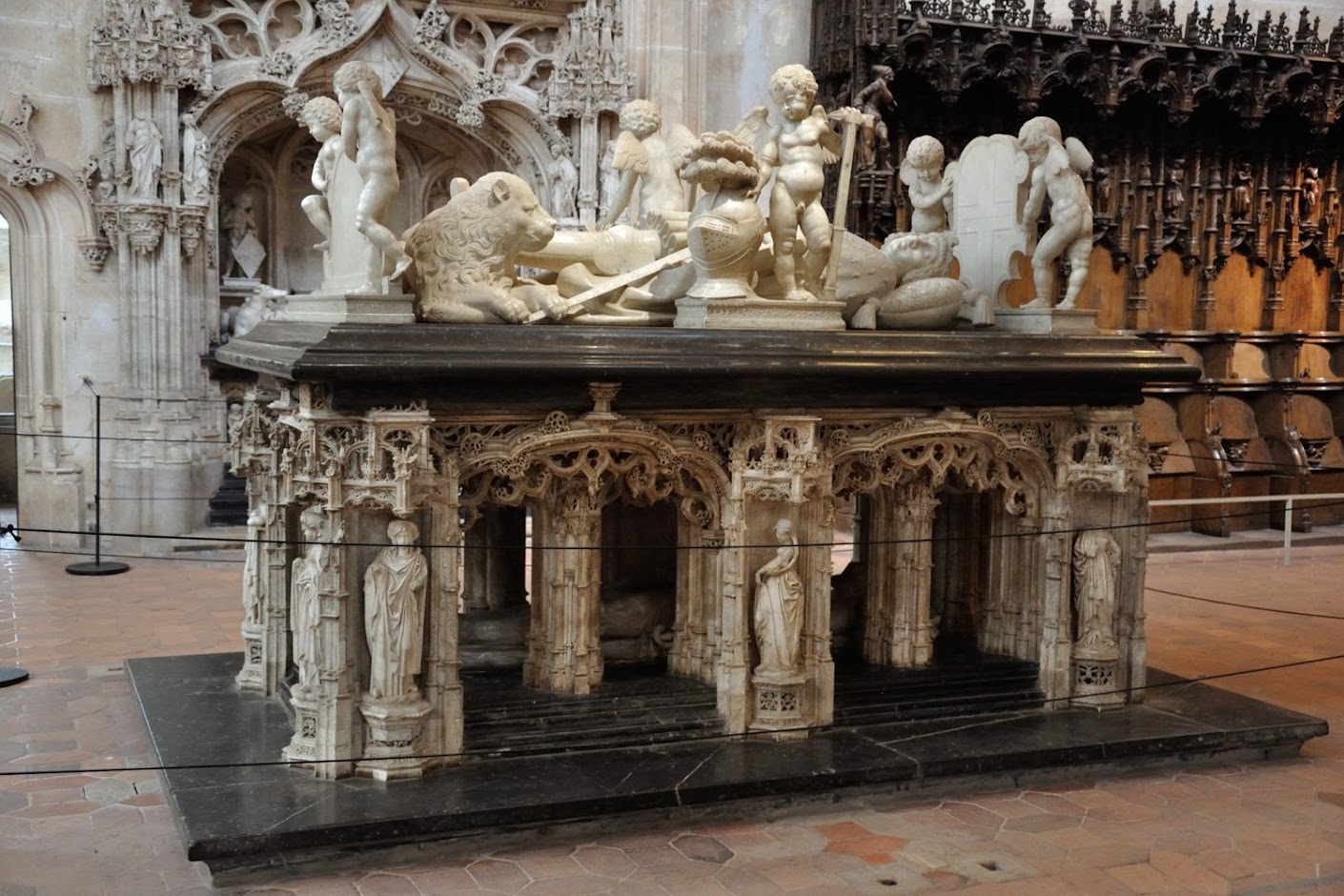
The church is a jewel of flamboyant gothic architecture from the hand of the Flemish master builder Loys van Boghem, whilst the mausoleums of Margaret of Bourbon, Margaret of Austria en Philibert II the Handsome of Savoy were designed by another Fleming Jean van Roome. The monastery boasts, apart from the stunning architecture and sculptures, a museum, and has 3 cloisters, which come across as a bit boring compared to the church.

Monastère Royal de Brou - Bourg-en-Bresse
For our own website click here.

Saturday, 8 April 2017

The community of Taizé

The bells of Taizé
I am woken up every morning by the bells of Taizé, the single bell for the monks rings out at 07.45 for about 5 minutes, calling the monks to their morning prayer then the bells start in earnest at 08.15 and ring until 08.30, letting all the pilgrims at Taizé know that the service is about to start. When the bells stop I know I really must get up. The bells ring from 12.15 to 12.30, so I know lunch should be on the table and if dinner is not ready when the evening bells go at 20.15, I know I am very late. And that was what Taizé was to me when I arrived here in 2005.

After Easter in 2006 we went to Taizé to have a look around and we were amazed at the number of young people milling around. We didn’t go to a service as that seemed inappropriate, with all these kids around it seemed like a young person’s thing. I wanted to go to a service, but I didn’t know how it worked, so I didn’t dare go alone. In July some campers (Ans and Simon) arrived, she had been to Taizé for the first time that spring and wanted to camp nearby to take in a few services and tempt her husband to go too. He however wasn’t interested and she didn’t dare go alone. At last my chance to go to a service, so on a Friday evening Ans and I went up the hill to Taizé.

A service in Taizé (Photo © Arnd Waidelich)
The services are made up of singing and silence. The songs are mesmerising. With pilgrims from all over the world the songs need to be simple to enable everyone to sing. There are a mixture of languages, Latin, German and some sort of Slavonic language are the most popular with French, English and Spanish there too. Each song has two lines and these are sung over and over again. The songs are a mixture of four voices, rounds and solo singing with the congregation singing the chorus. It is not to everyone’s taste, but I absolutely love them. In every service there is silence, five minutes of it. Five minutes is a very long time and it is quite amazing that a church full of people can be so quiet for so long. The singing continues after the monks have left and on a Friday and Saturday night this can go on into the early hours of the morning I have been told.


Pottery made by the brothers
The peace that pervades in a service is tangible and I can quite understand why some people come back year after year, just to regain that and to take a little bit of serenity back home with them. It is definitely not just a young person’s thing at all. Everyone is welcome to the services. Many, many of the visitors in our gîtes or on the campsite come for Taizé, to take part in a couple of services while being on holiday and enjoying other things that this area has to offer. Something not to be missed is a look at the stunning pottery the monks make to pay for their upkeep.

Special service - 5 years ago: Frère Roger killed; 70 years ago: he arrived in Taizé (2010)


We get many questions about how to walk or cycle to Taizé from here, so we have made some maps of the various routes and posted them in a photo album. Click here for those routes.

Text Sue Nixon

For our own website click here.

Saturday, 25 March 2017

Walking along the Balades Vertes

Quite recently Saône-et-Loire, South Burgundy has completed the Balades Vertes which are a large number of signposted walking routes throughout the whole of the département (71). Together with the Voie Verte (check out the article) these routes make this area a Mecca for walkers.

In the capital of our canton, St Gengoux le National, the tourist information office has a little book with details of the walks that are in the area between the rivers Grosne and Guye, rather unsurprising called "Guide les Balades Vertes entre Grosne et Guye". The book contains 26 signposted walks and costs €8.00, a little map and description of each walk can be bought separately and they cost € 2.00 each. All the signposts or markings on trees and fence posts are in yellow and are very clear.

A large number of communes along the Voie Verte have a starting point for their walks. The routes to these starting points are clearly marked with large signposts “Randonnée - Balade Verte” on the main roads. By each start point there is a carpark and a map with an overview of the routes that start and finish at that point and the route reference number, for instance the routes from Cormatin are CO1 and CO2, from Taizé TA1 etc. Click here for an album with some more pictures of the Balades Vertes.

Taking a break along the Balades Vertes
For those who want to be a bit more adventurous and make their own way around here, there are very well detailed maps from IGN in their Série Bleue (1:25000) which you can use to find all the footpaths in the area. One of the Grande Randonnées passes close to Cormatin (GR76) and Cluny is one of the starting points for the road to Santiago de Compostella.

Over and above all this, from early in the spring until late in autumn, there are organised randonnées most weekends. The routes are marked by different coloured spray paint arrows on the road or wooden arrows on temporary posts and the walks usually range from 5 to 30 km. At strategic points on the way there are refreshment stalls where wine, water, French bread, cheese and sausage are distributed. The prices vary by distance and range from €3.00 to €10.00.

We get many questions about how to walk or cycle to Taizé from here, so we have made some maps of the various routes and posted them in a photo album. Click here for those routes.

Saturday, 11 March 2017

Cycling down the Voie Verte

The Voie Verte (the Green Pathway) is a walking/cycle path that runs from north to south through Saône-et-Loire (71), South Burgundy. In the nineties, the local governing bodies decided to tarmac the old railway track from Chalon-sur-Saône to Mâcon as a leisure facility. Many of the old stations have been turned into “service stations”. This concept was so successful that the original 80km of cycle path has been extended to cover 320 km and extra circuits (boucles) that go off into the surrounding countryside have been created, giving in total approximately 730 km of marked out cycle routes. La Voie Verte runs not only over the old railway tracks, it now runs over canal tow paths and also specially created cycle paths have been built to link the various sections of Voie Verte together.

A special map on the subject shows the complete Voie Verte Saône-et-Loire (71) and its boucles. The boucles all begin and end on the Voie Verte and are signposted. Each boucle is graded for difficulty from 1 being easy up to 4 which is very hard work.

At some places near Cormatin and at the campsite in Cormatin, you can rent bicycles, by the hour, day or week. Prices in Cormatin are approximately €20 per day or approximately €65 per week. Click here for an album with a few more pictures of the Voie Verte.

The Voie Verte near Chazelle

The whole Voie Verte concept has extended beyond Saône-et-Loire and there are now plans to link all the paths in Burgundy (approximately 600km) and extend them by a further 200km by linking them into the paths in Rhône giving a total of about 800km of cycle paths near here.

La Voie Verte is about 2km from La Tuilerie and boucles 10 and 10bis (the Romanesque church route) almost pass the door (200m).

The Voie Verte between Cormatin and Cluny
You don’t have to just stick to the cycle paths for safe cycling. The secondary roads around here are very quiet and the French really stick to the rules when it comes to giving cyclists plenty of room, they overtake at a safe distance of about 1.5m. When Cees cycles into Cormatin to get the bread and newspaper on the main road, no one will overtake if he cannot be given enough room. It won’t be the first time that he has entered town with a long queue of cars behind him.

At weekends there are regular “randonnées” for VTTs (mountain bikes) where routes are laid out for you to follow. They tend to be from 30 to 50km and cost between €5.00 and €10.00. For that you get regular pit-stops where water, wine, French bread and sausage amongst other goodies are available to fortify you for the rest of the journey.

For those “passive” cyclists, the Tour de France comes to a town near here almost every year. In 2007 it came to Cormatin itself, in 2006 Mâcon saw the finish of an étape, in 2010 Tournus saw the start of an étape as did Mâcon in 2012.


We get many questions about how to walk or cycle to Taizé from here, so we have made some maps of the various routes and posted them in a photo album. Click here for those routes.

Whilst this item is about cycling, we do get asked from time to time if it possible to go horseriding near here. So just because I can't think of a better place to put the information here it is! In Saint-Martin-du-Tartre, at “Le Ranch des Jacinthes” horses can be rented for trekking in the hills.

For our own website click here.

Saturday, 25 February 2017

A day out in the Brionnais

Brionnais

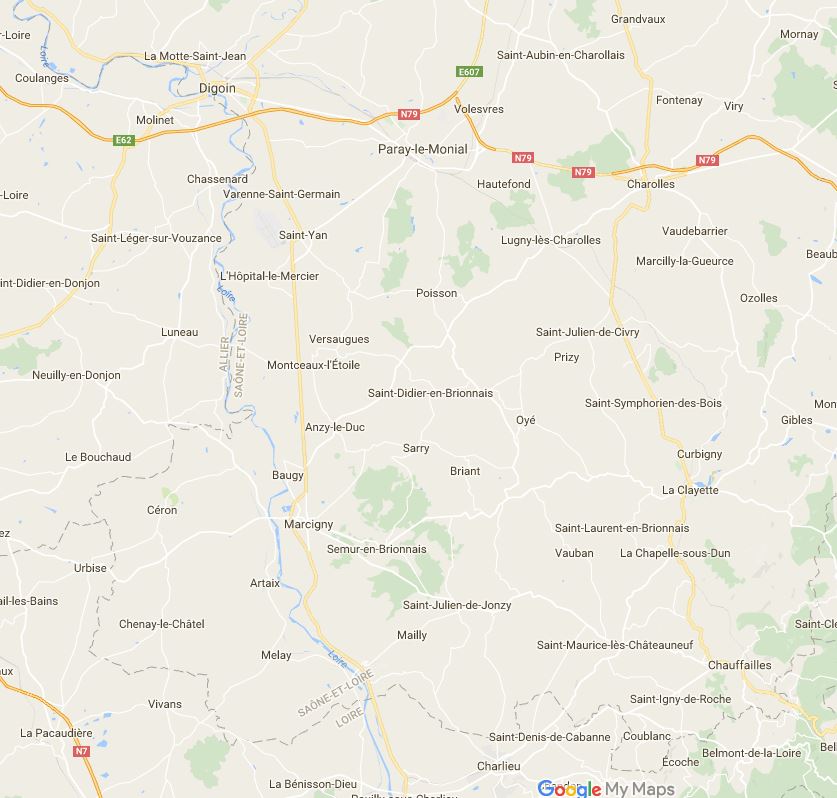
The Brionnais is an area in the southwestern corner of Burgundy, more or less enclosed by Charolles and Digoin in the north and Chauffailles and Iguerande in the south. It is an area with rolling hills, forests and meadows with only on the western side the flat plane of the river Loire. We visit the Brionnais regularly, for various reasons.

Saint-Christophe-en-Brionnais - Market
One of our main reasons to organise a day out to the Brionnais is the weekly cattle market (Wednesday all day) in Saint-Christophe-en-Brionnais. Although the old fashioned market, where the farmers trade with each other on a one to one basis, is getting smaller each time we get there, it is still a very lively, very busy market. The amount of cattle that is traded under canopies diminishes in favour of selling in the auction ring, where the cows are entered, their weight and particulars are displayed on a big screen, and where the farmers can bid electronically.

Saint-Christophe-en-Brionnais - Auction
The whole auction strongly resembles a Dutch vegetable or flower auction. On market day all restaurants in the village offer a menu du marché, which consists of a main dish, a cheese platter and a desert at a very reasonable price (approx. € 15 pp). One of the charms is also that one usually is seated at the same table as the farmers, whom for obvious reasons get priority over tourists when food is to be ordered. Even though by now we know the market inside out, we still happily visit the Brionnais on a Wednesday, if only to enjoy a first class steak frites in Saint-Christophe.

Saint-Christophe-en-Brionnais - Lunch
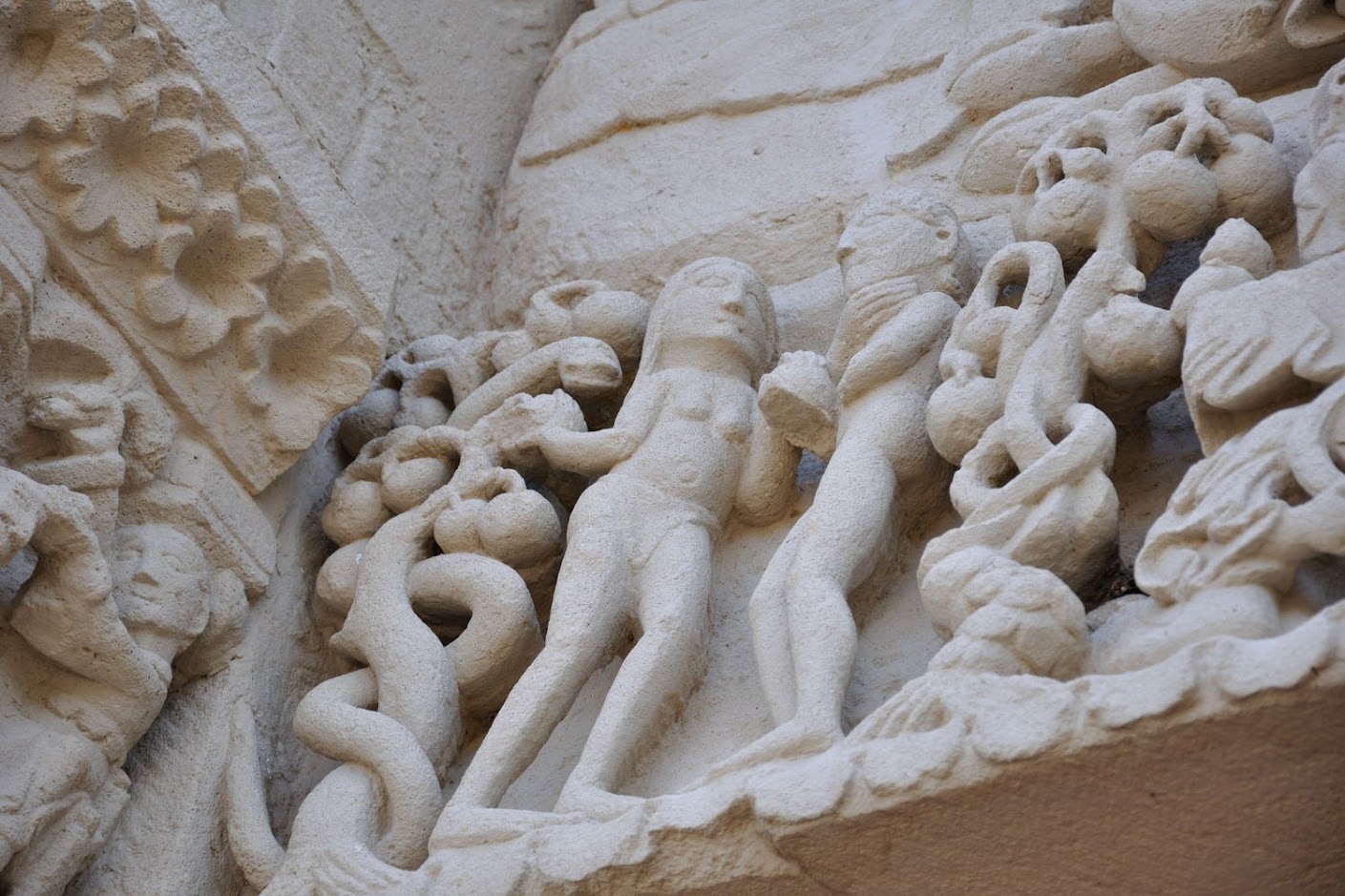
However, it seems a bit daft to travel roughly an hour just for a good lunch. The Brionnais boasts a big number of towns and villages with very interesting Romanesque (=Norman) churches; some have a crypt, others have beautifully carved capitals, and a number of them are decorated with stunning tympanums above the entrance doors.

Anzy-le-Duc - Capital
It is virtually impossible to mention all churches that are worth a visit; below are some highlights.
Those are, amongst others: Paray-le-Monial, Anzy-le-Duc, Semur-en-Brionnais, Montceau-l'Etoile, Varenne-l'Arconce, Saint-Germain-en-Brionnais, Bois-Sainte-Marie, Saint-Laurent-en-Brionnais, Châteauneuf, Iguerande, Charlieu (42) and Neuilly-en-Donjon (03). Those who would like to make a trip past the Romanesque churches can follow the signs "Circuit des églises romanes du Brionnais", a trip which is extensively described on the site "Le site sur l'Art Roman en Bourgogne".

Neuilly-en-Donjon (03) - Tympanum

For our own website click here.

Saturday, 11 February 2017

La Rochepot

La Rochepot
The name alone is worth a blog. The Herrschaft or Lordship La Roche de Nolay was in 1403 acquired by Régnier Pot, and his family name was suffixed to the place name. So that is where the name comes from, courtesy of Wikipedia.

La Rochepot
The village of La Rochepot is quite near Beaune, and even though Beaune certainly merits a full day, it is definitely worth to sneak an hour off this day for a visit to the Château de La Rochepot, beautifully set on a rock overlooking the village.

La Rochepot
It was originally an eleventh century castle, rebuilt in the thirteenth century, almost completely demolished in the nineteenth century and again rebuilt in fifteenth century style at the end of the nineteenth beginning of the twentieth century.

La Rochepot
The Château is privately owned, however it is partially open to the public. Not only the interior is worth the visit; the roof covered in coloured glazed Burgundian roof tiles gives the castle certainly an extra touch of distinction. From the castle one has a beautiful view over the surroundings, including a view of the cemetery with its beautiful Romanesque church Notre-Dame (in itself worth a visit as well).

La Rochepot
So those who are traveling to Beaune an cannot resist the temptation of a beautiful castle, should when nearing Nolay follow the signs to La Rochepot.

For our own website click here.

Saturday, 28 January 2017

Castles in all shapes and sizes

When using the word Château the first association of most French will not be with a Castle like Balmoral Castle, but with a place producing prestigious wine.

Château de Cormatin
Of course those sort of châteaux are galore in Burgundy, however the fortified châteaux or manor houses are certainly not unknown here.
To start near home: the Château de Cormatin is a beautiful 17th century castle with a lovely garden and a beautiful interior. Even though it is partially lived in, quite a big part of the building as well as the gardens can be visited.

Château de Cormatin
The Château de Drée is a bit further away from home, in the Brionnais, and is open to the public with beautiful Jardins à la française. Neither of those castles were ever meant to be fortresses.
For fortresses the French often use the word château fort, because château on its own is a bit ambiguous. A number of these castles have fallen into ruins, and can be seen from the outside, but cannot be entered. A few examples are: Lournand, Sigy-le-Châtel, Bissy-sur-Fley.

Château de Brancion
However, the ruins of Brancion Castle are interesting and open to the public.
Saône-et-Loire boasts also a few castles, complete and in good shape, which can be visited. Two examples of such castles near Mâcon are Berzé-le-Châtel, perched on a hill overlooking the Grosne valley and Pierreclos, which is a château fort as well as a wine castle. The castle itself can be visited, for a wine tasting one has to pay extra.

Berzé-le-Châtel
A castle, where according to legend Margaret of Burgundy died, is located near Couches. The castle is partially open to the public, partially a bed and breakfast place, and it offers wine tastings as well. And then finally there is the château de Germolles near Mellecey, once owned by the duke and duchess of Burgundy, Charles the bald and Margaret of Flanders. Originally it was the fortress of the Lords of Germolles, but Charles and his wife used it in the 15th century as a sort of holiday home.

Château de Couches
Note, that this overview does not pretend to be complete. It is only a very modest indication of what Saône-et-Loire has to offer on this subject.

For our own website click here.