Showing posts with label Industrial archeology; Steam. Show all posts

Saturday, 13 October 2018

Steaming Southwards

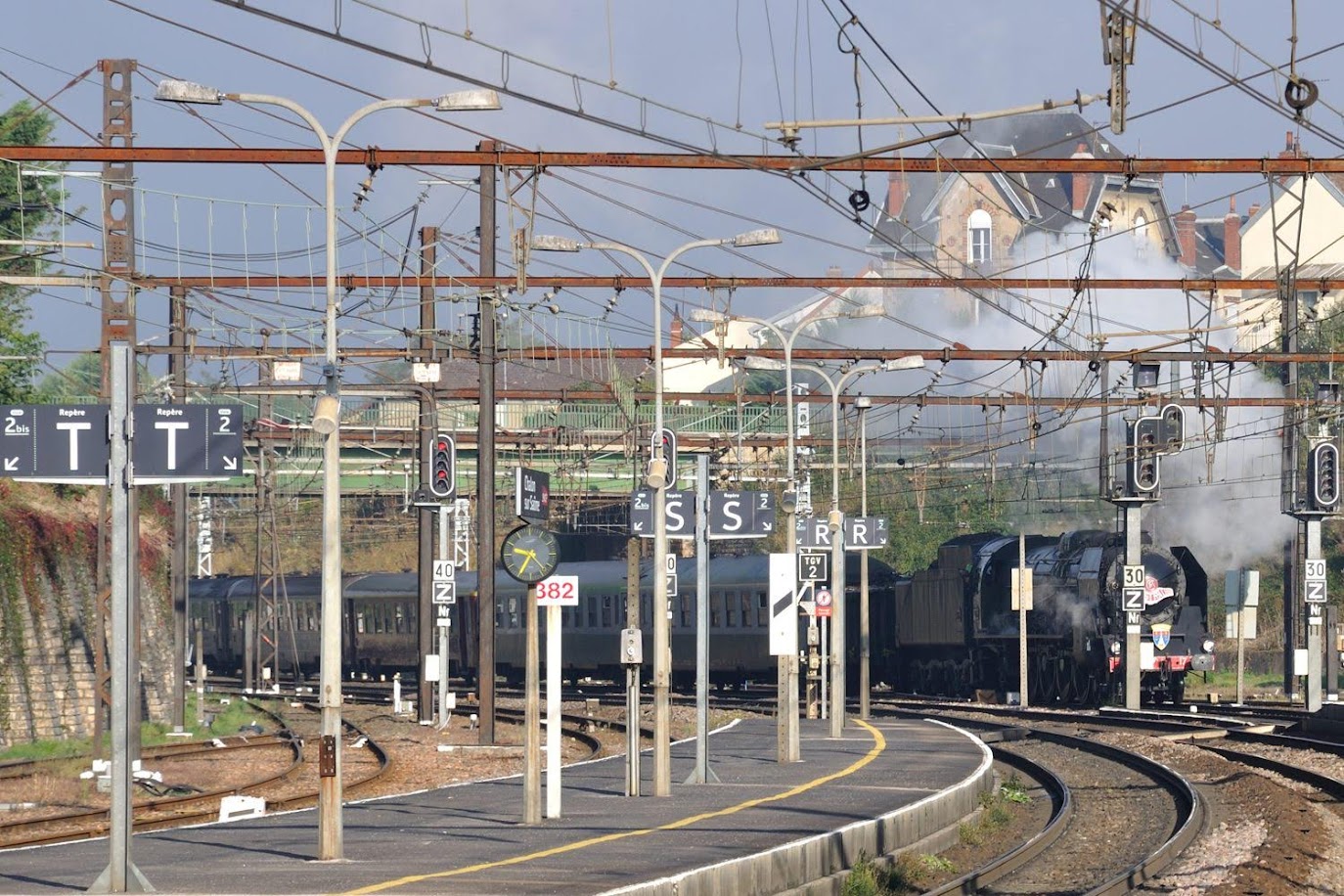
Arrival Chalon-sur-Saône
Last year we made a long trip, from Le Creusot to Mulhouse (in the Alsace) on board a train pulled by a beautiful steam locomotive, the 241P17. This was one of the last operating express train locomotives in France, and there are only a few of those left. The three first digits of the train number indicate the number of axles: 2 leading truck axles, 4 driving axles and 1 trailing truck axles. In England, where they indicate the number of wheels, this would be called a 4-8-2 locomotive.
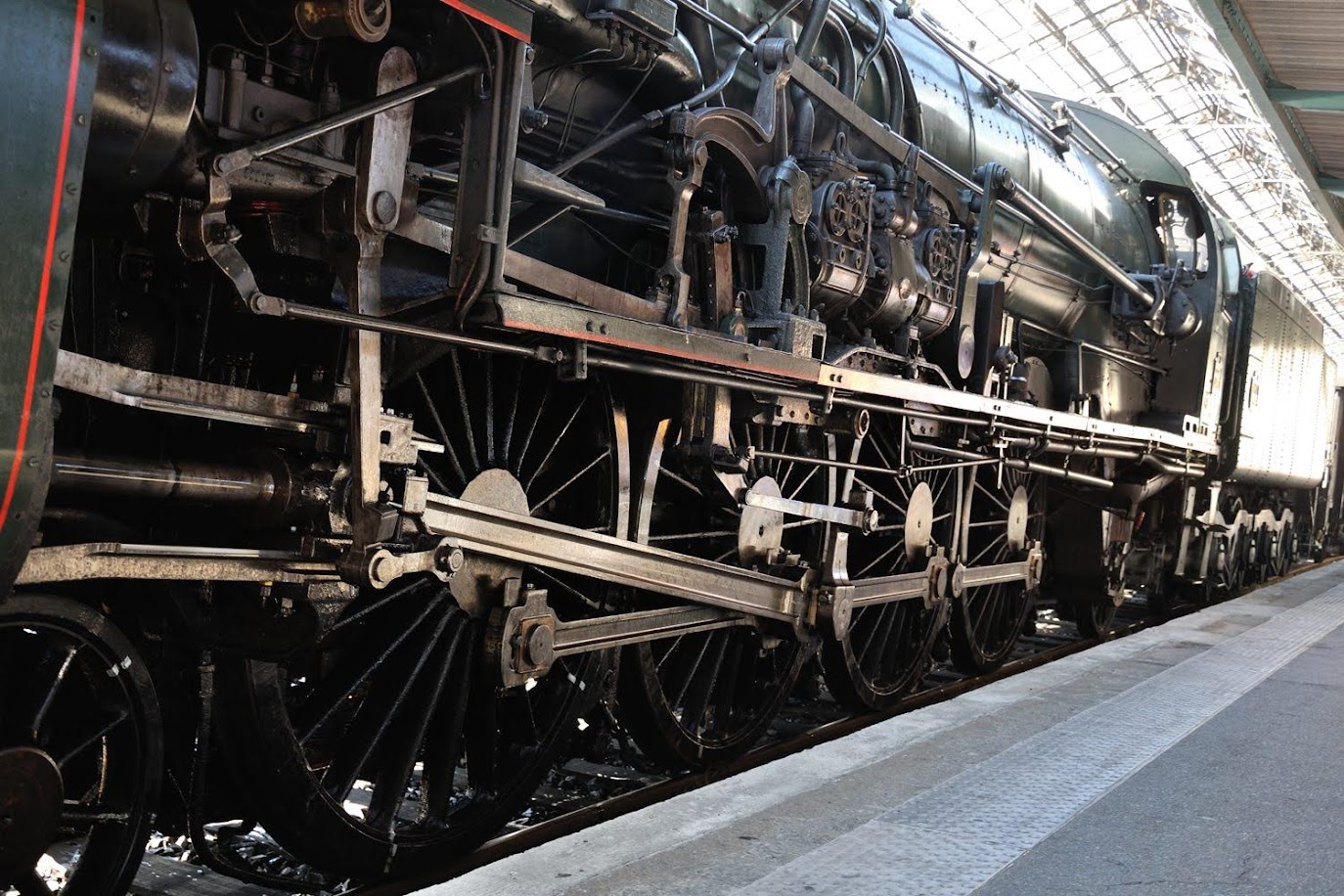
Lyon-Perrache
The home base of the train is Le Creusot, also the place where the locomotive once was built (1950) by the Schneider Company. She was operating until the end of the sixties.
An enthusiastic group of steam maniacs have revived this locomotive and keeps her going. Every year there are outings from Le Creusot to a.o. the Alsace, the Loire region, Lyon, Aix-les-Bains, Switzerland, etc. It is obvious that there is a price tag attached to these trips, however a "real" trip with a steam train is quite different from a 1 mile trip on a specially installed or restored short rail track.
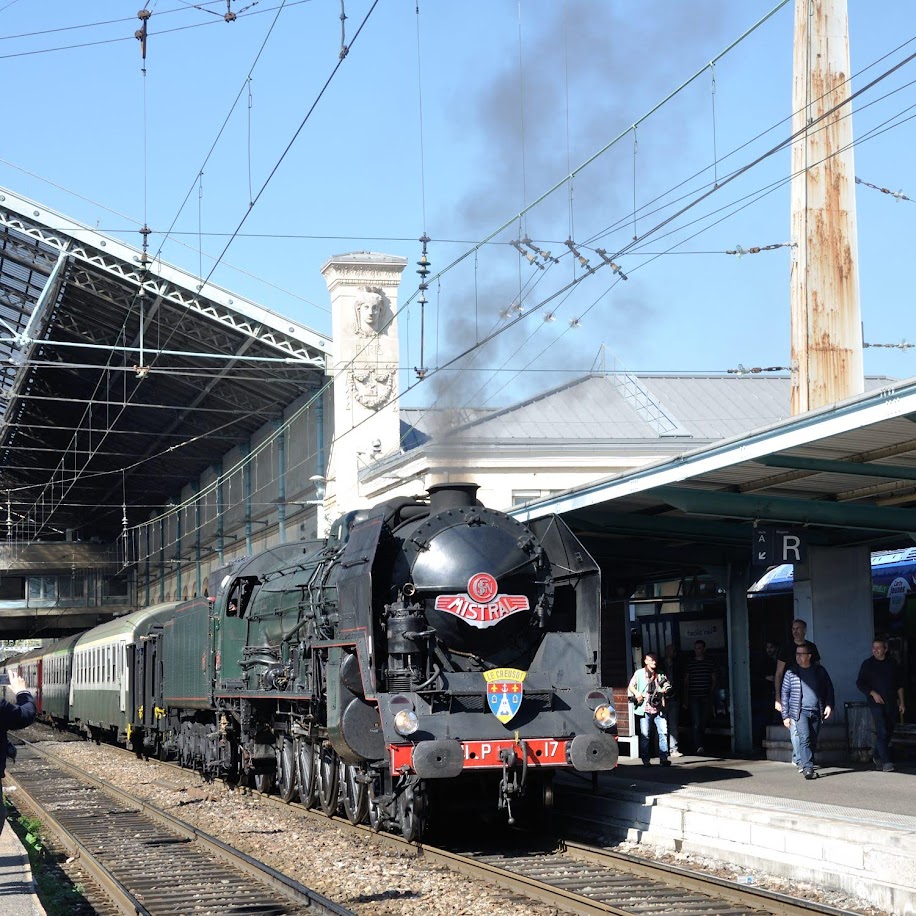
Lyon-Perrache
After last year's trip to the National Railway Museum in Mulhouse, where we had a dinner in the museum amidst historical locomotives, we decided to keep an eye on next year's program for a revival.
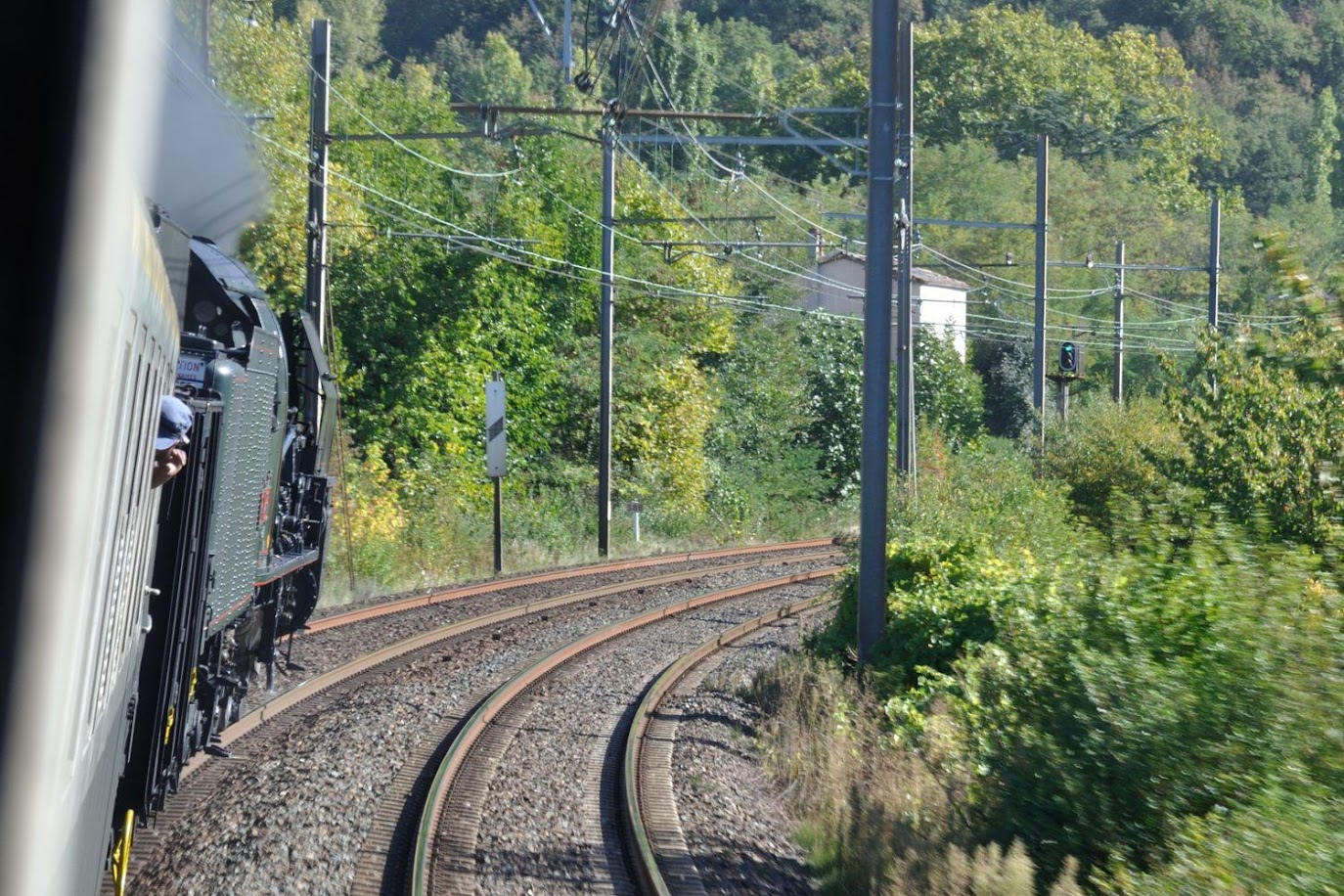
Between Vienne and Valence
The first brochure that came in advertised, apart from the "standard" trips, a three-days outing to Marseille, where the second day was reserved for a trip along the coast line. That sounded promising, hence we started to make inquiries. Last year we had reserved places in a 6 person first class compartment, and that worked this year as well. This year it looked like we could occupy all 6 seats, because some French friends would like to join as well.
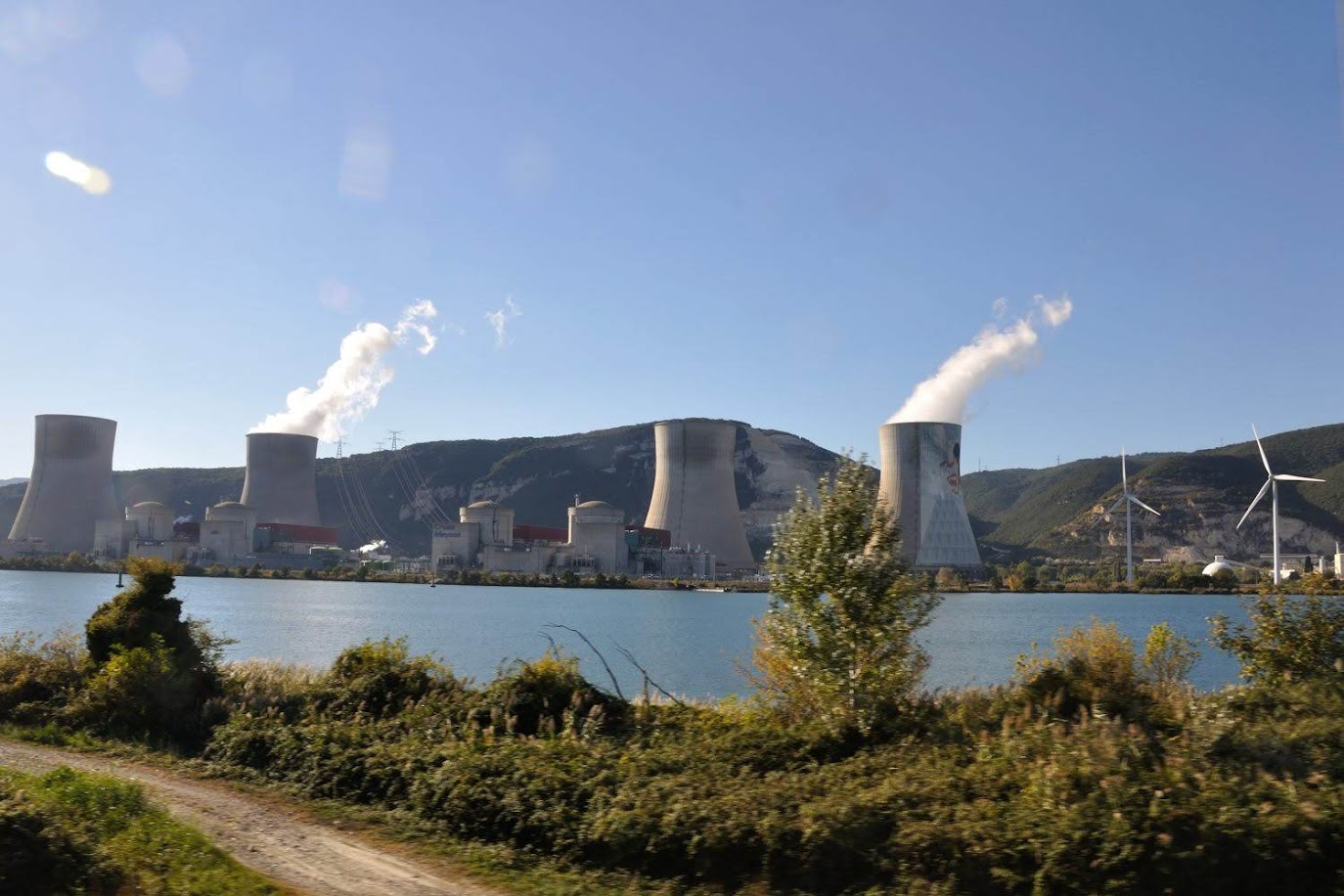
Steam on the left bank, nuclear energy on the right bank (Cruas)
The website https://www.train-vapeur.fr/ however did not give sufficient details, hence we decided to phone the organisers. In the meantime their plans had changed: the trip was one week later than the original one, and the trip went to Avignon instead of Marseille. For the second day one could choose between a river cruise on the Rhône at Avignon, a trip on our train to Arles where one could stay for the day, or from where one could continue to the Miramas Train Festival. We found neither the river cruise nor the Miramas Train Festival very appealing, hence we went for a day in Arles. Our French friends could not join us, because they were free during the original weekend, but they had other obligations the weekend after. Their place was taken by some Dutch friends of our friends, so we still had the compartment to ourselves.

Old next to new in Avignon
There appeared to be another bottleneck when we heard that the trip before ours had to be cancelled because of engine problems. Fortunately these were solved in time, hence our trip was still on the rails.
Two days before departure we received a phone call informing us that the departure times had been changed to one hour earlier than planned. However, since we had decided to board the train in Chalon-sur-Saône, this change did not affect us much. Instead of driving at the crack of dawn to Le Creusot (a good one and a half hours drive) to catch the 6h24 train, we drove at still a comfortable time to Chalon, to catch the 9h35 train.
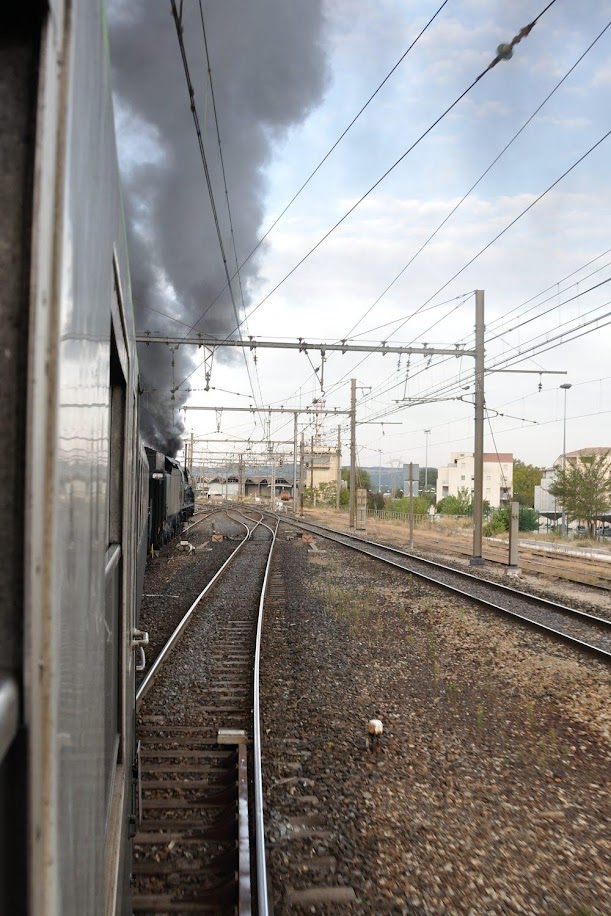
Avignon-Arles
The trip was wonderful. We had indeed our own compartment, we had ordered some sort of airplane lunch both ways, the weather was like in summer, hence we drove with open windows, fully enjoying the steam train noises and smells, the soot particles threatening one's eyes, the musical interludes the driver managed to get out of the steam whistle…. In a word, this was going to be a super trip.
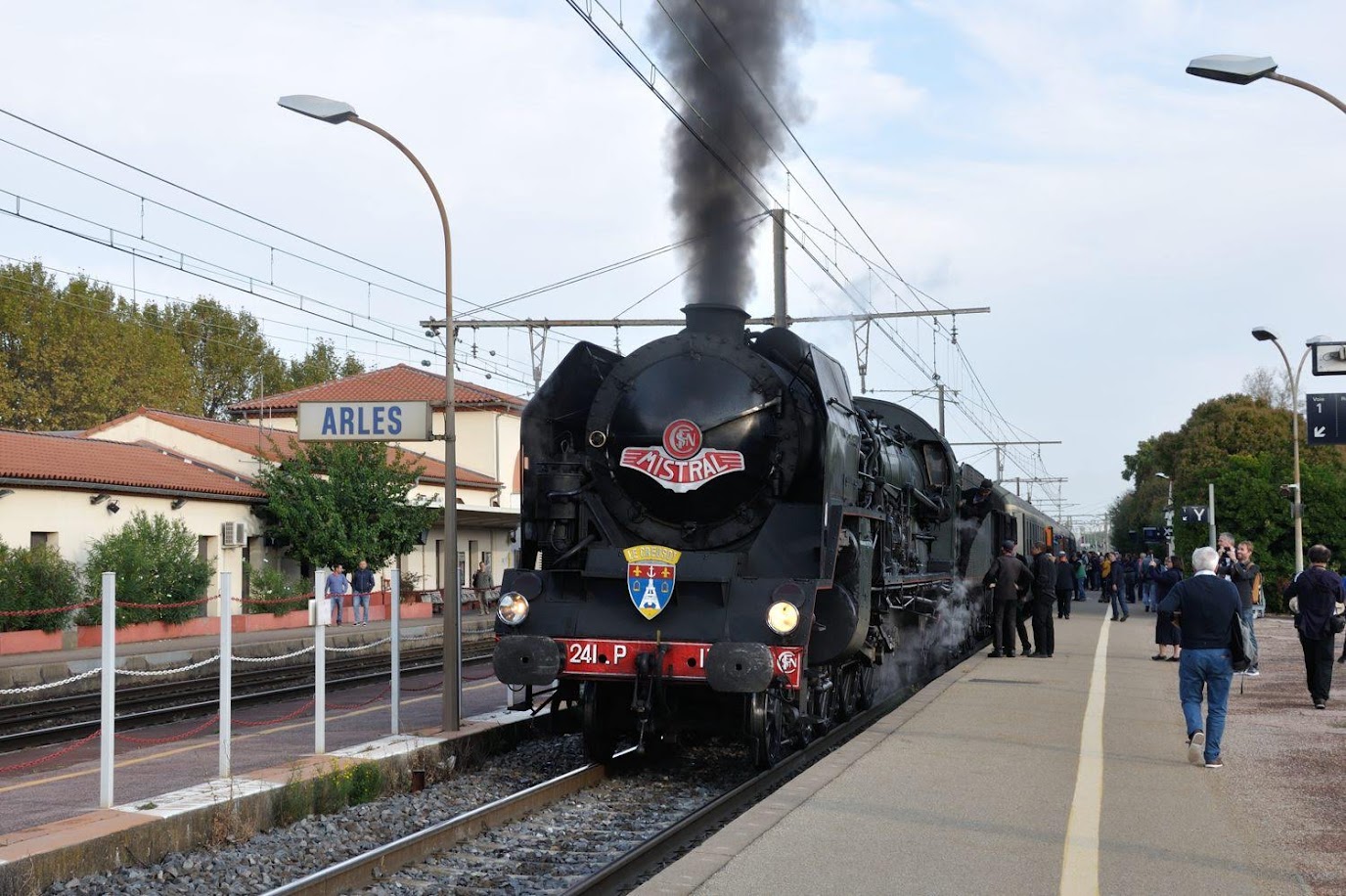
Arrival Arles
There were only a few minor drawbacks: the whole track was more or less straight, and for nice photographs of a steam locomotive in her full glory one needs long bends. And the amount of spectators along the track was disappointing. Last year, in Vesoul, where the train took in water, half the population was at the station to wave us goodbye. In Lyon, where we also had a long stop we were only gaped at by travellers to other destinations. However, this could have been to blame on the last minute change in the time table indicated on the website; when we left the website had not yet been updated (it has been now).
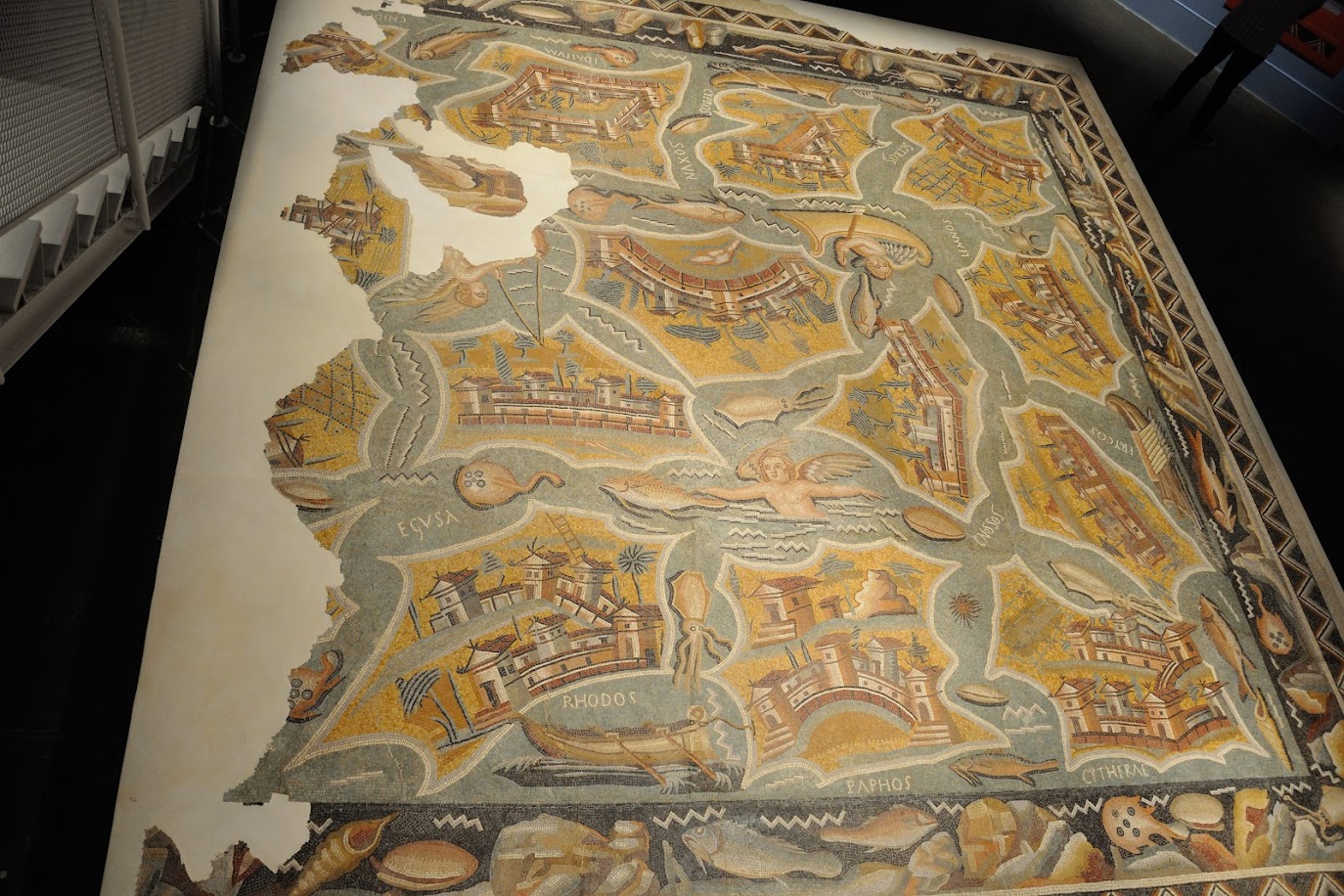
Musée Départemental Arles Antique
In Avignon we stayed in an Ibis Budget hotel, not luxurious but adequate, the evening dinner in Avignon was excellent, the day we spent in Arles (a place we know quite well) was very enjoyable, also due to the summer temperatures and a for us brand-new museum, the very interesting Musée Départemental Arles Antique.

Departure Arles
Even though the heavens opened the morning of our departure, we managed to reach the station in Avignon relatively dry. And the skies cleared during the trip north.
And that was the end of a nostalgic, long weekend. I am very curious to find out what trips are planned for 2019….

Saturday, 13 January 2018

Unexpected

Station Cluny
The Voie Verte, the cycle path connecting Chalon-sur-Saône and Mâcon, is located there where in the past an old local railway ran. At some places a few rail tracks are preserved, the small houses for the points operator or the railway signal operator are often still there and in a number of places the old stations can still be found. The former Cluny station for example now houses a place where bicycles can be rented.

Mulhouse, Station Cluny
This station used to have a nice open train shed, certainly for a station this size. We were quite taken by surprise when we found this shed, about 350 km from home, on display just outside the Cité du Train (the National Railway Museum) in Mulhouse (Alsace)!

Mulhouse, Station Cluny
For our own website click here.

Saturday, 4 November 2017

Steaming up to the Alsace

Chagny
Every so often, approx. 6 x per year, one can recognise the unmistakable sound of a steam locomotive not so far from where we live. And I am not talking about a small narrow-gauge locomotive, or a shunting locomotive, no, this concerns one of the last great express train locomotives in the series 241P that crossed France until the end of the 60-ies. The train has a power of 4000 hp, and can easily drive at 120 km/h even though the French railways have restricted the speed limit to 100 km/h.

Between Chagny and Beane
The locomotive's home base is Le Creusot (wher she was built as well with the Schneider Company) and makes yearly trips to amongst others Nevers, Aix-les-Bains, Villars-les-Dombes, Lyon and Dijon, the Loire Valley… This year there was a special trip planned. The idea was to travel from Le Creusot to Mulhouse, have a dinner with candle light in the Cité du Train (one of the biggest museums if not the biggest railway museum of Europe), stay in a hotel near the railway station.
The next day there would be a visit to the museum proper and then of course the return trip under steam.

Public in Vesoul
We had watched the train go by standing on a viaduct near Rully, but we had never been on board. Until September.
Because we had something to celebrate we had splashed out financially in order to make the trip with some friends.

A young spectator
The smell of oil, coal and steam, the sound of the cylinders and of the steam whistle, combined with a beautiful late summer's day which allowed us to hang from the windows to take pictures, the stops at various stations on our way to take in water with the help of the local fire brigade, the spectators along the tracks and especially the crowds on the stations of Chagny and Vesoul, all this made the weekend to be an unforgettable one.

Dinner Cité du Train
And not only the trip itself had been perfectly organised (the steam train had to be fit into the SNCF timetable). The lunches we had ordered were of good quality, the dinner in the museum was excellent with local specialities, the hotel was very efficiently organised, the museum which we had visited before was certainly worth another visit, and this is hopefully not the last time we boarded the 241P17.

A sister of our locomotive
For our own website click here.

Saturday, 21 October 2017

Grand rassemblement de véhicules agricoles et automobiles d'antan in Lux

Steam in motion
When it comes to steam our area is not very well served, with the exception of the trips with steam locomotive 241P17. In 2007 and 2013 we attended in and around Digoin the Festi'Vapeur event, which appears to be a two-yearly steam venue during the last week in June, of which we had missed the 2015 and 2017 editions.

Steam in motion
Recently we discovered that in Lux (near Chalon-sur-Saône) a second "Grand rassemblement de véhicules agricoles et automobiles d'antan" was organised. In the newspaper we saw that apart from old agricultural vehicules there would also be a number of vintage cars on display, including some old military vehicles and… some working steam engines.

Steam stationary
As I said before, it is not often one can see steam in action, and on a beautiful sunny day we took off for Lux. The emphasis was on agriculture, however, there were also some steam driven vehicles driving around the lake, and there was a nice collection of vintage cars (mainly French, like Simca, Citroën Traction Avant, etc.). Further there were some old Jeeps on the road as well as an armoured amphibian car.

Amphibian vehicule
In a word: this day has been noted down in next year's diary!
For our own website click here.

Saturday, 17 June 2017

L’exactitude est la politesse des rois

Rully, a village approx. 50 km north of us is renowned for its wines (mainly white Chardonays) and for its château.

Rully - Château
Around this château each year a "marche gourmande" is organised, about which I wrote a blog some time ago. Rully boasts 23 AOC vineyards producing Premiers Crus.

As soon as one enters Rully along the D981 one cannot miss, on the crossing of this road and the roads leading to the centre of the village and the SNCF station, a sculpture in stainless steel entitled "Le vigneron de Rully" van Alain Loget, a huge statue of a grape picker. However, these are not the reasons why we every so often drive to Rully.

Le vigneron de Rully
Le Creusot is the home base of the 241P17 (The Mistral), a beautiful compound steam locomotive built by André Chapelon. This locomotive is used for a number of trips from Le Creusot, among others to Aix-les-Bains, Les Dombes, the Loire Valley and Switzerland. Some of these trips are passing through Chagny station and continue direction Chalon-sur-Saône. At Rully, between Chagny and Chalon, the train runs on a straight track and underpasses a road.

Mistral - 2013
After having studied all sort of maps (Michelin, IGN) we came to the conclusion that Rully in the morning was the best place to take pictures of the approaching train. There is ample parking availability, it is quiet traffic wise, the viaduct has a pedestrian pavement, the train has not built up more than the usual delays and the sun, when shining, lights the scene at the right angle.

Mistral - 2016
The only disadvantage is that we have to set the alarm clock to be there in time, around 8h00. One certainly does not want to end up in the situation of the guy who turned up while we were walking back to the car asking us: "Has the train really gone yet?". French people are late by definition (hence the title of this blog, attributed to Louis XVIII), which is no big deal when attending a dinner party. However, trying to catch up along roads with speed limits of 50, 70 and 90 km/h with a steam train running at high speed is a completely different matter!
For our own website, click here.

Saturday, 17 December 2016

Musée de la Mine - Blanzy

That the area around and west of Montceau-les-Mines and Le Creusot once was a thriving coal mining basin is only reflected in some of the place names: Montceau-les-Mines is an obvious example.

Musée de la Mine - Blanzy
Apart from those names there is not much that reminds one of the glorious days of the industrial revolution. Many towns and villages in the Charolais however had in those days such an influx of miners from Italy, Portugal and Poland (all staunch roman-catholic countries) that the old Romanesque churches soon became too small to cater for this rise in population.

Gallery
Of those original churches only the bell tower is till old; often the Romanesque nave has been demolished and replaced by a longer and/or wider edifice. The coal exploitation in the area ended between 1992 and 2000.
In Blanzy however there is something more that reminds us of those days.

Gallery
There is not much remaining of the many mines in the area, but Blanzy boasts an original mineshaft lift tower of the Puits Saint-Claude (exploitation: 1857-1882), and the area around it has been converted into a mining museum.
http://www.ecomusee-creusot-montceau.fr/spip.php?rubrique9
The museum appeared to be very interesting and is daily open in the summer months (not on Tuesdays, and only in the afternoon) and outside that period in weekends only.

Miner
The group managing the museum runs (among others) the machine room, it has an interesting collection of miner's lamps and organises very interesting guided tours through replicas of old mine galleries, including old and "modern" machinery, built just under ground level. This way the visitor gets a good impression of what life underground has been.

The lift tower
Blanzy is about half an hour's drive from here, and for those who are interested in industrial archaeology a visit to the museum is well worth its while.
For our own website click here.

Saturday, 22 October 2016

The inventor of photography – part 2 and last

Because they are accessible free of charge we decided, on a day more suitable for a museum visit than for a day lazing in the sun, to visit the two museums in Chalon-sur-Saône.

Statue of Nicéphore Niépce - Chalon-sur-Saône
We planned to see the Musée Vivant Denon first, and to do the Musée Nicéphore Niépce, like the one in Saint-Loup-de-Varennes (see the previous blog) dedicated to the inventor of photography, afterwards.

Musée Niépce : the permant collection
We had seen both museums before; Denon for the first time in 2013, Niépce in 2011. Both had undergone some changes, and for the better.
Denon, a local museum with an archaeology and a fine arts department, had a small but interesting temporary exhibition of treasures from the Near- and Middle-East, and had extended its permanent collection with antique furniture from Senncey-le-Grand.

Musée Niépce : space for temporary exhibitions
Niépce had also been renovated or re-organised in the past years. It boasts a far more interesting collection about Niépce (and Daguerre) than Saint-Loup, including a display of antique cameras and objectives, and has ample space for temporary photo exhibitions. When we visited, there were two exhibitions running simultaneously: one with black-and-white pictures of Léon Herschtritt (La fin d'une monde) and one slightly less interesting (to my taste) of contemporary photographs in colour (L'oeil de l'expert).

Musée Niépce : space for temporary exhibitions
Two museums with the same theme: that cries out for a comparison.

The Maison de Nicéphore Niépce in Saint-Loup-de-Varennes has, as the place where the first photograph was taken, mainly historical value. It pays some attention to other inventions of Niépce, but the collection (mainly replica of inventions and re-arranged rooms) is not very impressive. The 6 € entrance fee could be better used drinking something on a sunny terrace elsewhere, to my humble opinion. I will leave the welcome and the opening times out of the equation to give the museum at least some credit. On a scale of 1 to 10: a meagre 4.

The most interesting display in Saint-Loup-de-Varennes

The Musée Nicéphore Niépce in Chalon-sur-Saône has a reasonable collection, and on top of that often interesting temporary exhibitions. Besides there is no entrance fee, and once one has seen the museum there are plenty of other things to see within walking distance (cathedral Saint-Vincent, Musée Vivant Denon, mediaeval houses, markets), and the old town boasts a number of terraces which invite one to sit down and watch the world go by. On a scale of 1 to 10: a good 8.

Musée Niépce : part of the permanent collection
For our own website click here.

Saturday, 8 October 2016

The inventor of photography - part 1 of 2

Chalon-sur-Saône, the place where he was born and lived and Sint-Loup-de-Varennes, where he lived, worked and died are both proud of Joseph Nicéphore Niépce, a man with an exotic name, inventor of among others "photography".

Saint-Loup-de-Varennes
The last statement is open to interpretation, but fact is that he produced the very first photographic picture (exposure time over 8 hours) in 1822.
Chalon has its Niépce museum, as has Saint-Loup-de-Varennes (a stone throw from Chalon): the house "Le Gras" where he took the first photographic picture ever.

Point de vue du Gras
The museum in Saint-Loup is open all day (except Tuesdays) from 10h00 to 18h00, at least so the website says. Not closed for lunch? That is a novelty, and as such "Unique en France"!
We arrived there at approx. 13h45, found all doors locked and a sign "Next guided tour at 14h00". At 14h15 we decided to do some shopping nearby and give it another last try when we were passing by again after our shopping expedition.

Another invention of Niépce
But alas, all doors were still locked. However, the sign had been removed as well. This time we spotted a young woman nearby, whom we actually had seen earlier, but further away. She was the tour guide, and she must have thought that we were some local burglars, not worth addressing because they were only guilty of almost kicking in the locked doors.

THE window
The next tour was at 15h00, but when we told her that we had already waited half an hour for the previous tour, and that we would not really be amused if we had to wait another 30 minutes, she gave in and started the guided tour at 14h30. The shed, which we thought was "the house", turned out to be the reception area and museum shop, and the big house nearby, where we had seen the woman in red earlier turned out to be the scene of Niépce's crime.

Workshop
The museum hosts some models of Niépce's other inventions, some pots with chemicals from his original lab in Chalon, a replica of his study and workshop and of course the window from which the first photographic picture was taken. The building has obviously historical value, but one can question whether the entrance fee of € 6.00 pp is not a bit steep for the things on show.

The shield at the door
The Niépce Museum in Chalon is at least free of charge!
For our own website click here.

Saturday, 30 July 2016

Killing two birds with one stone

Given the enormous amount of artisans around here who occupy themselves with all sorts of handicrafts, the artists have to go through some length to be able to sell their products.

Exposition Belles de Mai - Berzé-la-Ville
They are united in a number of associations, some rigid, some a bit more flexible, which regularly organize exhibitions of their work. One of these associations is the "Belles de Mai" (in winter they operate as "Mères Noël"), that organizes at the beginning of summer and towards Christmas an exhibition in a spot that is also of interest on different grounds.

Gypum kilns - Berzé-la-Ville
This year they had chosen the old gypsum kilns in Berzé-la-Ville. We knew the kilns from a previous visit in August 2012, when we were invited there by a group (Amis de Vieux Berzé) who occupied themselves with the restauration of the kilns. Of course this was reason enough for a revisit. http://amisvieuxberze71.org/
This exposition gave us a chance to see what the restorers had achieved, and what the artisan hat makers, potters, jewellers, etc. had wrought.

Exposition - Berzé-la-Ville
The kilns had undergone a metamorphosis over the last three and a half years and formed a perfect setting for the exhibited jewellery, ceramics, clothing, etc. The weather, which is an important factor for the success of these events did not spoil the fun. When we arrived around lunchtime (a perfect time to avoid the crowds) all the ladies were enjoying the warmth and the sunshine chatting and sipping their glasses of wine. The whole scene gave me a strange déja vu feeling, seeing all these ladies dressed in white.

Not a Chinese funeral!
That is however something very personal. It very strongly reminded me of the gatherings around Chinese funerals, where a certain generation of mourners is dressed in white, and where after a wake of 3, 5 or 7 days the mourners are behaving as a group of family or friends during a happier occasion than a funeral. Anyway, the "Belles de Mai" had every reason to be really happy and gay!

For our own website click here.

Saturday, 12 December 2015

Will the real Mr. Brickmaker please stand up?

We have always thought that Noël Marembeaud, no matter how the name is spelled, has been the founder of La Tuilerie de Chazelle. All clues were pointing in that direction: dozens of bricks we found around the house, a number of floor tiles, some roof tiles, all with his name printed on them, the memorial plaque which I have mentioned earlier, with his name, birth year and year of death chiselled in….

The well known stamp
Whenever we found another broken or damaged brick with his name printed within its distinctive cadre, we hardly looked at them, convinced as we were it was another Marembeaud brick.
Until Sue decided to protect the roots of a plant with some old roof tiles and broken bricks she had found somewhere.

La Tuilerie (sketch Michel Bouillot)
Without any apparent reason I picked up one of the bricks and noticed that the name I was expecting was not that of Marembeaud, but a totally unknown name to me of which most likely the first letter was missing.
Without too much fantasy one might draw the following conclusion: the name on the brick was "(B)OURGEON ANTOINE", with under it the text "(A CHA)ZELLE". The letters between brackets are my guess.

The odd one out
Bourgeon is not an uncommon name around here, and based on the length of the cadre around the name it seemed unlikely that there had been more than one letter in front of OURGEON. The question boils down to the following: who was the founder (or the successor) of La Tuilerie de Chazelle? The name Marembeaud occurs most frequently; Bourgeon we have only encountered once. And maybe Bourgeon was someone who ordered a load of bricks and wanted his name engraved in them.

To tell the truth (Saint Nicholas) Dutch version
To paraphrase the old game show "To tell the truth": "Will the real Mr. Brickmaker please stand up?". However, that would be a resurrection from the grave, I am afraid….

Click here for the website of La Tuilerie de Chazelle.