Showing posts with label Everyday life; Culture shock; Language. Show all posts

Saturday, 24 November 2018

A new second-hand shop

The old shop of Mme Nicolas
for a long time now we have had a weekly lunch at La Petite Auberge, a simple but good restaurant in Cluny's high street. The restaurant is located next to a second-hand bookshop, Livres Anciens run by Mme Nicole Nicolas. Even though we only ever bought one small book in her shop, we got to know her.

Mme Nicolas in 2012 (photo Journal de Saône-et-loire)
She often ate at La Petite Auberge, and Bugundians being friendly and polite people, we were soon on "Bonjour" terms with her. End of April however we noticed that the shop window had been emptied, and a week later there was a little card on the door saying that Mme Nicolas had passed away. From the owner of La Petite Auberge we learned that Mme Nicolas had died after a very short illness.

the shop of Amaury Bonnetain
Until August this year the empty shop was a painful reminder that nothing in life is eternal. In August however a new card appeared in the shop window. A certain M. Amaury Bonnetain was going to reopen the shop in October, again as a second-hand bookshop. In October the shop window had al of a sudden some books in it, one of which was a standard work on Romanesque churches in the region.

Book on Romanesque churches
One of my friends was interested in that particular book. After some phone calls and an inspection of the book itself the deal was made very quickly. The new owner happened to be a very amiable person, and we have left him in charge of some book titles of books that are new no longer available.

Saturday, 10 November 2018

The Arab market in Chalon-sur-Saône

The Arab market - Chalon

Every Thursday morning Chalon-sur-Saône hosts a very cosy and busy market, known by the locals as the Arab market. The market is located in a quarter where the population is originally from North-African or Arabic descent. That is also the reason why the market is more colourful and aromatic (due to the many different sorts of ground spices) than the average "normal" markets with predominantly French buyers and sellers.

The Arab market - Chalon
When some years back French politicians started to compete each other by imitating Marine Le Pen in an attempt to cajole part of her voters out of her supporters, Mayor Gilles Platret was one of the politicians of Les Républicains (the right wing party of a.o. Sarkozy) who announced taking "measures". One of his spearheads was stopping providing halal meals for school lunches.

The Arab market - Chalon
That is still challenged by the supporters of halal food, and every so often Platret is summoned again for another appeal case concerning this item (end October a court of appeal in Lyon decided that Platret's decision had te be withdrawn). More recently he ordered the police to do street checks around the Arab market, no doubt in search of potential terrorists. These actions however were not very successful. If they had caught only one person Platret would have made a big show out of it.

The Arab market - Chalon
However, after the police checks in the area we thought that that might have had a negative effect on the market, but that turned out not to have been the case.
Recently we went there again, not necessarily to buy something (although we did), but just to taste the atmosphere. The market is still what it used to be: a cosy day market, where lots of colourful clothing is sold, where people are friendly, where the vegetable stalls sell more exotic stuff than the supermarkets, and where there is a constant smell of freshly ground spices and herbs, which we recognise from markets in the Middle-East and Asia.


The Arab market - Chalon

Saturday, 12 May 2018

The Ikea-density per country (12 mei 2018)

Ikea Dijon
if you ever want to buy something at Ikea in the Netherlands, you will seldom have to travel more than 30 miles. In France that is slightly different; the nearest Ikea-shops for us are located in Dijon or Lyon, each about 60 miles from our home. And since Ikea Dijon is considerably more easily reachable compared to its Lyon counterpart, we have a strong preference for Dijon.

A car full of Ikea stuff, but no Billy case....
Hence, when we needed another Billy bookcase and some more Ikea stuff, we decided to check the availability of "our" furniture on the Dijon website. That seemed to be the case, although the remarks on the website were a bit ambiguous.
We understood "Disponible sur commande au magasin de IKEA Dijon" to mean: order on the spot and pick your parcel up at the collection counter. For another type of cupboard it said "Disponible à IKEA Dijon", which we interpreted as pick it up from the shelf, pay and leave. However, we found out that the Billy bookcase could be ordered there and then, but that the order had to be delivered to your home by Ikea itself.

This Mackapär cabinet however was available in Dijon
We were advised, if we did not want to pay the delivery charges, we should make another trip to Lyon, where the bookcase was available and from where it could be taken home straight away. Since we did not need the bookcase urgently, we decided to leave the Billy bookcase in Lyon for the time being.

The exreme left Billy case came all the way from Eindhoven!
A few weeks later however, we had to go to the Netherlands, and about ten miles from Den Bosch, the place where we were staying, there happened to be an Ikea in Eindhoven. They had the Billy bookcase in stock, so when we returned to France a few days later, we had a brandnew Billy in the boot, and, it turned out to be marginally cheaper than its French counterpart as well!

Saturday, 31 March 2018

What's in a name?

Lenin (Internet)
Long time ago I was christened as Cornelis Gerardus van Halderen, shortened for daily use to Kees (pronounced as "Case"). I have been quite content with my short name, but when I entered puberty (in the early sixties) I found that Kees was a rather bourgeois name. From then on I could have called myself Ilyich, or Yevgéniy, or Che (in certain circles quite fashionable names then), but I had a strong feeling that this might not catch on with many of my friends and family. Hence I chose a simpler solution: Change Kees into Cees, and all of a sudden a simple boy from a working class family had something special, something artistic.
Che Guevara (Internet)
And even though the pronunciation of both names should be different (Case becomes Sase), I can only remember one colleague who consequently called me "Sase". When time passes one realises that such adolescent behaviour had been rather childish, but by then I and the rest of the world got used to a name that is differently written than it is pronounced.
When we ended up in France I held on to my illogical short name, irrespective of the fact that some people were quite confused by it. Normally I am addressed as Kees (hence as Case), but some people address me as Cees, which they turn into "Cease".

Uitnodiging van de Préfect
The reason: they think that Cease sounds more logical and more English than Case (given the spelling of Cees). Again, in hindsight, I should have chosen to be called Cornelis (albeit this sounds very official to me) or Cornelius (not common, but also not totally unknown in France), or Gérard, a perfectly French name which also corresponds to my second Christian name.
Since I have obtained the French nationality another "problem" has arisen: my official name (in my French passport) has been changed to Cornelis Gerardus Van Halderen. (Note the capital V in my name!).

Monsieur Van....
It is a bit like in the Singaporean telephone directory: one found most Dutch nationals under D for De (Boer, etc.) or under V for Van (Houten, etc.) and not under B resp. H. As of now I am findable under V for Van Halderen, and no longer under H of Halderen as is normal in the Netherlands….

Saturday, 2 December 2017

A holiday job

Voor de grote schoonmaak
This summer I was "told" to cut down some brambles, located on a corner where the person who often drives around on a lawnmower got severely scratched on head, shoulders, arms and legs by whizzing past the thorny branches. Well, cutting down some brambles, that should be a doddle for any guy, wouldn't it?

Na de grote schoonmaak
And that is how it all started: one thing led to another. What started as cutting back some branches somewhere at the beginning of July, turned out to be a full-time job, because after each bramble bush another was hiding, and another, and another…

En opeens was er uitzicht!
Anyway, some time ago, to be precise Saturday November 4, the job was ceremoniously declared finished, and celebrated with a cold Belgian beer. In the meantime I had cleared a big area of brambles, and one day I hit upon a ditch so overgrown that I did not even know it existed. The ditch also gave me an unpleasant surprise. In the ditch, at the bottom of the slope I found, more or less vertically sticking out the remains of an old fence. Fortunately the removal of the fence was less tricky then I thought, and on that last memorable working day we drove off to the dump with a car full of muddy wire fencing.


Een groot deel van het werk: de sloot ligt rechts
As can be seen on the picture of that bit of garden, the 1 to 2 m wide strip of brambles, separating our garden from the meadow has completely disappeared. For as long as it lasts, of course….

For our own website click here.

Saturday, 24 December 2016

Laïcité

I thought I had seen it all when it comes to laïcité (separation of church and state) with the arrival of the burkini, the injunction of the same bathing suit and with the cancellation of the injunction of the burkini.

Burkini arrest (picture The Mirror)
The elimination of Sarkozy as presidential candidate during the primaries seemed to confirm that. Until…
Until a small nativity scene in the hall of the town hall in Paray-le-Monial hit the front pages of the regional press. the pictures in this blog come from the local newspaper, and from the pictures one can deduce that had not Sherlock Holmes personally been involved in the search, the stable would never have been discovered.

Nativity scene - Paray-le-Monial (picture JdS&L)
Showing or wearing of religious symbols in public spaces is more or less forbidden in France, and the LDDH, a self-appointed watchdog on the subject, has brought this "case" to court, and the mayor of Paray lost this case.
What followed was predictable: Paray is a busy place for all sorts of roman-catholic pilgrimages, evry 4th building in town is a church or chapel, the mayor is a staunch roman-catholic jurist, in a word the proverbial shit started to hit the fan.

Nativity scene - Paray-le-Monial (picture L'observatoire de la Christianophobie)
According to the mayor this decision has serious consequences for the democracy in this country.
And for the Front National, which has hardly any influence in Burgundy (yet), this is grist to the mill. In a pamphlet about this case issued by FN this is the beginning of the end: a tsunami of minarets, headscarves, terrorists, etc. is heading for Burgundy. And yes, this sounds all very familiar. Maybe I can get hold of a cheap Linguaphone course Arabic somewhere….

Saturday, 15 October 2016

Citizenship course

We have cracked many a joke about what one has to do to obtain a foreign passport. Each country has different demands in order to accept foreigners as one of their own.

It's a gas, gas, gas!
For example, to be able to pass as a Frenchman one has to adhere to a number of house rules; below is just a very small random choice.
Never walk anywhere, take your car, even between two shops which are bordering each other. Avoid leaving your car; chatting to another motorized friend can be done through the car windows, hence blocking the road for at least 20 minutes. However, if for an emergency one has to leave the car, make sure not to switch off the motor. That is the only accepted way to maintain the greenhouse effect.

Ah, what is 15 muntes among friends....
Never be on time. It is frowned upon when one arrives on time, let alone when one arrives a trifle early. Even when concerts are supposed to start at 20h00, do not appear before 20h15. That is the best way to annoy those who came "only" 5 minutes late.
As I said, this is a very small selection.
For a Dutch passport there are of course different rules.

It can be done this way...
I remember very clearly an English lady who had major problems jumping on the luggage carrier of a bicycle in motion. Most of the time the cyclist was thrown off the bike because of the sideways impact the passenger exerted. After weeks of practice and a partner with bruised ribs the lady was ready to apply for a Dutch passport.
Mounting a bike where the passenger already had taken place on the luggage carrier requires yet another skill, as attached picture shows…

Or this way!
For our own website click here.

Saturday, 2 July 2016

Fear of terrorism

In January 2015 France was once more confronted with the cruel truth of reality: a small but determined group fanatic militants appeared to be able to paralyse a whole country.

Place de la République - Paris: after 7 January 2015
The French were confronted with the state of emergency, armed soldiers appeared in the streets and near possible "vulnerable" targets, scanners appeared at the entrance to museums and other public buildings, in a word, France was started out of its lethargy and a number of sometimes rather draconic measures were taken to prevent a repetition of the Charlie Hebdo murders.

Place de la République - Paris: after 7 January 2015
That one cannot prevent these things happening, no matter how hard one tries, was proven again by the bloodbath caused in November 2015, again in Paris. Anyway, doing something is better than doing nothing at all, and that fear is not restrained to Paris alone but has spread throughout France can be deduced from the following anecdote.
On a Wednesday night, to go to our weekly taichi-lessons in a gymnasium, we always park in a parking area opposite another school. One evening however all parking spaces, except for one disabled parking space, were cordoned off with a few barriers connected with red and white tape.

Rue du 19 Mars 1962 - Cluny: after 13 November 2015
Assuming that the parking spaces were cordoned off for works in the day time, we shoved a barrier aside and parked our car where we normally park. That went o.k. for a couple of weeks, until the tape disappeared one day to make place for more metal barriers. We had no other choice but to park half on the street, parallel to the barriers.
The "works" however seemed to be a never ending story. And finally we decided to read what the decree of the city council, pinned to one of the barriers, said.

Rue du 19 Mars 1962 - Cluny: na 13 november 2015
It appeared that the headmaster of the school opposite wanted to create a safe zone around his school, inspired by the terrorist attacks of November 2015. Hopefully potential terrorists will not be clever enough to use a vehicle with a disabled sticker….

For our own website click here.

Saturday, 30 April 2016

The Government Gazette, or Liberté, Egalité, Fraternité (part 6 of 6)

The Government Gazette
The last spasm related to my naturalisation was sending off the paperwork concerning my partner's name. Scanning was a bit tricky whilst on holiday, however, taking a picture in JPEG format was no problem and was just as good as a scanned copy. On March 14 we were at the consulate in Paris, received "THE" document (the excerpts from birth and marriage certificated I had already scanned beforehand), and the same day all documents and my answers to her questions were mailed to the Service Central Etat-Civil.


Ministerie van Buitenlandse Zaken
Of course we had no idea how everything would develop from there. However, on April 4 an e-mail ended our misery and despair: March 26 my dossier had been approved, and within a few weeks the decree regarding my naturalisation would be published in the Journal Officiel (the French Government Gazette). However, where does one buy a Government Gazette? Not at one's local Tabac, that is for sure!


What does he have to do with it?
And then it was again: wait, wait, and wait…. Finally Saturday 23 April the long awaited letter from the Ministry of the Interior landed in our letterbox: my naturalisation as a Frenchman was registered in the "Journal Officiel" of (Sunday!) 3 April by decree no. 13. Once knowing this it was just a matter of an internet search, and bingo, there was the decree of approx. 30 pages. With Photoshop it was a doddle to move my name out of the approx. 1200 to a prominent place just under the heading of the decree. Within six months the remaining paperwork should be finalized: a letter from the French President, the Livret de famille français and, who knows, maybe a blessing from the Pope.

Excerpt from the French Gazette of 3 April 2016
An overview of the road towards French citizenship:
Liberté, Egalité, Fraternité (deel 1 van 6) How to become French?
Liberté, Egalité, Fraternité (deel 2 van 6) The dossier
Liberté, Egalité, Fraternité (deel 3 van 6) The interview
Liberté, Egalité, Fraternité (deel 4 van 6) Bureaucracy
Liberté, Egalité, Fraternité (deel 5 van 6) What's in a name….

For our own website click here.

Saturday, 16 April 2016

What's in a name…, , or Liberté, Egalité, Fraternité (part 5 of 6)

Court ruling
When I was asked by the French Ministry of the Interior to produce the court ruling concerning my divorce, I was unpleasantly surprised. The Préfecture in Mâcon had accepted the excerpt from the Dutch authorities which stated clearly when and from whom I was divorced, and I assumed that what was good enough for civil servant X should be good enough for civil servant Y. However, arguing with civil servants, no matter their nationality is by definition a lost cause, hence …..
After taking that hurdle early February 2016 my paperwork was most likely in order, and after that I could do nothing but wait, wait, wait…

Service Central Etat-Civil - Nantes
One day before we (on 12 March 2016) were off for a week's holiday in Paris I received a phone call from a lady working in Nantes, at the Service Central Etat-Civil, Département Établissement, whatever that may be. She confirmed that my paperwork was in order (pfff…), but that she still needed some information from me. It appeared that she was creating a complete new file, with birth, marriage, divorce etc. certificates, all in French this time, following French rules. Her first question was how I would like to be registered: as "Cornelis-Gerardus" or "Cornelis, Gerardus". That question was easily answered. Her second remark concerned my surname: however, here I was not given a choice. I will enter French history as "Van Halderen", not as "Halderen, van". One can live with that; it is always a big surprise how I have been registered in shops, with doctors, hospitals etc. Where to look, under V or under H?

British consulate Paris
Her last question was more problematic. My partner is a British citizen, and in England people are or were more or less free to change their name if they wished to do so. As a widow she had chosen to keep the surname of her deceased husband. Her passport only refers to Nixon; her maiden name Mullin is nowhere to be found. The French have a problem with that concept; it is a bit similar as in the Netherlands, where one is registered as Mrs. Nixon born Mullin. However, the name Mullin could not but after extensive searching be connected to the name Nixon, and that was something the lady from Nantes could not handle. She had a list of countries (like Russia) where one could legally and officially change his or her name, but the United Kingdom was not on that list.

Letter from the consulate
What to do about this? Well, that turned out to be relatively easy. Once we arrived in Paris we contacted the British consulate. They knew about these sort of problems, and they produced a bi-lingual document stating that the name in your passport is your legal name, and together with a birth and marriage certificate of my partner and of her parents that should satisfy the Lady in Nantes.

To be (hopefully soon) continued!

For our own website click here.

Saturday, 26 March 2016

Bureaucracy, or Liberté, Egalité, Fraternité (part 4 of 6)

The French are notorious for their bureaucracy, certainly with the Brits and the Dutch.

A French civil servant
In my view the Dutch should not moan too much about bureaucracy, because Dutch civil servants can be far worse than French ones. The main difference between the two is in the approach of a problem. The French can be (depending on their mood) either absurdly strict when it comes to applying rules, or waive them. The waiving attitude is quite common in rural areas.

His Dutch counterpart
In the Netherlands rules are rules, and when an exception is made it has to be turned into a new rule first.
That makes French bureaucracy often unpredictable, and its Dutch counterpart sometimes frighteningly efficient. The latter comes in very handy when one requires official documents from authorities: requesting can be done through internet, paying uses internet as well, and normally the requested document lands within a week on your doorstep.

Paying online
However, there appears to be one exception: Dutch Courts of Law. For my application for French citizenship I needed an official court ruling concerning my divorce. After having explained to a French civil servant in Mâcon that I had no such piece of paper, and did not know how to get hold of it, but that the required information could be found on another official document issued by my place of birth, she waived the request as being fulfilled. Somehow I was not entirely happy with this solution: given Dutch efficiency it must be easy to get hold of something trivial like that?

Préfecture - Mâcon
Internet provided a solution. I downloaded (18 May 2015) a form from the Courts' website, filled it in and posted it to the Hague. Pretty quickly afterwards (26 May 2015) I received a letter that they could not find the ruling, could I provide them with a case number? After starting digging through my archives once more, I found a photo copy of a piece of paper concerning the ruling (that looked like it had been torn out of a scrapbook), which also mentioned a case number. There was no letterhead, nor anything else indicating this might be an official piece of paper, but it was all I had. I filled in the form once more, sent it off and waited.

Court of Law - The Hague
When, towards the end of the year I still had no news from the courts, I decided to phone them (we are writing 4 November 2015). They told me that they most likely had lost my application, because these things should not take longer than a month. Could I fill in a new form and submit it? The form was posted the same day.

Ministry of the Interior - Paris
A month later (4 December 2015) I received a photo copy of the same piece of scrap paper I had found in my archives, however, this time it was stamped and dated by the Courts in The Hague. And that was all, or so I thought.
Until… on 15 January 2016 I received a letter from a civil servant in the French Ministry of the Interior in Paris, who disagreed with her colleague of the Préfecture in Mâcon: could I please provide them with a the court ruling and a sworn translation, to be submitted at the latest two months after the dateline of the letter?

A warmly recommanded sworn translator
So I had not persued this document for nothing!

The translation was quickly organised, and the document was posted 4 February 2016 to Paris. And how will this story continue?
God, this time impersonated by a French civil servant, only knows….

Note : Most pictures are copied from the internet.

Saturday, 5 March 2016

From old to new

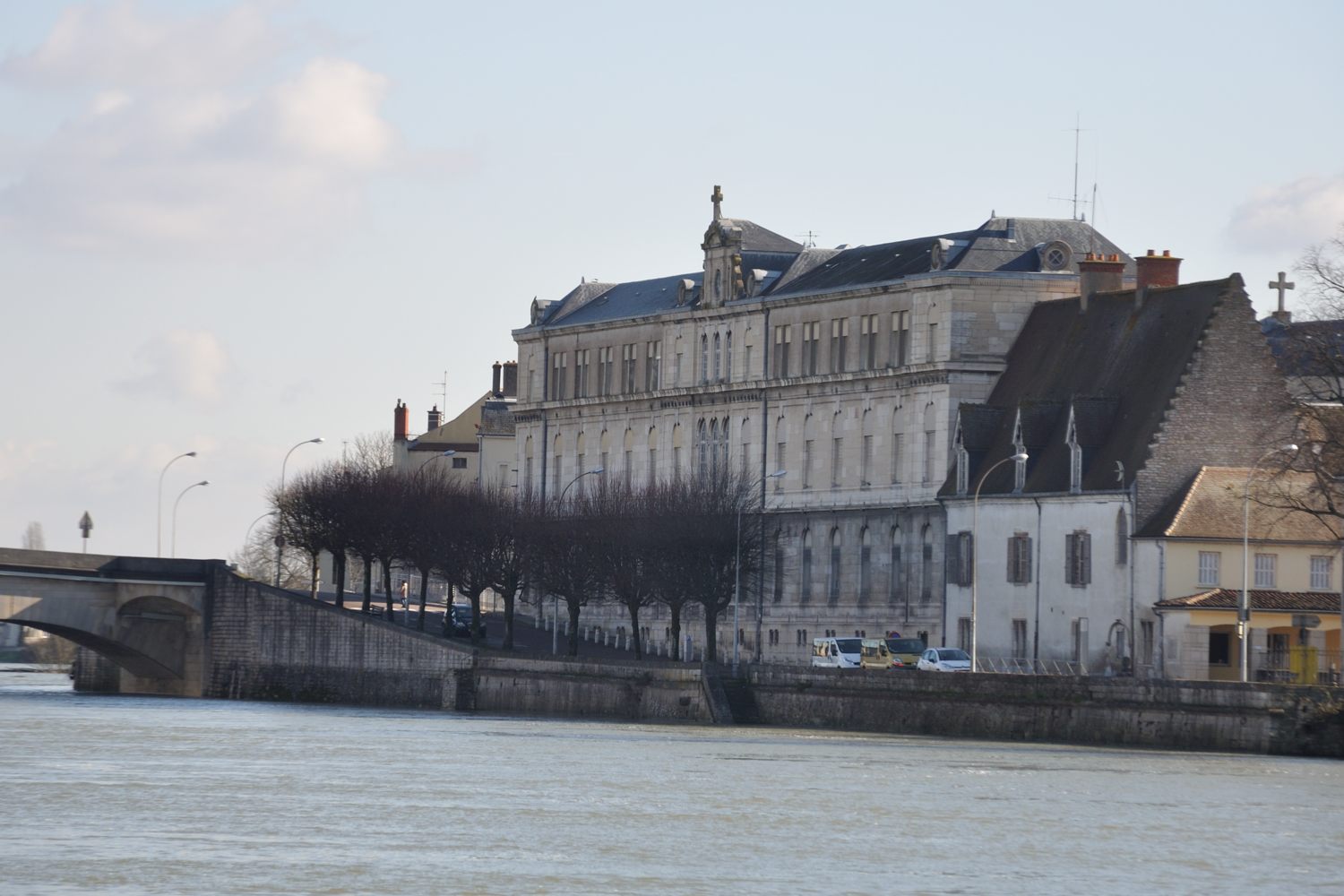
In 2008 and 2009 I had the dubious honour to spend some time in hospital. That hospital was the Centre Hospitalier William Morey in Chalon-sur-Saône, in those days located in an old building on a small island in the Saône.

The old hospital
The care I received was excellent, but the building was old and rickety and the Intensive Care Unit, where I stayed twice, had rooms for one or two patients. Once one was released from Intensive Care one ended up in the normal wards for, if I remember correctly, 6 to 8 patients per ward.

The new hospital
When I recently had to go to hospital again for two nights, the old hospital had ceased to exist and I ended up in the brand new hospital of Chalon at the edge of town near the station. Fortunately there was no need to go to the Intensive Care again, and I was pleasantly surprised to find out that I ended up in a single room (with - at a price! – a radio, TV and internet connection). The nurse told me that the new hospital only had single and double rooms.

Single room (picture from a brochure of the hospital)
That was of course very nice for the patients, but the nursing staff was not so happy about it, for the simple reason that there were not only more, but also bigger rooms which increased the amount of walking they had to do day in day out. However, the care was excellent again, and, though I would have preferred to stay at home, one can think of a worse place to spend a few nights.

View from the old hospital
The only thing I missed in this new building was the view. In the old hospital I had a stunning view over the Saône on the two towers of the Cathedral Saint-Vincent. The new hospital offered me a view on an inner courtyard of the building; not exactly very inspiring. However, to be honest: no matter what the view is, what the quality of the care is and how comfortable the rooms are, it is always better to avoid hospital if one can!

However, I prefer this view!