Saturday, 11 September 2010

Know your classics!

Sue, my better half, cannot suppress a grin whenever I know the answer to one of the questions of the TV quiz Questions pour un Champion, based on what I remember from reading comic strips. A fact is, that, contrary to the UK, comic strips in the Netherlands, and even more so in France and Belgium, are looked at as lecture for grown-ups, and not so much as children’s books. When I was a child, my mother was not very happy when my sister and I were continuously trying to persuade her to buy a copy of Donald Duck, a brand new weekly in those days. She was convinced that reading comic strips would damage our brain. Having said that, traditional Dutch comic strips did not have balloons like American (and French and Belgian) comic strips. Dutch comics had two or three illustrations per episode, with a big field of prose underneath the pictures describing the events. Not dissimilar to Rupert Bear in England, one could say. With the popularisation of Asterix (French) and Tintin (Belgian) the comic strip with text balloons became quite common. But that even real children’s comic strips can have some educational value, may be deduced from the following. When my son was about 10 or 12, he sometimes made remarks of which I thought: ”Where the heck did he pick that up?”. The answer was most of the time “Oh, I read that in one of my comic strips”. In this case he was referring to a very popular Belgian comic strip “Suske and Wiske” by Willy van der Steen.
In the quiz mentioned above one of the questions was “Which painting of a shipwreck caused quite a bit of unrest under the visitors of the Salon of 1819?”. I immediately shouted the answer : “The raft of the Medusa”. That I was right, was confirmed by the quiz master: “Le radeau de la Méduse (The raft of the Medusa, 1818) is the name of a famous painting by Théodore Géricault, nowadays displayed at the Louvre in Paris”. When I had heard the questions, a newspaper article from 1967 sprang to mind, in which was explained that one of the scenes in “Asterix and the first legion” was based on the painting by Géricault. Also questions about famous comic strips, like Asterix and Tintin very often are part of the quiz. And not only the great classics are part of the questionnaire; also modern comics such as XIII and Largo Winch by Vance and van Hamme are regularly coming back as part of the questions. But what I like most is, that I can blurt out the answer at the time a cryptic remark, only meant for the TV audience, appears on the screen even before the question has been read out. One of those hints was something like “A classic nose”, at which point I shouted out immediately “Cleopatra”. Not that I know anything about this Egyptian queen, but in “Asterix and Cleopatra”, throughout the whole book, Asterix, Obelix and Panoramix are continuously referring to Cleopatra’s nose with remarks like : “Oh, what a beautiful nose!; Have you ever seen a nose like this?”. And my answer turned out to be correct! Which proves, that it pays off to know one’s classics….

The website of La Tuilerie de Chazelle

Saturday, 28 August 2010

The Quest for a book

Although Internet shopping is getting more and more popular, I still prefer to walk into a book shop, browse around a bit and buy something if I find what I want. In my view, book shops are superior over Amazon and the like. And of course book shops can only survive if they have regular clients like us. Cluny has a book shop which has served us well in the past, and since I needed 3 sequels in a series of books, I orderded them in Cluny. The books would arrive on Friday; if there were any problems, I would be phoned. I told them I would pick the books up on Saturday. That Saturday, under a beautiful blue sky, I got onto my bicycle, cycled the 8 miles to Cluny only to hear that the delivery was delayed. Not very happy I cycled back, to find a message on the answering machine that the books had arrived in the mean time. After lunch I got on my bike again, returned to Cluny, and heard in the bookshop, that volume 2 was not available. Would I mind to take volumes 1, 3 and 6 (!) in stead? Yes, I did mind, and returned with volumes 1 and 3. I had also made up my mind never to order anything from that shop again. The next stop was Amazon.fr. The book seemed to be available, although not through Amazon themselves, but through a third party. Not long after I had placed my order, emails started coming in from Amazon as well as from the third party. The book was in reprint, hence not available; no money would be taken out of my account, and that was the end of my order. The following option was Fnac, a French competitor of Amazon.fr. And they had a number of copies in store! After a session of literally hours (the Fnac site is top heavy, and works at snail speed through our narrow broadband connection), creating an account, ordering the book and paying via credit card, I found out that something under way had gone dramatically wrong. I had not created an account, not ordered the book, and (luckily) not paid. A few weeks later we had to go to Mâcon for something different, when we passed by a good bookshop called Univers du livre. Out of habit we walked in, and out of curiosity we looked for part 2 on the shelves. And lo and behold, part 2 was available, and on special offer, so our quest for this book ended happily after all!

The website of La Tuilerie de Chazelle

Saturday, 14 August 2010

Let nature take its course

On 7 August 2009 we finally managed to get hold of a very small cat, so small it hardly deserved that name, which up to that day had earned a living by scrounging at dinner tables in a village not so far from here.
We were looking for an outdoor cat to keep the mouse and mole population at bay, our friends in Vaux had more than enough wild cats roaming around their house, and that same evening we became the proud owners of a very young cat.
How old she was we did not know, but we guessed she must have been roughly 8 weeks old then. Even though Fifi has grown a lot since, she is still a very small cat given her age.
Recently she started to put on a lot of weight, which more or less coincided with the sighting of an orange-red cat on the premises. This cat seemed very at ease in the courtyard, not being bothered by Fifi, which made us think that this well could have been one of the 3 cats which were born here early May 2008.


Our first thought was that Fifi had been scoffing too many mice, but slowly we started to put Fifi (one) and the red cat (one) together, and the fact that Fifi had not been “done” yet made us think that she could well be pregnant. One evening something unusual happened. Fifi was not to be found in her usual hang outs, like in her own cave, or in the roof of the toilet block for the camp site, but she had draped herself on the doormat in front of our front door, and she certainly did not feel at ease. She even did not make one attempt to slip inside as soon as we opened the door to see how she was. At the end of the evening we decided to sit with her for a while, and finally managed to get her down to her own dwelling, and in her bed lined with her favourite blanket. Around midnight she was the proud but tired mother of two, and the next morning we found out that she had had a litter of four. In the mean time we are looking for a vet, because, however nice these young cats may turn out to be, five cats on the premises could well be more than enough!

For our own website click here.

Saturday, 31 July 2010

D-day

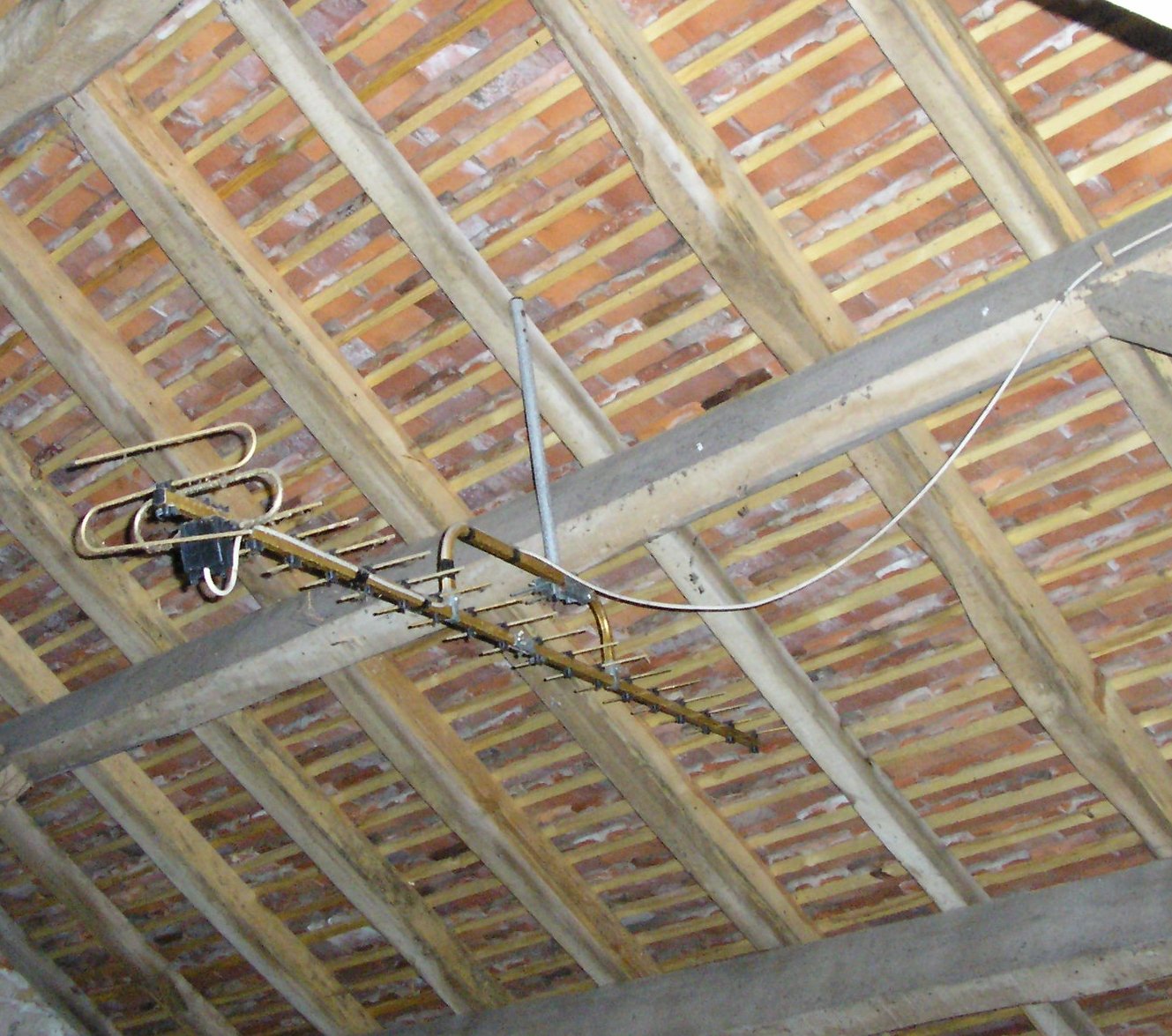
More and more often the local newspaper goes on about D-day, the day that France will go digital. On D-day “someone” will turn a switch somewhere, and from that day on the broadcasting of analogue TV signals will stop and will be replaced by the broadcasting of digital TV signals only. If your TV is older than a couple of years, tough. Most expats here have a satellite dish, so they will not have a problem. However, we, old-fashioned as we are, have an aerial in the attic as old as Methusalem, and an analogue TV. In order not to be deprived of France 1, 2 and 3 in the future, we went to “Boulanger”, asked for information, and went home with a decoding box of € 30 under our arm. At home we installed the box, and yes, as we had feared, no more signal.
Through the grape vine we had heard, that there was a shop in Cluny specialised in digitalisation. The same grape vine had told us, that there were various possibilities : a) our aerial was too old, b) that it was pointed at the wrong transmitter, and c) that there was too much interference of hills or forests to receive a digital signal. We made an appointment in the shop, discussed the possibilities of old or new aerials or a satellite dish, and went home. The engineer of the shop turned up on the day of the appointment, and it turned out that the guy did not even have to see the aerial. He only switched on the TV to see which channels we received, and from that he could deduce that we were pointed at Mont Saint-Vincent. They presently transmit digital and analogue; however, the digital signal is not (yet) transmitted in our direction. His advice was : wait till around D-day; if the box does not work by that time, obviously there is too much interference or too few people this way to start broadcasting in our direction. In that case Sarkozy will most likely take care, that we will get a subsidy either to have a new higher aerial or a satellite dish. So with a bit of luck, the French state might pay (partially) for our satellite dish!

The website of La Tuilerie de Chazelle

Saturday, 24 July 2010

Practice makes perfect

After the last ceremony on the eight of May, where the Marseillaise played a prominent part, it was time for a new episode on the fourteenth of July. Everybody was gathered around the mairie, waiting for marching orders, when the flag carrier Monsieur N. whispered something in Monsieur P.’s ear. He in turn opened the boot of his car, got the new amplifier out and started prodding and poking at the back of the thing, following the whispered instructions of Monsieur N. After a short while we heard the beginning of the Marseillaise at an acceptable volume. In one word, Monsieur P. was ready for the challenge! Although ten minutes later than usual, we were ready to face the music in front of the monument, at quarter past eleven. The wreath was laid, and it was time for the obligatory speech dictated by Paris. However, this bit was skipped, and Monsieur P. asked for attention. He read out a letter he and some of his friends had written to FNAC. FNAC is a big French chain, which recently had written out a photo competitition. The winning photograph in the catagory “Politically incorrect” had been one of a young guy, trousers down on his ankles, wiping his behind with the French Tricolore. This sort of thing does not go down very well in Sarko’s France, and it certainly did not go down well with Monsier P. He ended his speech with the words “And I am curious to read their answer”, after which we indulged in a shortened version of the Marseillaise.
In the mean time the "Journal Officiel" has published a decree instigated by Michèle Alliot-Marie (Minister of justice), whereby an insult of the French flag is punishable with a fine of max. € 1500. Monsieur P. should be a bit more careful in the future; before you know it, fooling around with the Marseillaise could become a crime as well!

For our own website click here.

Saturday, 17 July 2010

Say cheese, please

What could possibly be wrong with French cheese, to invoke me to write a Blog about Dutch cheese? There is certainly nothing wrong with French cheese, even better, I love it, but what they sell in the supermarkets as Dutch cheese here (Gouda, Edam, Leerdam) resembles putty, or at best plastic. Everybody has sometimes, all of a sudden, a craving for a good strong cheese, in case of the British a nice hard cheddar.
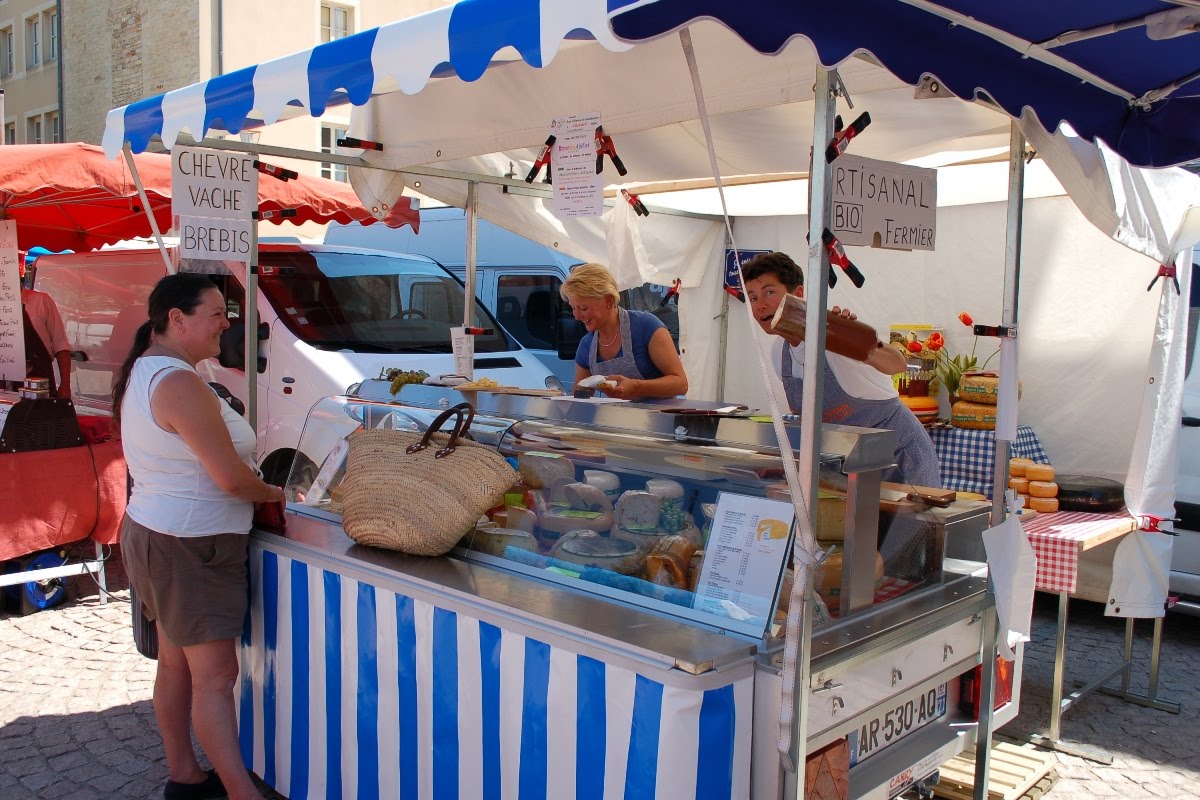
One day we were having lunch in Cluny, in our favourite hang-out, when the lady who ran the show came to us, told us about two Dutch women who had set up shop in Cluny’s Saturday market, and gave us a flyer.
The next Saturday, not 100 % convinced yet, we went looking for these two women. Opposite the ticket office for the abbey, on a little square, we found them.
Suus en Paula van der Linden are living in France for some time now, sell on various markets around here, sell cheese from their place as well, and from the look of it, they are doing quite well. Their cheeses are selling like hot buns, and even the Brits are impressed with the variety of cheeses they are selling. And the sell not only cow’s cheese, no, they also sell sheep’s and goat’s cheeses.
Not just to support Suus and Paula, but also to help our French, Dutch and Anglophone friends, we have picked up a handful of flyers from Suus and Paula, and we are distributing those among them. We have also put flyers in the information folders we use for the gîtes and the campsite. That this sort of publicity works, may be deduced from the piece of cheese we got off them the other day when we went to buy some cheese. And really, believe me or not, that is not why we are doing it!

For our own website click here.

Saturday, 3 July 2010

Back to the future

Since I started this blog I have already written so many articles about the various ceremonies around here, that I have created a separate label for those pieces. Those interested in the continuing story of Monsieur P. and our mayor, and the struggle with modern technology of those two, can click on the label “Ceremony” in the right hand menu.
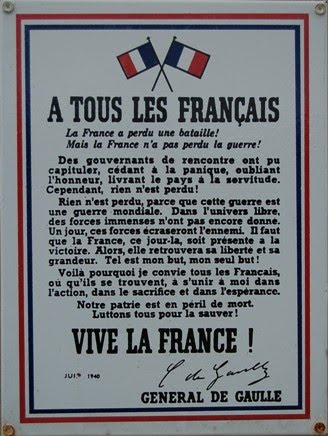
The call to arms of General de Gaulle in which he ordered the French to take up arms against the Germans in stead of collaborating with Pétain and his gang 70 years ago was celebrated big time this year in France. We were rather curious how the ceremony at Bois Dernier would go this year. Would Monsieur P. be able to handle the brand new amplifier, or would he again require the assistance of the flag carrier Monsieur N.?
Around six thirty in the evening an extremely small group had gathered near the Mairie. It was really only a handful of people, which surprised us in view of the 70 years celebration of the event. Even the thriving force behind it, Monsieur P. was not there. Anyway, what had to be done had to be done, Monsieur P. or no Monsieur P. We were spread over fewer cars than normal, and the co-voiturage equippe drove off to Bois Dernier. To our relief we saw that Monsieur P. was already there, his car parked near the monument. After the wreath laying was done and after the mayor had read the speech from “Paris”, Monsieur P. asked one of the youngest pompiers, a girl in her early teens, to read out De Gaulle’s words. After this had been accomplished, it was time for the musical closure of the ceremony.

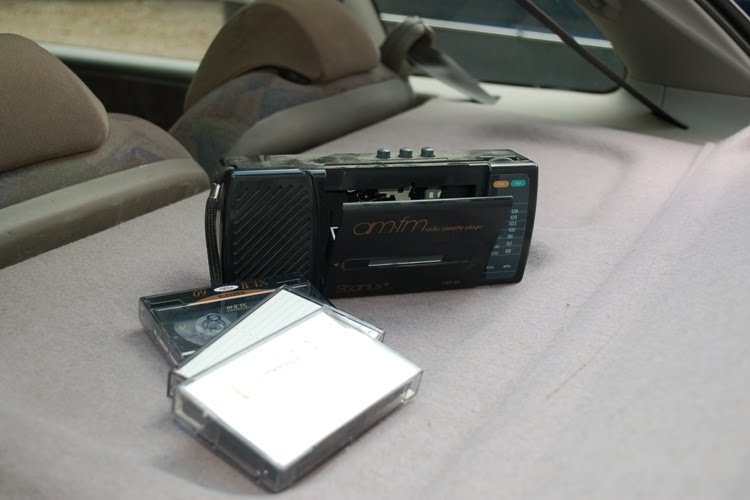
We were completely baffled when Monsieur P. walked to his car, opened the boot, and revealed to us his pre-historic cassette player. As if it had never been away, it churned out a shrieking, howling and crackling rendition of General de Gaulle’s speech (very authentic!), a ditto version of the Chant des Partisans and the best version of the Marseillaise ever played (apart from the one in Casablanca of course).
May we draw the conclusion that Monsieur P. has given up when it comes to modern technology? Time will tell....

For our own website click here.

Saturday, 19 June 2010

Country bumpkins and concert etiquette

It is summer, and hence festivals around here are all in full swing. Cormatin boasts each year two important festivals, the guitar festival (Guitares en Cormatinois - June/July) and the theatre festival (Les Rendez-Vous de Cormatin - July/August). The guitar festival is quite popular, also with tourists. Most likely music is much more accessible for foreigners than plays in French. Almost every year the opening of the guitar festival takes place in the romanesque church of Malay with a concert by the nationally well known French guitar player Emmanuel Rossfelder. This year he did not open with a solo concert; this time he accompanied the mezzo-soprano Yana Boukoff (of Yugoslavian origin) with a program called Viva España.
The program consisted of mainly Spanish music (not illogical, given the title), although the program also showed pieces like Bach’s “Jesus joy of man’s desire”, two pieces by Heitor Villa Lobos (Brasilian) and the well known aria from Bizet’s (French) Carmen “L’amour est une oiseau rebelle” (Habanera). As an encore they played Bach/Gounod’s “Ave Maria”, a German/French cooperation. But who cares, as long as the music is good! The program was nicely balanced between instrumental and accompanied vocal pieces. For me, as the father of a classical guitar player, it was really nice to hear again many pieces my son once had on his repertoire. There were “Andaluza” written by Granados, the famous tremolo piece “Recuerdos de la Alhambra” and the “Jota” by Tárrega, all played with gusto and technically perfect. And also the “Canciones antiguas” by Garcia Lorca were not unknown to me.
What I find very amusing during these sort of concerts in this environment is the (lack of knowledge of) concert etiquette. I have learned it, as many people, the hard way, e.g. by applauding at the wrong instant. And that certainly took me a number of concerts. I must say, that it all sounds easy for the average visitor of concerts, but what about those who rarely see the inside of a concert hall? Applauding during the performance? Very normal during jazz concerts; almost impolite not to clap after a solo. Applauding during an opera, after a beautifully performed aria? Perfectly ok, even shouting Bravo is allowed. Clapping after a good solo dance in a ballet? Nothing wrong with that either. But during a classical recital, after each part of “Seven popular songs” by de Falla? Ai, ai, ai, almost a deadly sin. It is also not uncommon, not to applaud in between pieces when the pieces are written by the same composer. But there are also exceptions to this rule....
I have to confess, that sometimes I lost count, causing me to applaud with the majority of the audience as well. Having said this, for those who lost count or do not remember whether a piece consists of three or four parts, it should be clear from the body language of the artists whether a piece is finished or not. Rossfelder for example raises his guitar demonstratively when he finishes his piece. But again, in this audience of farmers, ex-farmers or villagers the lack of etiquette seems to be no problem for the performers. Rossfelder as well as Boukoff were very grateful for every “illegal” applause. Most likely they thought to be better of with a public that did not exactly know how to “behave”, but was at least appreciating the music they played to the full extent!

For our own website click here.

Wednesday, 16 June 2010

A blogging community

What is more flattering for a blogger than to discover that people are actually reading his articles, and even enjoy them?
Not much, really.
I have had some unexpected positive reactions from an American couple living part time in a nearby village, but who else but family and friends is reading those little stories one churns out every so often?
Well, more than one thinks; living proof can be found on the following links.

Keith Eckstein reviews blogs about France on a regular basis, and I was happy, not to say a bit proud that he chose my blog recently to be reviewed, and published a nice rundown of it. Read for yourself what he has to say about it!


Before my blog was chosen, my better half’s blog has been reviewed by Keith as well.

Chris and Linda are (in my eyes) real bloggers.
At least Linda Hubbard blogs every day, which makes her stories in general short and very readable.

Chris Gulker writes less frequent, and consequently his articles are slightly longer, however not less readable.

My own blogs are normally published once every fortnight, unless I have got extra material to be published on my Saturday off. Since I have just made a new exception to my own rules, I can finally make an attempt to be a bit less long winded!

For our own website click here.

Saturday, 12 June 2010

Repeated offenders

My better half has already published a Blog dedicated to guests who not only are regularly coming back to La Tuilerie, but who also (on a voluntary basis!) help out in making the vegetable plot ready for the summer and by splitting big logs which are to big to fit in the wood burner.
Fortunately they are not the only ones who seem to like it so much here. We have a number of guests, campers as well as gîte lodgers, whom we can welcome on a regular basis over a number of years. And what is better than discussing the state of affairs in Cormatin as well as in their home country over a nice glass of whine in a sunny patch in our garden?
People come here for a number of reasons. Part of our clientèle are very much attracted by the vicinity of Taizé, where they can follow the services whenever they wish, but where they are not submerged in the hubbub of 6000 youngsters; others come here with bicycles, skeelers or good walking shoes in order to do reconnaissance of the many possibilities the Voie Verte has to offer; some people come to indulge in the over abundance of romanesque (norman) architecture; and of course there are those who like to chill out for a week after having been in the rat race for a year.
Recently we had a couple here for the third year, who came here the first time after in depth investigations. Their son in law, an acquaintance of ours, popped in one day in 2008 on his way to a different holiday destination in the South of France, seemingly for a cup of coffee. however, he was told by his in laws to take pictures, inspect the place thoroughly and find an answer to the question of questions “Is everything clean there?”.
Obvioulsly his reconnaissance satisfied his in laws, because that same autumn Hermann and Carla became our guests. We got on very well, and when they left they booked straight away for 2009. That year they ordered a meal, a service we render, if convenient for both parties, on their arrival day. Our guests share our table, and we as well as they find it a pleasant way to getting to know each other a bit better. Sue always tries to come up with something local, and her boeuf Bourgignon can compete with the same dish pepared at La Terrasse in Cormatin (which we find the best within a radius of 50 miles). And although Hermann and Carla could not give us a definite date for 2010, it was quite obvious that they would come back again.
And lo and behold, by the end of 2009 they made another reservation for two weeks, under the “condition” that we would feed them again a boeuf Bourgignon. But that was not all. A couple of days before they arrived, another e-mail came in with the question whether we would appreciate it if Carla brought an Indonesian meal over for the second evening.
There are few things in this part of the world that I miss every so often, and one of them is a genuine Indonsian meal, in the Netherlands, and certainly around the Hague, readily available everywhere. So the second night the tables were turned, as a matter of speech, and we sat at their table and enjoyed a wonderful meal with nassi putih (white rice), sajur lodeh (vegetables in coconut milk), babi ketjap (pork in sweet soy sauce), rendang (spicy beef) and ajam semoor (well simmered chicken).
And that is, irrespective of the quality of French cooking, one of the few things I miss every so often; a simple, good Indonesian meal.

For our own website click here.

Saturday, 5 June 2010

Questions pour un champion

How to improve your French listening skills, if you hardly ever have contact with Frenchmen? One way is listening to radio or TV. However, whilst living in the Netherlands I was never a keen TV watcher, and the French channels we can get, France 1, 2 and 3, are not much better than the Dutch ones. The only watchable programs were the weather forecast and the news.
Clear pronunciation and diction, known subjects, at least that did not have disaster written all over it. Some time later we discovered game programs and quizzes. After watching some rather stupid programs for a couple of weeks, we stumbled upon Questions pour un Champion. The program has just celebrated its 20th birthday, has all these 20 years been presented by the same charismatic presenter, Julien Lepers, and is immensely popular. I will not bore the reader with a description of the rules of the game, but the candidates, each having a tremendous general knowledge, must answer question on many subjects, such as art, science, gastronomy, geography, history, etc. The presenter asks the questions in a tempo that makes a machinegun sound like an old lady, because there is also a time limit in answering. We normally switch on the subtitles for the deaf, because without that it really goes far too fast most of the time. Not only is it good for our French, but we started to like the program as well. Nowadays we both are sitting in front of the TV, shouting out the answer on the rare occasion that the candidate has not got the answer before us. By now we are so addicted, that we switch on the answering machine between 17h50 and 18h30, because we do not want to be disturbed during that time!

The website of La Tuilerie de Chazelle

Saturday, 29 May 2010

A tragedy

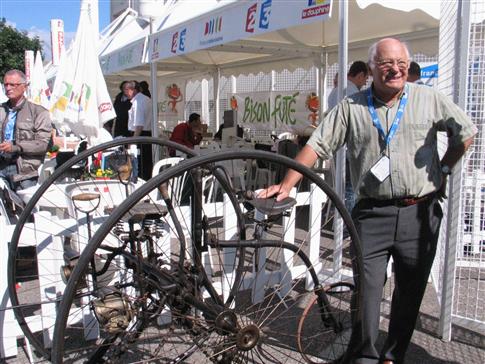
When we came here, in 2005, there was a huge building bordering the Voie Verte, on which was written in mega letter size “MUSEE DU VELO”. It would be quite difficult to come up with a better location for a museum dedicated to the bicycle. The owner, a man from Tournus, rented the building and had on display a collection of over 200 old and new(er) bicycles, bicycle tax shields from the Netherlands and Belgium, posters for the Tour de France, trophies, jerseys in various colours, in short anything remotely connected to bicycles and bicycle racing. We have been there a number of times, and not just for the collection (after the 3rd visit one knows what there is on display). It was also a place where one could, after a long cycle ride on a hot day, sit down and have a drink or an ice cream. Unfortunately, in 2007 the museum closed down. According to those in the know it closed because of the declining number of visitors, and because the commune of Cormatin did not provide sufficient support (read subsidies). The next year the building reopened, this time carrying the name of Musée du Poilu. Poilu (=hairy) was the name for the French soldiers fighting during the Great War. The museum displays artefacts and utensils made by the soldiers in the trenches in between charges. As materials they used everything that was abundant in the trenches: shrapnel, cartouches, even aluminium from the ignition mechanism of grenades, brass, cartridge cases, shells. The collection is interesting enough, but, although the Great War has asked its toll in this part of France just as in any other part, the real fighting took place much further North from here, this location seems to me (literally) a bit out of place. Having said that, the museum is still open, and features in the summertime theatre plays about the home front during the Great War. There certainly seems to be a market for this museum.
In our local variety of the Cormatin Times we saw recently articles emerging about a resurfacing of the Musée du Vélo (in the words of their PR manager “Unique en France”), not in Cormatin however, but in Tournus. And indeed, the museum will reopen on June 19, and the Commune of Tournus has offered the space for this museum, for a trial period of 3 months. The tragedy of it all is, that the owner of the collection, Michel Grézaud, did not live to see the day. He died beginning of this month, just before his dream would have come true again.....

For our own website click here.

Saturday, 22 May 2010

Living history

The nerve centre of all information in a small village like Cormatin is undoubtedly the local Tabac. Everybody visits this shop either daily or weekly, to buy the local paper, cigarettes, a magazine or a greeting card. During one of my visits I noticed an announcement, saying that the following evening a lecture would be held with as subject Cormatin and the resistance during WW II and the influence of general de Gaulle in Burgundy.
The connection between those two subjects was not immediately clear, but that would undoubtedly be revealed during the lecture. And although we were expecting guests for our gîte that day, we had decided that on early arrival of those guests (which they did) we could attend the evening. So on the night concerned we drove up to Salle Beun, the village house, where everyone in our village who could read was gathered.
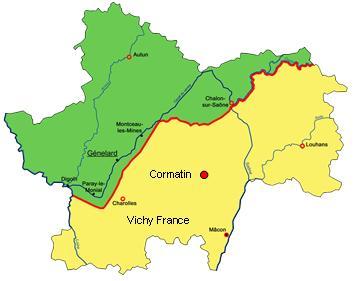
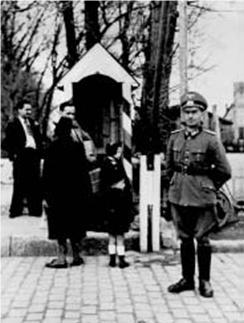
The object of this particular Blog is not to give a run down on the lecture itself. But one has to admit, that Gilles Plattret, historian, writer, journalist, politician and lecturer (he appears to be quite popular as “conférancier” - meaning stand-up comedian in Dutch! - in Saône-et-Loire) delivered an excellent story about how the war started, what the influence was of the line of demarcation (which ran not far from Cormatin) between “free” Vichy France and its occupied northern counterpart, when and how the resistance movement started and what the influence was of de Gaulle in ’40-’45 in communities like Cormatin. The lecture was illustrated with a projection of images of this period. No need to say, that those who were born and brought up in Cormatin regularly threw in remarks and comments about the contents of those pictures.
What I found most interesting during the presentation was the personalized way Plattret interacted with his audience. Of course our Monsieur P. was prominently there. Plattret told several anecdotes, in which Monsieur P.’s father (deported and victim of the camps), and Monsieur P. himself (deported and survivor of Buchenwald) played an important role. But not only Monsieur P.’s name was mentioned. Several (even for us) well known names were mentioned, of whom in many cases the descendants were amongst the audience.
This evening proved to me that a presentation about history, no matter how well documented and presented, certainly gains accessibility for a bigger public when the presenter somehow has personal ties with the subject and with the audience itself.
I was well impressed. and I will keep an eye out for the name of Gilles Plattret as of now.

For our own website click here.

Saturday, 15 May 2010

Village gossip

It may be clear from this Blog that village life in Cormatin is not dissimilar to the stereotypical life in the fictitious village of Clochemerle.
A previous posting got an unexpected follow-up.

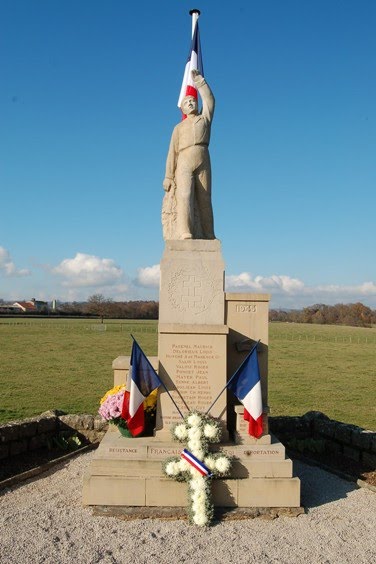
Understanding of modern technology by older citizens and progress of this technology do not always go hand in hand. The new amplifier cum CD-player, recently obtained by the commune (and not, as I wrongly stated earlier, by our war veteran and deportee Monsieur P.) was supposed to make the most recent ceremony (the wreath laying at the Monument for those who gave their lives for France during the wars) last Liberation Day a feast for the ears. After the various speeches the Marseillaise was supposed to be played through the amplifier at an acceptable, but clearly audible volume. However, Monsieur P. had forgotten how the thing worked. After what seems to be an eternity, during which Monsieur P. pressed buttons, turned knobs, at the end assisted by the flag bearer, who had to lower the flag for this purpose, all of a sudden the Marseillaise blurted out over Cormatin at House Party volume. It was loud enough to wake the fallen from their graves. But the official part was not over yet. Once every heart had recovered from the sudden shock, the whole group moved off to the monument for the deportees, just outside the village. Those who thought that Monsieur P. had left the amplifier running, just to be sure, were wrong. This time he could not get the thing working at all. The crowd started to get a bit restless, but Monsieur P. had a solution: if the blooming thing would not work, we could beat it, by SINGING the Marseillaise! There are French politicians, who are adamant that foreigners and French should be able to sing and know the words of the Marseillaise. If these politicians had had their way, the performance would have been great. However, obviously they had not had their way, and the majority of those present hummed away, or (amongst others the mayor) kept their mouth shut.
Anyway, after this rather embarrassing intermezzo the mayor announced the venue of the vin d’honneur, and he also explained that a number of ex-combatants and/or resistance fighters would be presented with “Un diplôme d’honneur pour les vétérans de la Seconde Guerre Mondiale”. This had to be handled before the wine started to flow, and one of the “lucky” ones was Monsieur P. After this last eruption of the ceremonial part of the day, Monsieur P. said that he would like to say a few words. But instead of thanking Mayor and Government for this generous diploma, he complained about the fact that “Paris”, so many years after the events, could not come up with something better and more apppropriate than a shoddy piece of paper in flyer format. Every other word he used was “ridicule”. And I think, that most people present, including the Mayor, deep down in their heart agreed with what monsieur P. had to say that day.

The website of La Tuilerie de Chazelle

Saturday, 8 May 2010

How to read a traffic sign?

Until recently there was an agricultural path between Chazelle and La Bergerie, the other hamlet that resorts under the jurisdiction of Cormatin. It was, apart from the last 100 m, a macadam road. Since the road has been used as a deviation during roadworks in Chazelle, the status has changed to road “Communale”, and the last bit of sand has made place for asphalt. After the road had been opened to the public (before that it was a “secret” road only known by insiders) a new traffic sign appeared on the side of La Bergerie. At the Chazelle side the old sign (voie agricole) is still there. The new sign consists of a no-entry sign, and underneath it it says : “Except for school busses from 8h15 to 8h30 and from 17h00 to 17h15”. That seemed a bit strange to me: it suggests that the road is closed throughout the day, and only school busses are allowed there twice a day for a period of 15 minutes. In the other direction the road is open all day. It would effectively turn the road into a one way street. Since we had to go to the mairie for something different, we asked the question about the new road sign. No, we had completely misunderstood it, was the answer.
It clearly said - according to the deputy mayor: the road is only closed for all cars driving from La Bergerie to Chazelle during 15 minutes in the morning and in the afternoon, at the time the school bus uses the road from Chazelle to La Bergerie. This would prevent the school bus from having to dive into the roadside when cars are approaching from the other direction. Obviously the guy who wrote the sign wanted to make it extra clear, but doing it this way he actually obscured the issue. He should have said “Only between 8h15 and 8h30 and between 17h00 and 17h15”, without mentioning school busses. Anyway, we are now in the know, and we are happily using this handy short-cut, but only outside the mentioned hours!

The website of La Tuilerie de Chazelle
Saturday, 24 April 2010

Fancy a quick bite?

The people who live in Burgundy enjoy an extensive lunch. In the evening they eat a light meal, often composed of the leftovers of the lunch. In that sense we have not really integrated; we have a proper dinner, and prefer something light for lunch. It would be nice to be able to walk into a fish and chips shop when one is not at home during lunch time; however, these do not exist in this part of the world… Although, by now we have found some alternatives.
The most logical one seems to be a “Sandwicherie”. Although French sandwiches do not resemble British ones; a French sandwich is usually a French loaf with savoury filling. Normally baker shops (Boulangerie and/or Pâtisserie) offer these French sandwiches, but in the tourist season they might sell slices of pizzas and small quiches as well. But be aware, bakers open extremely early in the morning, and usually close around 12h00 for a couple of hours. Along the Voie Verte near Chazelle there was a Sandwicherie, but unfortunately this will not re-open this year.
For those who want something not too heavy and warm for lunch, the kebab shop might be worth considering. Again, kebabs here are quite different from the English equivalent. They sell all sorts of kebabs in different guises. There is an “assiette kebab”, a “sandwich kebab” and a “galette kebab”; the assiette is a plate with meat, French fries, green salad and sauce blanche and/or harissa (spicy). The sandwich is identical but does not come with French fries; everything is propped into half a loaf of Turkish bread. The galette is again the same as the sandwich, but in stead of bread they use a thin wrap. There is a good kebab shop in Cluny, called Bosphorus”, and every bigger place or even village might host one or more kebab shops.
There is also something called “casse-croûte”, which literally means “packed lunch”. It is often displayed on signs (L’Orée-du-Bois, along the Voie Verte), and sometimes it even is the name of the establishment. The menu is simple; there is normally a choice of sandwiches, salads, and French fries with a choice of meat. Our favourite in Cluny is steak-haché frites, a hamburger like piece of (quality) minced meat with French fries. The whole concoction is also available as sandwich steak-haché frites, where everything is propped in between the two halves of a baguette. Still another variation is something called steak-haché au cheval, where the “au cheval” does not stand for the type of meat; the hamburger is topped by a fried egg, which sits on top of the hamburger as if riding a horse (hence “au cheval”). It is safe to eat, even for Brits!
Of course there also pizzerias and normal restaurants. It is often worth to look out for the plat du jour. Usually restaurants offer a menu du jour (starter, main course and dessert - price range approx. € 13) and a plat du jour (price range under € 10), which is the main course only. Our Monique, the owner of La Terrasse in Cormatin often has Boeuf Bourgignon as plat du jour. In my opinion, and I tried a few in the region, she makes the best within a radius of 30 miles. Another of our favourites at La Terrasse is the salade Bressane, a green salad with maïs and chicken livers. However, most salads there are good quality and big enough for a normal meal.
But the real die-hards, craving for fast food, will have a hard time in this part of France. The nearest McDonald’s is either in Mâcon or in Chalon, hence approx. 35 km from here. Saône-et-Loire, our Département, boasts 6 McDonald’s outlets. Do you think that this is much? Saône-et-Loire covers an area of 8500 square kilometers and a population of 550000. Amsterdam, the capital of the Netherlands has a (land) area of 220 square kilometres and 750000 inhabitants. For those who love statistics:
Saône-et-Loire has 1 McDomald’s outlet per 90000 inhabitants; Amsterdam has 1 per 47000, hence a density twice as high.
Saône-et-Loire has 1 outlet per 1400 square kilometers, Amsterdam 1 per 14 square kilometer, hence a density 100 x as high.
As far as I am concerned, I will stick to the local food; I was never keen on beef burgers anyway!

The website of La Tuilerie de Chazelle

Saturday, 10 April 2010

Easter market in Louhans

For those who are following this Blog via Facebook or email: the accompanying slide show is only visible on the Blog itself.

We advise guests, who show a keen interest in markets, to visit the Monday market in Louhans. Not only is Louhans a nice little town, with a lively newspaper printing museum, but on Monday is boasts one of the best markets in the area. It is not really next door (35 miles), but the road leading there is pleasant and not very busy. The whole town has been turned into one huge market stall, where one can buy vegetables, fruit, meat, clothing, gadgets, household goods (even Tupperware!), etc. You will also find the occasional guy shouting out all the marvels his “magic cutter” performs on melons, tomatoes and the like.
The real attraction however is the “animal market”. At the edge of the town, just outside the centre, the market stretches out for another mile or so. Here they sell rabbits, goats, ponies, dogs, cats, ducks, chickens, etc. in all shapes and sizes. The buyers go home with there newly acquired friends locked up in cardboard boxes with air holes, to make sure their pets survive the journey.


One of the best days to visit this market is on Easter Monday. The town is seething with people (comparable to New Years Eve on Trafalgar Square), one has to park his car 1 mile before the centre of town. It would take half an hours drive, if not more, to reach a designated parking area at the edge of town from there. This Easter Monday was a beautiful spring day, hence most plants and trees were green and in full bloom. It seemed, like half the population of Saône-et-Loire had come to Louhans. The one thing which is impossible on a day like that, is to haven lunch somewhere in town. All restaurants were not only full, but also fully booked. The few stalls selling sandwiches had long queues of people waiting for their bite. Finally, we managed to buy a piece of pizza and a quiche at a baker near where we parked. Simple as it was, it tasted like manna from heaven!

The website of La Tuilerie de Chazelle
Saturday, 27 March 2010

Jonquilles

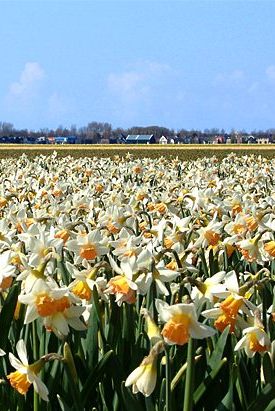
A couple of years ago - we had just moved to France - we were regularly driving around to discover the area where we lived. On one of those outings we noticed quite a few brand-new direction signs; some said Bonnay, some said “jonquilles”, others were in the shape of a daffodil or had a daffodil painted on it.
In this area it is not uncommon that villages like Bonnay set out organised walks or cycle trips, whereby these randonnées often carry poetic names like “jonquilles” (daffodils) or “jouvence” (source, fountain). We decided to follow the signs, but at some stage the signs disappeared, and we did not get any wiser. Some years later - by then we had made some friends in that area - we found out that those signs were put up in spring, pointing towards areas in the woods where wild daffodils flowered. This spring (spring had literally just broken out, and that is how winter ends here) we went over to see our friends, and noticed the “jonquilles” signs. Our friends told us, what a good place was to look for these daffodils, and last Saturday we took the camera, got into the car and drove off to the woods around Bonnay in search of the French equivalent of the Dutch bulb-fields. When we arrived there, there was hardly a car to be seen on the grass field near the forest. We were obviously too early; one could see the daffodils, and plenty of them, but there were no flowers yet. Anyway, we had a pleasant walk, and decided to come back in a couple of days. Last Wednesday, it was beautiful weather, we went out to the wood again.
This time the field that served as a parking area was swarming with cars and people. We had come at the right time, at least that is what we thought, because people emerged from the forest with arms full of daffodils (and that is no exaggeration!). As is common around here, the “foyer rural” of a nearby village had set up a drinks stall, where one could buy a refreshment at very reasonable prices.
Once we entered the wood we realised how much damage can be caused by a horde of “nature lovers” in a relatively short period of time. Where once daffodils had flowered, it looked like a pitch where a number of gladiators had staged a fight. The only flowers that had escaped the pillage, were hidden under the thorny branches of a bramble bush. The few photographs I managed to take are of the daffodils that could not be picked without cutting open your hands. Anyway, it looks like if I ever would like to see a field of daffodils in full glory, I will have to go back to the Netherlands, to admire them in or around Keukenhof....

The website of La Tuilerie de Chazelle
Saturday, 13 March 2010

Tour de France 2010

Cycle-racing in France is, like in Belgium and the Netherlands, a big thing. As soon as there is talk of a cycling event, no matter how big or small, they are omni-present; men, and sometimes women, dressed in brightly-coloured lycra, bent over their handle bars, whereby the first guy often shouts out loud and inarticulate words, or raise a hand or an arm to warn the crowd behind him for a pothole in the road, a walker, a parked car, or an aged person crossing the road.
And events there are plenty in France. In June, when the Tour de France fever hits France once again, many cyclists throughout the country start their own modest Tour de Village, Tour de Département, Tour de Région or even Tour d’Environnement. And each of these lycra-clad people has his own hero to project himself onto: Alberto Contador, Lance Armstrong, Jan Ullrich, Indurain, LeMond, or for the older ones Hinault, Mercx, Anquetil, Bahamontes...
Also Cormatin is not spared this ordeal. Last year, 2009, the Route de Saône-et-Loire (a race of four stages) passed through Cormatin. Hours before hand the roads were closed, in order to ensure free passage for the breakaway or for the peloton thus reducing the chance of nasty accidents. But this race is nothing compared to the real French classic, the Tour de France.
In 2006 the Tour did not (yet) pass through Cormatin, however the finish of the eighteenth stage was in Mâcon. Reason for some of our fanatic cycling fans to get on their bikes and cycle to Mâcon to experience the spectacle. They have been regular returnees to our campsite ever since! The next day the Tour continued starting in Le Creusot and finishing this time trial in Montceau-les-Mines. No doubt the cyclists were brought to Le Creusot by bus or train.
In 2007 the sixth stage (between Semur-en-Auxois and Bourg-en-Bresse, approx. 200 km) passed throug our village, Cormatin. From well before lunch until approx. 17h00 quite a number of roads were closed, amongst them the main road D981 from Cluny direction Givry vv., thus making space for the passing of the caravan followed by the cyclists. The circus certainly was in full swing; an endless row of hooting cars “decorated” with adverts, driving through the village at neck breaking speed, in the meantime throwing promotion material into the crowd; hundreds of spectators of whom several threw themselves almost in front of the cars in order to obtain that wonderful cardboard sunshade....
And then finally the climax, a coloured band travelling so fast that the faces of the racers were no more than a vague blur. That particular year we had quite a few campers on the site who had chosen to stay with us especially for this occasion. A couple of them were very keen to see an intermediate sprint at Brancion. Unfortunately they never made it, partially because of road closures and partially because they did not have a detailed enough map to avoid the main roads....
In 2010 anothe stage starts nearby Cormatin. The seventh stage starts on Saturday 10 July 2010 from Tournus (25 km) for a stage of 161 km to Station les Rousses. We are really curious which of our cycling die-hards will be staying with us again!

The website of La Tuilerie de Chazelle
Monday, 1 March 2010

The tempest

The short slideshow accompanying this Blog shows some pictures of the flood in the Netherlands in February 1953 and France in February 2010.


Whenever there is a gale blowing around the house I start feeling restless and uneasy. It brings back memories of the big flood of February 1953 in the South-Western part of the Netherlands, which inundated a big part of the country. I was a child then; I was not allowed to go to bed that night, which I, as a child, thought was extremely exciting.
My mother had prepared a little bag with “valuables”, which stood in the corridor, ready to be taken with us in case we had to be evacuated. I lived in Delft at the time, which lies approx. 1 meter below sea level. My father was glued to the radio (of course we did not have TV in those days) waiting for the message that one of the crucial dikes near Rotterdam had caved in, in which case Delft and surroundings were under serious threat of being inundated.
The days after the tempest were also very strange; my school was a collection point for clothing and blankets for those who lost their home due to the flood. Also slowly film coverage became available in the news reels of the cinemas; as said before, TV was hardly known then. When the French coastal region was under “vigilance rouge” (the highest alarm level) Burgundy was under vigilance orange. Contrary to February last year, when we were severely hit by a tempest, this time Xynthia skirted Burgundy. However, in the evening news of February 28 I recognised the same images; houses just poking out of the water, people being carried out of their houses, helicopters rescuing peoples from roofs....
The death toll in the Netherlands in 1953 mounted 1800; the flood in France made approx. 50 deadly victims. And no matter how different the scale of both events was, the desperation transmitted by the TV images was he same in 1953 as in 2010.

The website of La Tuilerie de Chazelle

Saturday, 27 February 2010

The Crescent Jazzclub

After having found Jazz à Trivy, I wondered whether there actually might be an ordinary jazz club somewhere in the vicinity. In the summertime Cluny hosts occasional jazz concerts in the local theatres, and Couches has a rather prestigious jazz festival in the summer, but I was more looking for something like the Ronny Scott Club, only at a smaller scale. In Mâcon (not really next door, approx. 35 km from here) I had found a jazz club called the Crescent Jazzclub. It is smack in the middle of town, and hosts regular concerts and jam sessions. It looked like the prototype of the old fashioned jazz clubs from the sixties; smoky and with a very low ceiling. Although smoking is no longer allowed in French public places, the rest of the description fits the place well. It is located in an old, very small (wine)cellar, which is so low, that a bass player cannot stand his instrument upright. The photo actually shows the amount of people that fit in; one is hard pushed to squeeze more in. One night we went there, wisely combining the concert with having a meal out; we paid entrance fee and membership fee (€ 3.50 for a year) and went inside. The music was rather boring, and that is an understatement. We left the club during the break. A couple of weeks later we gave it a second try, because a “young, promising” guitarist was playing in the Crescent. After these two disappointing experiences we left the Crescent for what it was, although I keep an eye on their program. One never knows, maybe one day a good group might be playing there. The only thing which impressed me, was how the musicians handled the volume they were playing at. Firstly they played acoustically, or, in case of the guitar player, used the amplifier with moderation, and secondly, in case of e.g. the drummers, they managed to play in such a way that one was not blown away by the noise. That is certainly one of the minus points of most Dutch jazz venues; they play at a volume sufficient to bring down a stadium like Wembley, and than they wonder why so many of their fans have problems with their ears!

The website of La Tuilerie de Chazelle

Saturday, 20 February 2010

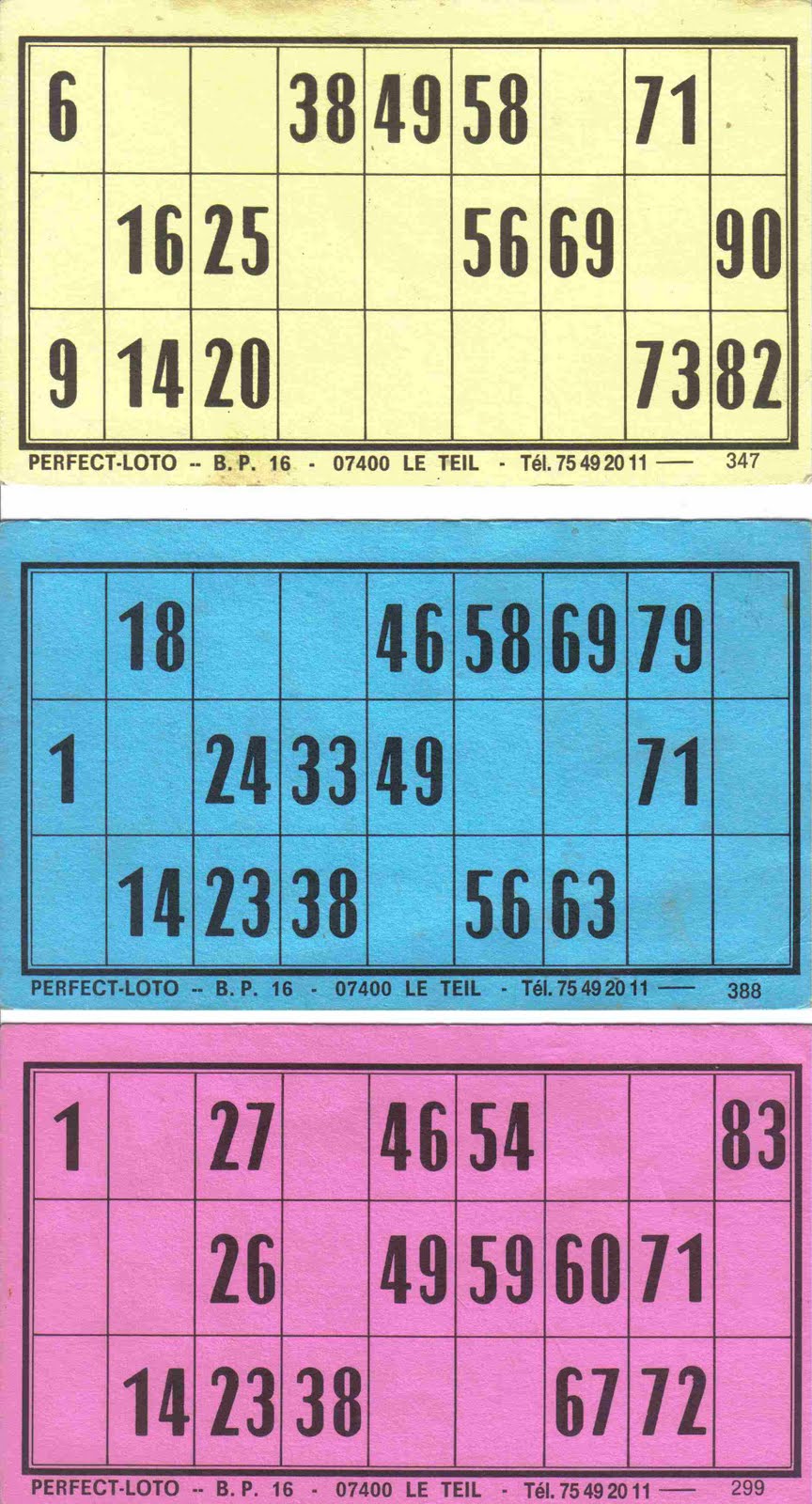
Loto, Quine, Kien and Bingo

Actually I am not interested in Bingo or Loto, as it is called in France, at all. When living in the Netherlands, I played Bingo only once (an experience I gladly forgot!) and I hardly remember anything of it.
However one thing has intrigued me for a long time. As a child, my mother sometimes allowed me to play with small wooden circular pieces of wood, with a number written on it. And she referred to those small discs as being part of a Kien (pronounce Keen) game.
When we were explained the rules of Loto more than a year ago, we were told that we had to shout “Quine” (pronounce Keen) when we had a full card. Assuming there is a link between those two words is, in Dutch, a matter of applying non-scientifically founded etymology, or popular etymology. Anyway, Wikipedia could possibly help here.
The origin of the game lies in Italy, where it was played around 1530 as Lotto. The word Bingo is derived from the American version of the game, which was played in the twenties on a form called Beano. The word Beano in itself is derived from the beans which were used to cover the numbers on the card. Hence Beano was corrupted to Bingo.
The Dutch word Kien is derived from the French word Quine, which comes from the Latin word Quini (= 5), and which refers to the 5 numbers on each row of a Loto card. The forms used as well as the rules of the game seem to vary per nationality.
The French (Loto) and the English (Bingo) use forms of 3 rows and 9 columns, whereby the first column is meant for the numbers 1 to 9, the second for 10 to 19, etc. The last row is for 80 to 90. This makes checking the numbers relatively easy. The game can be played per row (the winner is the first one who fills a row) per 2 rows (as before but with 2 rows) or per full card. When one plays by row, the French call out “Quine” (= 5); when one plays for a full card the French shout “Carton plein”.
The Americans, as the Dutch (Bingo), play on a form of 5 x 5 squares, whereby the square in the middle does not contain a number. The 24 numbers (between 1 and 75) are either randomly put on the form, or sorted per column (1-15, 16-30, etc.). Here one can also play per row, per column, per square or per any other form determined beforehand, or of course, per full card.
And all this, because I was curious about the relation between the words Kien and Quine!

The website of La Tuilerie de Chazelle

Saturday, 13 February 2010

French Bureaucracy

Many of our English friends are getting upset over and over again whenever they only think of French bureaucracy. As someone who lived his whole life in the Netherlands, the French bureaucrats seem to be a lot more laid back than their Dutch colleagues. Having said that, sometimes it has advantages when you know beforehand how a civil servant is going to react; one can actually anticipate a bit that way.
The last time we had to go to the Mairie was to obtain the yearly “certificat de vie”, without which Dutch insurance companies do not pay out annuities. This is a very relaxed exercise; you hand in your form, the secretary asks “Comme l’habitude?”, she writes something, seals it with a stamp and a few seconds later you are back on the street, with a form that would even satisfy the Dutch Minister of Foreign Affairs, and without any costs. Just pointing at a doorknob in a Dutch town hall would set you back at least € 10! We were just about to set off for lunch, when one of the local officials, in charge of the “Recensement” (Census) who saw us walking past his window, came after us.
Could we spare some time to fill in some questionnaires? It would save him the 3 km trip from the town hall to our house....
The French do not keep a proper record of who is living where and since when; the only way they keep track of demography is the census. The INSEE (Bureau of Statistics) organises every year a number of censuses, spread over the whole of France. It is not organised by postal code or by Canton, because Cormatin is on the list for 2010, whilst Saint-Gengoux, capital of our Canton with the same postal code is up in 2013.
The guy who called us back was Pierre M., a very amiable man whom we know quite well now because he is always present whenever an event in Cormatin is being prepared. So a few minutes later we answered the questions on his questionnaire, which were questions for the two of us: when did we move to France, were we living together, what sort of heating did we use in the house, etc.
After that we had to fill in a personal questionnaire, about educational and professional backgrounds, etc. Whenever we did not understand a question, and he thought it was irrelevant (or he could not be asked to explain!), he waved his hand as if to say “Ah, why don’t we forget about that one!”. After 15 minutes we were released with the words: “Well, that got you off the hook for another 5 years!”. Anyway, if my English friends read how easy these sort of things are handled in the “campagne”, they should stop moaning about French bureaucracy. And if they still insist, I would advise them to move to the Netherlands for just one month, and then say what they think about the French!

The website of La Tuilerie de Chazelle

Monday, 1 February 2010

Bingo! (part 2 and last)

For part 1 of this thrilling story click here.
The yearly Loto is over again! We had, as good citizens, flogged off all our 20 Loto cards to friends and relatives, and handed over proceeds and cards to the responsible authorities. Last Saturday it was our turn, together with other volunteers, to play an hour of Bingo for those who had been conned into buying those cards. The following day, a Sunday, was the day of the “Cormatin open”. On both days however it happened several times that the prize fell on more than one card at the same time.
Contrary to what is normal in the Netherlands, the prize was not given to the first “Quinne” shouter, whilst the second winner would get the next official prize, etc. No; in one case there were actually three people who claimed a prize simultaneously. Lots were drawn between the three of them, and the winner got the proper prize. The other two won a consolation prize, in this case a bottle of wine respectively a can of pâté. And after this the Loto went on with a new round for the next proper prize. The rules in France are rather French; whether you shout Quinne, Bingo or just Oui does not really matter. As long as you shout something, everybody is happy. In the Netherlands a simple “Yes” disqualifies the “winner” in many bingo halls.
We did not have to play in the real Loto, because we were on bar duty. Hence we did not have to break our heads about French counting. Our basic mathematical skills, used in sums like “Quatre-vingt-dix-neuf = 4 times 20 + 10 + 9 = 99” were not required that day. Bar duty in France without having something to scoff is unheard of. Hence we were flogging off small containers of “Bugnes” as well as wine, beer, coffee, tea and soft drinks. Of course we did not have a clue what bugnes were, but all was revealed once we were on duty.
They resemble small donuts, although they are not necessarily circular with a hole in the middle, and are deep fried with icing sugar sprinkled over them. Although served cold, they sold like hot cakes. At the end of the day we had sold almost all soft drinks, most of the beer and all bugnes to those who needed a break in between straining Bingo sessions. This was not only because we were such excellent sales persons; the number of participants was exceptionally high compared to other years, and before the Loto started we actually had to put up more tables and chairs, although there was hardly any space left to put them. Apart from the usual crowd from Cormatin, there were people from other villages in the neighbourhood, and of course the mayor and his deputy, the honorable member of the Conseil Général of Saône-et-Loire Monsieur Jean-Paul C. and the star-reporter of the Journal de Saône-et-Loire Michèle E.-D. were all there and played Loto like their lives depended on it. Very soon this event will be head-line news in our local paper; however readers of this Blog definitely have a scoop on this one!

The website of La Tuilerie de Chazelle

Saturday, 30 January 2010

Jazz à Trivy

There is a very strong link between Jazz and France. Paris has acted as a magnet on a lot of great jazz musicians; after the war quite a few actually stayed in Paris for a shorter or longer period of time. Apart from this, France has produced some great names in jazz as well, to mention a few: Martial Solal, Daniel Humair, Pierre Michelot, Michel Legrand, Jean-Luc Ponty, Louis Sclavis and the unforgettable Quintette du Hot Club de France with Django Reinhardt and Stéphane Grappelly. The tradition of the Hot Club is still alive in a great number of “manouche” combos.
One day we were browsing around in the Office de Tourisme in Cluny, when we got hold of a brochure called “Jazz à Trivy”. One of the first concerts in that series was a concert of Biréli Lagrène and his Gipsy Project. In Cluny the tickets had been sold out, but they told us that tickets were still available in a pharmacy in Charnay-lès-Mâcon. Charnay is not so far from here (approx. 30 km) so the next day we had tickets. Everybody who knows something about jazz also knows that Lagrène had developed from being a Django clone into a musician with a fabulous technique and a very own sound, even though he still has not forgotten his manouche background. The concert was excellent, and two seasons after the first concert, Lagrène performed again in Trivy, this time with Gipsy Project and singer Sara Lazarus. And that is what I find so amazing. Someone like Lagrène can easily fill a big concert hall, and has done so in the past. And still, this guy gives concerts in a piss pot little town, in the middle of nowhere, in a small Romanesque church which can be filled, with a lot of difficulty and after much pushing and shoving, with a maximum of 100 spectators. I am pretty sure there is a simple explanation. Possibly Lagrène was born or has lived around here, or has got some friends who live in this area and whom he does a favour; or of course a combination of both. Whatever the reason, Lagrène is a very welcome guest in Trivy. And Trivy has more to offer. The Swingle Singers of Ward Swingle were scheduled to perform not so long ago. Anyway, for jazz fans who are staying here in the summer: keep an eye out for “Jazz à Trivy”!

The website of La Tuilerie de Chazelle

Saturday, 16 January 2010

Bingo! (part 1)

Last year we read in the “Bulletin de Cormatin” that the “Amicale de Cormatin”, an association that organises amongst others the yearly brocante and randonnée, the outing for the aged and the Christmas party for the schoolchildren, was in need of volunteers. During the New Year’s reception at the Mairie we asked a local friend of ours whom we should approach, and she pointed Monsieur Alain G. out. We spoke to the guy and his wife, and yes, we could help; we had to be on a certain Saturday at 17h00 at Salle St. Roch to help with the Loto (= Bingo). We thought it to be a bit odd, because we were pretty sure that the Loto was in the afternoon. But maybe they needed us for the washing up, or for clearing chairs and tables.
The plot thickened when we realised that the Loto was held on a Sunday. But again, maybe we had to help setting up tables and chairs. Anyway, we arrived in time, together with a lot of other people. Every person got a handful of Loto cards, without payment, and the Loto began. Each time when a price fell, the “winner” stood up and handed in his card, which was carefully registered. And although three prices fell, nobody collected them; after the 3rd prize everyone packed up and went home. No need to say that we did not have the foggiest what had been going on that afternoon.
In the mean time we are a bit more integrated in the social life and events of Cormatin, and during the most recent meeting we finally saw the light. At the end of the meeting of the Amicale each participant received an envelope with 20 Loto cards à € 2.00 each. Every person present was asked to sell these cards to friends and relatives; the cards were numbered and had to be registered. The day before the “public” Loto, we are supposed to hand in the sold cards, the list with registered names of the absent players, and we had to play for those absent guys. The next day the proper, “public” Loto was held, and there one could also grab as many cards as one liked; however not without paying for them!
For part 2 and last click here.

The website of La Tuilerie de Chazelle

Saturday, 2 January 2010

Never again! (part 3 and last)

Summary : this is part 3 about cutting down trees in a forest.
After a long, hot summer we were supposed to pick up the wood in August, with our Citroën Picasso and trailer. Fortunately we do not live far away from ‘our’ piece of the forest, and we noticed in time that the path along the affouage plot was quickly overgrowing with shrubs. It appeared that we did not have much time to loose. We got our ass in gear pretty soon, and started to go into the forest, upload wood, and carry it to the field behind our house.
Unfortunately the path was sheltering a hidden tree trunk, which made a nice dent in the chassis of the car, under the right hand side door. Result : we could neither open nor close the door anymore. Fortunately we had an ex-car mechanic on the camp site, who was friendly enough to hammer the chassis in such a way that we could use the door again. The wood had become a lot dryer thanks to the hot weather and was quite a bit lighter than in winter.
Finally we had managed to collect approx. 18 stère, which means if one neglects labour cost approx. € 2 per stère. Considering that we normally pay € 50 per stère, this sounds like a bargain. However, when ordering from a wood merchant, one gets ready to use logs in lengths of 30 cm. The main question is, how much savings one really achieves. That is of course heavily dependant on the craftsmanship and competence of the affouageurs. I will make a rough estimate:
Affuage = € 35. Chopping trees and stacking - 32 hours with 4 people à € 10 (on the black!) = € 1280. Transport from the forest and stacking - 15 hours with 2 people à € 10 = € 300. Cutting to size and stacking - 10 hours with 2 people à € 10 = € 200. Forget petrol, chains and damage to the car. Total : € 1780.
Buying 18 stère à € 50 = € 900. Considering the accuracy of the hours spent, and the fact that nobody works for € 10 per hour anymore, the wood would be quite expensive even at an hourly rate of € 5. And who would dare to offer somebody an hourly rate of € 5? Given the fact that I still have pain in my right shoulder caused by shifting the wood, the question remains whether affouage, done by a bunch of good willing amateurs is worth it. My answer to this question is a wholeheartedly : Never again!

De website van La Tuilerie de Chazelle