Saturday, 12 May 2012

Birds of a feather?

Regularly, throughout the season, we notice campers as well as gîte guests going for a walk, armed with a pair of binoculars. Others are staying on the premises, pointing their binoculars at trees and listen very attentively to the surrounding sounds. No doubt these people are bird watchers, who keep an eye and an ear out for everything that warbles and flies or flutters.
I am a total nitwit when it comes to nature, and I have asked some of these people what exactly they were looking for, and what they found. Bird names like red-backed shrike, a tiny little bird, several types of woodpeckers that hammer our trees, red kites and a variety of song birds were mentioned. I think I myself might have spotted a golden oriole, I certainly have been woken up by nightingales, and I had a number of brief encounters with hoopoes.
However, I am more excited about encounters with in my eyes more exotic species. In winter, and only then, I have seen a white heron around here. It stands in various fields around here, flies off very elegantly, and I assume it is every time the same bird I have seen around here. Last winter I drove through Chazelle, and there it stood, on a weir in the Grosne, close to the lavoir. Fortunately I had my camera ready, hence I could have a good picture of him before he flew off. An internet search revealed that it might have been a great egret, but having said that, an expert could come up wit a better determination.
Last summer a pair of storks took residence in Cormatin. We spotted them for the first time in a field near Cormatin, pecking the ground in search of, I believe, worms or frogs. They build a nest on a chimney of the Cormatin château. I know that storks are not exactly rare; in the Alsace, but also in Southern France and in Spain almost every bell tower is crowned with a stork’s nest. But the whole population of Cormatin, all 503 of them, find the storks a fascinating phenomenon.
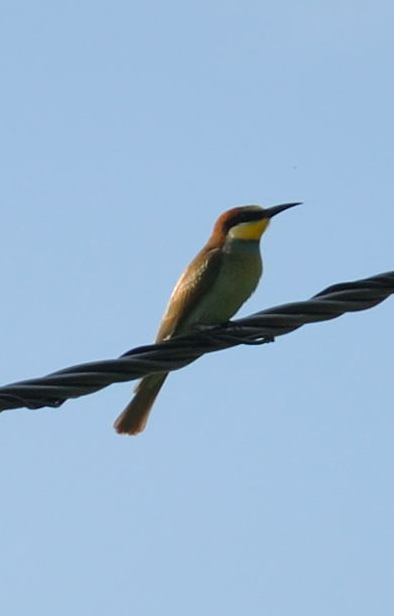
My last spotting was a rather strange one. Towards one September evening I was looking out over the fields from our sitting room, when I noticed a swarm of birds landing on the telephone cable running to our house. I saw them with the sun aslant behind them, hence I could not see them very clearly; still they did not seem ordinary birds. When I looked at them through a pair of binoculars, I noticed they were beautifully coloured birds. I managed to catch one with my camera just before the swarm took off again. With the help of a small bird book for laymen and some internet research, I suspected these had been European bee-eaters. Checking this with a birdwatcher confirmed this suspicion. The swarm was migrating, and obviously landed in Chazelle for a short break.
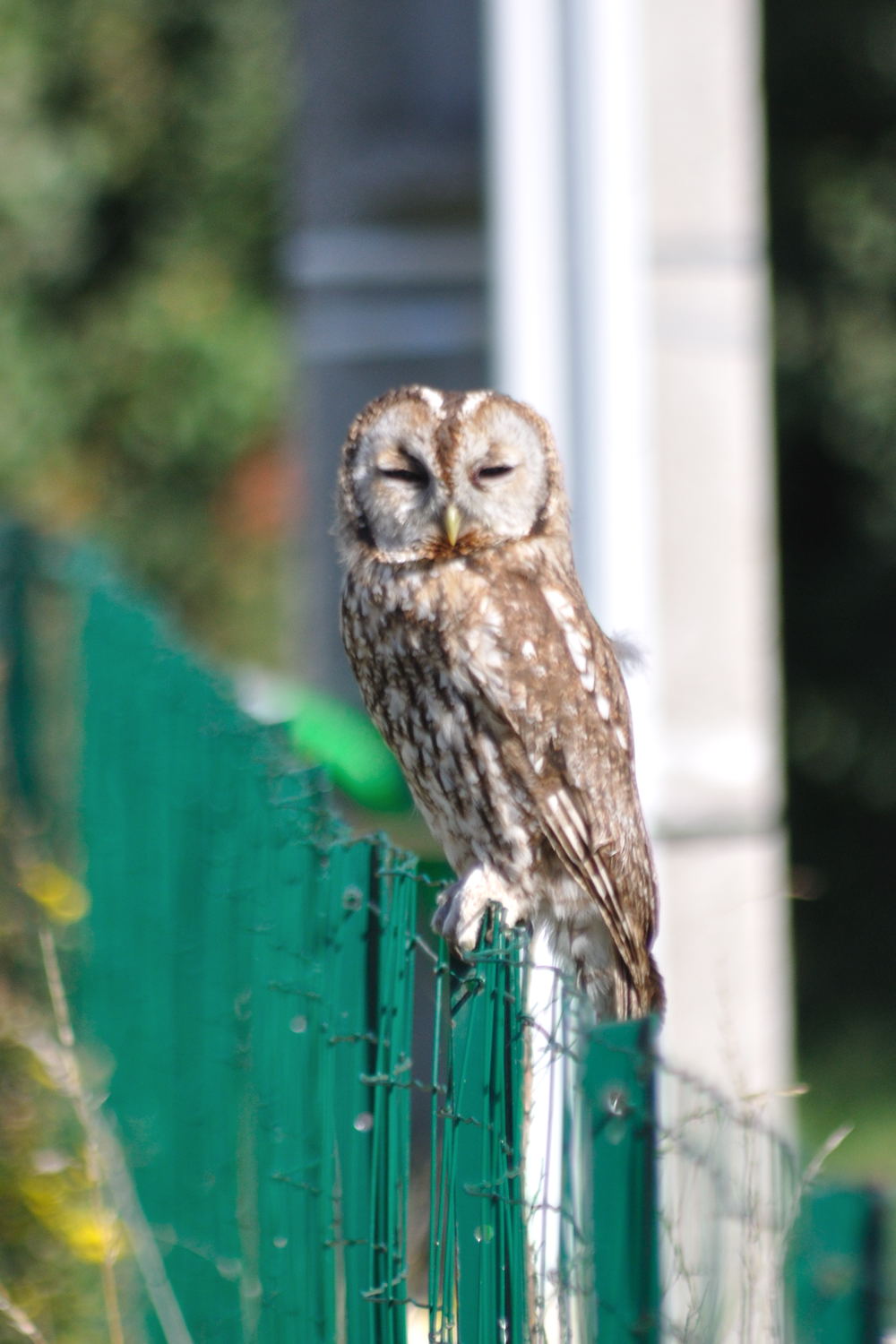
And then I thought how to close off this blog? The answer came the same day. We drove through Saint-Gengoux on our way to the local cave to get some wine, when we saw, sitting on a gate post in the middle of the day, a tawny owl. They normally live in the woods, and although Saint-Gengoux is not exactly a metropolis, it is also not that rural that tawny owls would nest in the town itself. The owl looked a bit sleepy, and I suspect it somehow got lost and mistook the gate post for a tree.
The moral of this story: to see interesting birds, it pays off to keep your eyes open in stead of investing in expensive equipment!

For our own website click here.

Saturday, 11 February 2012

A tale of 11 stères

This time of year the Dutch are very ambivalent about the weather; on the one hand trains come to a grinding halt because of the low temperatures, on the other hand most people are hoping for the “Tour of 11 Cities”, a 200 km skating race along canals and across lakes in the Northern part of the country. The ice has to be of considerable quality and thickness to hold the hundreds of skaters.
For us in Burgundy the cold is much more associated with keeping the house warm, hence the title of this blog. We prefer to wait until the ground is properly frozen before we order our yearly 11 stères (approx. 11 cubic metres) of firewood. The wood is delivered in three loads, which we stack under a half-covered area of the toilet block for the campsite. The wood can dry there, and is ready for consumption by next November. We normally manage to stack one load before the next one arrives, but not this time. There was such a horribly cold gale blowing, making the temperature feel like -20 degrees in staed of the -7 it really was. We had to go inside to warm ears, fingers and feet after having stacked only a few wheel barrows.
Our blogs and our website are very often found by people who are using Google to find out “what is a stère”, “how to stack wood under a roof”, “match sticks from one cubic metre of wood”, “stacking a stère of wood”, etc. Most of these wood-obsessed people are strangely enough from Belgium, but also an occasional Brit, American or Canadian has been affected by this aberration. Whether they have ever found in my blogs what they were looking for is questionable, hence this little helping hand concerning the stacking of wood.
Whenever you drive around here, one cannot miss the neatly stacked, freestanding rectangular “walls” of firewood along roads, by houses or even in the forest. Whoever has tried to stack logs of wood should know the problem. One starts with a neat row of logs, followed by a second row which is one log shorter than the previous one, etc., until the required height has been reached. The result is a “wall” which is not rectangular, but has the shape of a trapezoid (see photo no. 1). Not only has the stacking to be done neatly, the various layers also have to form horizontal planes. If they are not horizontal enough inevitably collapse follows at some stage. Our first stacks were built this way. The only advantage we had was that our “wall” was stacked against a brick wall, hence the danger of collapsing was not so big, provided the wood was more or less leaning towards the brick wall. The disadvantage is obvious; a lot of space is lost in the triangles on the side of the stack. In order to see how it should be done, we looked at how the French were stacking. And that was fundamentally different!
They start building a tower at the beginning of the stack. Two or three logs of equal size form the first layer; the next layer is the same, but the logs are perpendicular to the first logs, etc., etc. When the tower has reached the required height the whole process is repeated at the end of the stack. Choosing the right logs is a bit tricky, but once one gets the knack of it it results in two free standing, stable towers. Then the space between the towers is filled as usual. The towers assure that no logs are rolling away, and when the planes are more or less horizontal, a stable rectangular “wall” is the proud result of all the work (see photos no. 2 and 3).
We have just done this, and the same amount of wood, last year stacked in 3 trapezoidal walls, has now been “reduced” to 2 more or less rectangular walls!

For our own website click here.

Tuesday, 31 January 2012

Loto / Bingo

Last Saturday was the big day in Cormatin; your humble narrator and a hall full of Cormatinois and Cormatinoises were playing bingo till death did us part, in loco parentis for our generous friends who could not play personally.
Alas, all to no avail.
Of all the 91 cards we managed to flog off note even one was good for a prize. We did try to bribe the Bingo Master, apparently also without success
But do not despair; next year there will be another Loto, and hence another chance to win a TV, a Home cinema or a ham!

Saturday, 21 January 2012

Des chiffres et des lettres

We are now finally part of the real world; we have an address and a house number. This must be a relief for the Dutch tourists who call us with the question whether there is no betterbetter address available than “La Tuilerie de Chazelle - Cormatin”, because not having a street name, let alone not hsving a house number is for a Dutchman more or less a blasphemy. So for those who cannot cope, as of yesterday we live at 10, Rue de Chazeux.
Irrespective of this Great Leap Forward, instigated by our Great Helmsman, we will stick to our “old” address. The reason is quite simple: most people in Chazelle and Cormatin know exactly where La Tuilerie is; whether they can imagine where 10, rue de Chazeux lies is questionable.
The rue de Chazeux starts at the D881, and runs through Chazelle until it ends on the boundary of Cormatin between the hamlets Chazelle and Chazeux, in the middle of a forest. The agricultural path we live on, well outside Chazelle has been designated as a cul de sac of rue de Chazeux by the officials involved in naming roads and giving numbers.
The distance between no. 8 and 10 is approx. 1 km (slightly over half a mile).
Had these officials taken their job a bit more seriously, and better, had they sought our valuable advise, we possibly would have ended up with a slightly more poetic or romantic road name.
We knew that street names were about to be dished out, hence we had given this matter some thought, as one does.
What about “Boulevard Noël Marembeaud”? That would have been a nice tribute to the man who started the tuilerie or tile factory here in the second half of the 19th century.
A French play on words always goes down quite well with the local warlords, hence the link between “Avenue des Champs Elysées” and “Avenue de chez Sue et Cées” would be quickly established.
The house number 10 has strong associations with Downing street, certainly when one thinks of the British owner and of the recent film “The Iron Lady”.
We would have been quite happy with something simple like “Les Tuileries” or even with “Rue de la Tuilerie”, but no, the authorities knew better...
To summarize this complaint: the mairie has chosen the line of least resistance, and again we are the victims of this lax attitude.
But of course this is not the end of this nasty affair: I have already send a letter in high dudgeon to the mairie, including the relevant photos. And knowing our mayor, this will no doubt be part of the agenda in the next council meeting!

For our own website click here.

Tuesday, 17 January 2012

The latest on Loto Cormatin, extra, extra, read all about it!

Hello everybody; I am only posting this to announce that we have managed to flog off all our 78 bingo cards for the Loto.
The remaining cards are with the other members of the Amicale and with the local shopkeepers.
We will certainly inform any possible prize winners after January 28th!
Thanks again on behalf of the children and pensioners of Cormatin.

Friday, 13 January 2012

Again : a call for help

Just like last year we received a number of bingo (or loto) cards from the Amicale de Cormatin, which we were asked to sell. The proceeds of these cards are used to finance the yearly dinner for the aged of Cormatin (April) and for Christmas presents for all kids in Cormatin between 0 and 10 years old.
At the beginning of 2011 I placed a call for help in my blog, begging my readers to donate something to this fund raising event. I got quite a few positive reactions, and we managed to sell our 40 cards quickly to some expats and friends around here, to some guests who stayed previously on the campsite or in the gites and to friends and family abroad (the second prize fell on one of our cards!)
Because over time we have gathered some more friends and acquaintances among the French population of Cormatin, we made the rounds in Cormatin and environs, and we managed to sell all our 40 cards in no time. No call for help on my blog or on Facebook required, or so it seemed...
Until Sue spoke to some less pro-active Amicale members; they had been “unable to sell any cards at all”, and on top of that they possessed a box with more than 60 unsold cards! She will be on the road this afternoon, to try to persuade the shopkeepers in Cormatin to flog off some more cards. At the same time I will try to interest some of my readers in again buying some cards off us through my blog and through Facebook. Who says that social networks are useless?
I ask those who are willing to invest some of their hard earned money for this good cause, to send an e-mail to this address cees@latuileriechazelle.com, specifying the number of cards requested à € 2 (or £ 1.70) a card.
The potential benefactor will receive our bank details; continentals my (Dutch) BIC and IBAN numbers, islanders who want to pay in sterling will receive Sue’s account number and sort code.
On Saturday 28 January half the population of Cormatin will play bingo on your behalf for 3 prizes well worth the money:
1. a Techwood 32 “ flatscreen TV-set (PAL & SECAM)
2. a Life’s Good home cinema
3. a ham
None of these goods will go off shortly!
I hope this call for help will have the same effect as last year; all contributors receive a well meant “thank you very much” in advance.

Saturday, 19 November 2011

People’s democracy

No day goes by in France without big numbers of Frenchmen being “en colère” about something somewhere. Either the farmers, or the fishermen, or the railroad workers, or the judges are infuriated about something, and most of the time this results in big demonstrations in Paris or near a Préfecture in the neighbourhood. Abandoning a required right or reforming traditional institutions is always a good reason to take to the streets for the average Frenchman. Being an old left winger, I always get a kick when I see streets full of people, waving red flags, marching towards their goal. One of the most recent protests here were aimed against transforming one of the main East-West roads of France, the N79 (RCEA, Route Centre Europe Atlantique) from Route Nationale into a toll road. Understandable that this does not go down well with people who are using the N79 day in day out to travel from home to work and vice versa. Another recent protest was aimed against privatising La Poste. And even though the government had already promised that La Poste would not be privatised directly, the French left wing had organised a nation wide “referendum”, to see what the population thought of privatisation. Throughout the country there were voting boxes strategically placed near post offices, and the CGT (the biggest French union) announced the next day, that an overwhelming majority of the 2 million “voters” had said “No” to privatisation.
My first encounter with demonstrating “the French way” was in 2005. There was going to be a European Union protest against the Bolkestein directive (Wikipedia) in Brussels. Since I was a member of one of the bigger Dutch unions, FNV Bondgenoten, I joined the crowd.
In the bus on the way to Brussels all Unionists received a parcel, containing a dull bread roll with ham, an even duller one with cheese, an apple and a carton of orange juice. Once in Brussels we were guided to the place from where the demonstration was supposed to start. The FNV was to start in between Unionists from Poland (Solidarność) and France (CGT). And it only dawned on me then, that for the French a demonstration is a bit more like an outing on a nice summer’s day than for the grim Polish and the serious Dutch. While we were desperately trying to rinse our bread rolls down, our neighbours of the CGT opened their picnic baskets. A tablecloth was draped over a bench on the side of the road, and out came the French loafs, with all sorts of sausages and cheeses, and last but not least, bottles of wine and glasses. When you see this, would you not like to take part in a demonstration against no matter what, every day?

The website of La Tuilerie de Chazelle

Saturday, 12 November 2011

A bit boring, this time!

Yesterday it was 11 November, the day when in many countries the armistice of 1918 which ended the First World War is celebrated and remembered. Strangely enough (at least in my eyes) is the wreath laying of 11 November the one that is attended by the biggest crowd, far bigger than the one on July the 14th. Unfortunately the man who normally unwillingly turns these events into something more amusing than just a wreath laying, Monsieur P., was unable to attend. The wreath laying takes since 2009 on instigation of Monsieur P. place at both monuments, the one for those fallen during the wars in Cormatin, and the one for the deportees at Bois Dernier. Everything worked smoothly this time. The traditional flag-bearer, Monsieur N., took Monsieur P.’s place to operate the CD-player, and the flag was this time carried by Monsieur G. No ramshackle old cassette-deck, no hick-up in the Marseillaise, no frantic searching for the off-button, no, actually everything went too smoothly...
The attendance however was so unexpectedly big, that the mayor had to move the venue for the vin d’honneur from the small Café de la Poste (which was supposed to host the drinks) to the bigger Les Blés d’Or.
That these sort of last-minute logistic changes often cannot be implemented without any problems was proven by the fact that there were insufficient tables, chairs and even standing room available for the crowd. But the rest of the ceremony went like clockwork, after the mayor had uttered a few times the word “Bordel” (“What a mess!”) to the owner end the first drinks and snacks had been passed around. Let us hope that next time Monsieur P. will be present again; with him there has so far never been a dull moment!

For our own website click here.

Saturday, 5 November 2011

Sans Virus!

Some time ago, when we went to the Intermarché in Cluny for our shopping, we found part of the parking area closed off for works. Recently the works were completed, and it appeared that they had built two covered parking places, both with an intercom facility. We had no idea what these parking places were for; our best guess was a facility to return a rented van (the Intermarché rents out vans) outside opening hours of the supermarket.
Today a big sign revealed that we had been completely wrong. The parking places were part of a new service Intermarché is offering: “Le DRIVEINtermarché”. The client orders his shopping via internet, and indicates when he comes to pick up his shopping. He passes by at the agreed hour, parks his car at the intercom and announces his arrival. Somebody from Intermarché then comes to the parking area and delivers the shopping.
When I read this and thought about it for a second, I realised that this concept had disaster written all over it. Inhabitants from the villages around here ordering their shopping through internet?
First of all they would miss out on an endless conversation at the till whilst unloading their shopping trolley, followed by digging in a bottomless handbag looking for the chequebook, after which a pen has to be found as well. Then the cheque has to be signed and handed over, after which the said piece of paper disappears in and reappears a number of times from a magic black box which happens to verify the cheque. This whole procedure which so far has lasted at least 10 minutes is concluded by the stowing away of the shopping followed by an in-depth conversation about the neighbour’s cat. No Burgundian would miss out on something like this, would he?
Secondly, and that does not go just for the locals here but for big parts of France, computer illiteracy and fear of computer viruses are rather high in France compared to the UK or the Netherlands.
To illustrate this: a number of our French friends, amongst whom also business people, only open emails if they come from someone they know. All notorious carriers of computer viruses, such as films, jokes, web links, etc. are opened without any hesitation as long as they know the sender. However, one potter who works around here received a request for some home made pottery from my daughter, who had been there once and had bought some stuff there and then. The request was binned without being opened, for the simple reason that she did not know the name of the sender!
Another illustration: in our favourite quiz show every so often one of the prizes is a PC. This is always announced as “ordinateur avec écran plat, SANS VIRUS!”. One even finds these adverts on the internet.
I really wonder if it is at all possible to buy a brand new computer from a French retailer which contains a virus.
Anyway, to cut a long story short: I do not give this service a long life; I am pretty sure that soon the two parking spaces are going to be used for the rental vans…

For our own website click here.

Saturday, 29 October 2011

Who are these guys?

In Cluny one often bumps into a handful of people dressed like this. They did not walk away from a Carnival celebration; no these are students of the ENSAM, one of France’s Grande Écoles in their working outfit. The ENSAM is a very prestigious technical university (that seems to come as close to the school type as one can get), and Cluny is just another (very small scale) branch of the École Supérieure des Arts et Métiers of Paris. We have never been able to figure out how the school exactly works, but we do know that these students are in Cluny only for a couple of months. The lecture halls are in one of the remaining parts of the former abbey.
The students live together in a couple of blocks of flats, and sometimes, when there is a party going on, one really gets the impression that Cluny is a university town. But generally one only sees the students in their extravagant outfit wondering around the market or browsing the shop windows in Cluny’s main street. The school possesses a beautiful collection of “masterpieces”, a piece of handicraft the students must produce to prove that they master their trade. The collection is open to the public on the open days of the school. The students in the bottom photograph are standing next to one of the old “masterpieces”.
The ENSAM is also heavily involved in the abbey of Cluny. Various 3D films about the Ecclesia Major and other buildings of Cluny III often bear the signature of the ENSAM.
We were not aware what else was involved when it comes to the French Grandes Écoles. We found out about it when one group of students was leaving and another one was coming in. This normally happens during the weekend, and a sure sign that something is going on is the lack of available parking spaces. But once having discarded one’s vehicle, one bumps regularly into bunches of students and their parents and friends.
To our amazement, the students had undergone a metamorphosis. No more grey, with bright colours painted or embroidered dust coats; on those hey days the students are wearing a military like uniform, and the few female students wear a similar skirt suit.
When comparing working cloths and gala cloths, the difference between those two is even greater than within the army!

For our own website click here.

Saturday, 15 October 2011

Mental arithmatic

Although un-officially retired, I still have to do some work every so often. Most of our clients live quite close, a few a bit further away. One of our clients lives half an hour’s drive Northeast of us, and nearby there is a village called Bissy-sur-Fley, which we had never seen before. We knew it had a Romanesque church, and since it was at least dry, we went there after inspecting our client’s house. Unfortunately, the church was closed, but fortunately we found a few other things we did not know about. Bissy-sur-Fley appears to have an old castle, which once belonged to Pontus de Tuyard, a French 16th century poet. I had read in the local paper about music performances at the castle, but did not know where this castle was.
The next find? In the past I have reported about rumours that “Aux berges de la Grosne” is going to be transferred into a beer bar, which was at the time located in a place not near here. I was quite surprised, to find, very near the closed church, the “Café le Papillon”, offering a selection of 111 different beers. I seemed to remember that the original beer bar was located in a village with Fley in its name, so adding up one and one, and still another one, I came to 111!

For our own website click here.

Saturday, 1 October 2011

Paranoid, moi???

Early 2011 Egypt, and the middle East, were very much in the spotlight; regimes in Tunisia and Egypt were toppled by weeklong demonstrations.
Which makes me think of a story we heard from a guy who lives in La Bergerie, a hamlet not far from here. This guy, C.P., told us that his neighbour was building a pyramid opposite his front door. This all sounded rather strange, and the way he described it pointed at something quite bizarre. According to him, there was a big group of people living opposite his house, most of them lived underground, and they were erecting a pyramid with Egyptian statues at the entrance. There was also talk of red eyes of the statues, which would be lighted up at night. He had complained at the Mairie, but according to the Mayor his neighbours had received planning permission from Mâcon, so there was nothing he could do about it.
Give C.P. his due, he is a juicy story teller, so which part of his story was true, we could not work out. How do you find out? Simple, you just drive past. And so we did.
C.P. had not really exaggerated. Opposite his house there was a former pond, with tapered dikes around it. In the middle of this pond stood a house, and the entrance through the dike which had recently been clad with concrete, seemed to give access to some underground corridor. There were at least 10 cars parked next to the pond. With the story of a big number of people living there in mind, and also considering that C.P. obviously was not on speaking terms with this neighbours any more, we did not really dare to get out of the car and start taking pictures.
However, one sunny afternoon we finally got our act together, plucked up the courage and went off to La Bergerie. Plan of campaign (think Private Eye!): I had my camera with tele-lens ready to roll. We drove to a path from where we could see the house without really being seen, windows rolled down. I got out of the car, found some support against a pole, and shot some pictures. From there we drove off to the front of the house, doing a turning manoeuvre (paranoid, moi?) - implying to those who might think “What are those people doing here?” that we had taken the wrong road - which brought me and my window in a position to take some pictures of entrance and Horus statues at close range.
Operation Moscow Rules went very smoothly, and once home I could have a close look at the pictures I took. Well, I must admit, that I would not be very pleased if someone was building a tourist attraction opposite my front garden.
Now what connections is there with the fall of dictatorial regimes? France has a tradition of giving shelter to ex-dictators (Baby Doc and others), so it would not surprise me if Sarkozy has built this little cosy pyramid for his friend Hosni Mubarak......

For our own website click here.

Saturday, 17 September 2011

Some like it hot

Sue had recreated a dish which was one of our favourites when we still lived in the Netherlands; a fiery dish with chicken livers spiced up with Madam Janet, a very hot small bell shaped pepper which is very popular in Surinamese cuisine. It is something which is not available in France, at least not around here. Around dinner time one could smell a very strong smell of something extremely hot: that was the smell of cooking a dish with Madam Janet in it. The taste was as hot as the smell did suggest. It was actually so hot, that Sue had difficulty eating it. Sheer luck she had taken the seeds out before cooking!
When we talk about hot food, the conversation always ends with remarks about the quality of Indian restaurants in the neighbourhood. Sometime ago we received through Facebook a suggestion for a good Indian in Chalon. We followed this suggestion up, and had indulged in a buffet, which seemed to be a good way to sample the available dishes. Of course, there were no hot dishes available at the buffet, because that would most certainly scare off their French clientele. The verdict was, not bad, but also not very exciting. And because we had to go to Chalon today, with the taste of Madam Janet still burning on our lips, we decided to give the place a second try, this time ordering à la carte.
We had to go to Chalon for a financial problem. We were, incorrectly, charged to pay € 7.00 for some medical care in Chalon. The Michelin road planner told us that petrol cost for a trip up and down to Chalon would be around € 8.00; so whether the trip was economically sound is debatable. But no excuse is weak enough for a good lunch, so off we went.
My knowledge of Indian cuisine is based on my three years stay in Singapore, and Sue knows Indian cooking from the UK and from India itself. In most English Indian restaurants Vindaloo is top of the range when it comes to spiciness, although some restaurants offer Phal, which is hotter still. On the menu of Bollywood the rating was different. The hot curries ranged from bottom end Madras to Vindaloo, with Jalfrezi at the top end. I was a bit surprised to find a whole range of beef curries on the menu, but I have eaten Malaysian beef curry in the past, and of course Muslims would have no problem eating beef, as opposed to their Hindu compatriots. So I ordered a boeuf Jalfrezi for a change, and although not as hot as Sue’s dish the day before, this curry certainly deserved the designation “very hot”.
The beef had the consistency of a beef stew; pointing at is with a fork already made the meat disintegrate. All in all a good choice.
For those readers who are hesitating to go to Burgundy, because they will miss their local Indian too much: forget your fear, and eat out in Chalon. The same holds by the way for good Chinese food, with an excellent Chinese (buffet) restaurant in Mâcon. Chalon as well as Mâcon offer now suitable substitutes for Indian / Chinese food addicts! The only thing we are still missing is an Indonsian restaurant. For an Indonesian take-away meal we will have to wait until one of our regular gite guests brings one from the Netherlands!

For our own website click here.

Saturday, 3 September 2011

Plat du jour

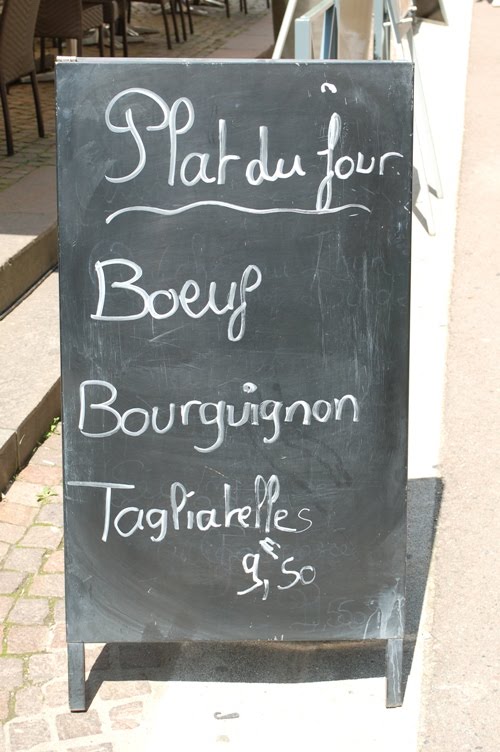
I have written about eating, restaurants and fast food on various other occasions, but I don’t think I have ever pointed out the advantages of a plat du jour or a menu du jour. Almost every restaurant offers these two things around noon: the plat du jour costs approximately € 8 and the menu du jour (starter, plat du jour, dessert, sometimes incl. a glass of wine) is approx. € 13. Since most French still have their big meal at lunch time, and since the prices are more than reasonable, plats du jour are sometimes sold out after quarter past one. There are even restaurants where one cannot order à la carte during lunch hours. Only the plat or menu du jour are available then.
But not only are the prices reasonable; the price-quality ratio is normally excellent as well. As an extra advantage I would like to mention that this is the occasion for the more adventurous to try out something they certainly would not order à la carte. An example is given below.
When we were forced by circumstances beyond our control to exchange our weekly lunch at Cass’ Crout’ (closed down) for something else, we stumbled upon La Petite Auberge, another restaurant cum pizza parlour in Cluny’s main street. On the first occasion we tried out this place the plat du jour happened to be a pavé du boeuf, which turned out to be an excellent piece of steak. After about ten weeks we had found out that they had a very wide range of different plats du jour, and even now, after about 4 or 5 months, I believe I had the same plat du jour only twice.
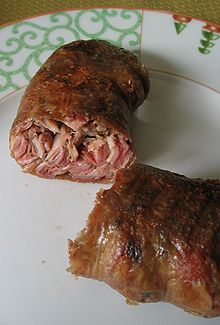
One of the ever recurring horror stories one hears whenever expats gather somewhere, concerns andouillettes. Every expat has tried it once, knowingly or unknowingly, and everyone agrees that they strongly resemble cut up car tires cooked in a rich crude oil. Because everybody seemed to be so horrified about those things, we bought them once in the supermarket. I strongly believe in not believing other peoples horror stories; I rather trust my own judgment. Anyway, the consistency was not too bad, but the smell that came off those things really put me off them after having eaten my second.
When I saw andouillettes as plat du jour one day, I reasoned, that if there ever was a chance to eat good quality and well prepared andouillettes, it was this. To my partner’s abhorrence I ordered the plat du jour and started to eat. The andouilettes were indeed filled with finely cut-up intestines and other spare parts of various animals, but the consistency was digestible, the taste was not horrible, and it did not smell awful. Had I known what they would taste like, I would not have ordered them, but given the fact that I wanted to try them once, I could not have chosen a better occasion.

The moral of this story: the plat du jour is generally a good bet for a good quality meal, and for those who insist on trying typical French horror story meals such as tête de veau or andouillettes, they have the best chance that these dishes at least are of good quality and well prepared.

For our own website click here.

Saturday, 20 August 2011

Scent of a woman

Have you ever been driven in a car, where the driver turned out to be a blind man? It happened to us, not so long ago, and I can assure you, certainly with the film “Scent of a woman” in mind, that is no fun! In this film Al Pacino, a blind ex high army officer, convinces his chaperone, a young sudent, that it is safe to make a “slow” test drive in a Ferrari, whilst he, Al Pacino is driving.
In our village Chapaize we come regularly across an elderly couple, making a short walk just outside the village. The man wears dark glasses, and always walks, or shuffles alongside his wife, with whom he holds arms. Whenever they hear a sound they stop, and wait in the soft shoulder until the noise is over. It seems obvious, that the man is either blind, or has very poor eyesight.
At one of the wreath layings in Cormatin we bumped into this man again. He was very jovial, said hello to us, did not wear dark glasses, and was with another woman whom we also know from Chazelle. The wreath was going to be laid at the monument in Bois Dernier, too far to walk for any French person. The woman offered us a lift, and we got into the car. To our big surprise (and horror!) the man climbed behind the steering wheel and drove off. Luckily we drove in convoy, and very slowly; further the distance between the town hall and Bois Dernier was not more than a couple of hundred metres, which eased the pain a tiny bit. We did not know how quickly we had to leave the car when it stopped. Fortunately the couple did not return to Cormatin for the vin d’honneur; they had to go back to Chazelle straight after the wreath laying. We talked about the incident for weeks to follow, and never figured out 100 % how the whole thing fitted together. But the most logical explanation seemed to be the following: the man who gave us a lift was not the same person as the blind or half blind man, even though they looked exactly the same. The driver walked normally and quietly, although not fast, and he walked on his own. The blind man however, always shuffled very slowly, and always held his wife by the arm. The only conclusion could be, that both look-alike men were (twin?) brothers, and that both lived in Chazelle. That would also explain the wife swapping. Anyway, in future we only accept a lift from people we are sure of they possess full eye-sight; we do not want to take any risk in this matter anymore!

The website of La Tuilerie de Chazelle

Wednesday, 10 August 2011

Les Rendez-Vous de Cormatin

More or less by accident I ended up being a volunteer for the yearly theatre festival Les Rendez-Vous de Cormatin. This is a prestigious festival, whereby a renowned theatre company from the town of Asnières (not far from Paris) takes possession of the Château de Cormatin for a period of four weeks to perform a number of plays, varying from classical to modern pieces, including some musical pieces as well. This year features plays by Molière and Feydeau, whilst Stravinsky’s L’Histoire du Soldat is performed by 4 actors and a chamber music orchestra consisting of 7 musicians. I only volunteer for “heavy” work, i.e. building stages, erecting tents before and loading lorries with stage-props after the festival.
Work like checking tickets, standing at the gates of the château, selling programs etc. is not feasible given the large number of shows and the facts that we have to run two gîtes and a campsite. As a token of appreciation the volunteers are given a free ticket for one of the shows performed in the open air theatre.
Because listening to classical French theatre requires a bit more than good listening skills to everyday French, we had chosen to go to L’Histoire du Soldat, a Faust-like Russian fairy tale. Having read the synopsis from Wikipedia several times made following the narrator and the actors relatively easy.
The music, performed by a chamber music group of 7 musicians and a conductor from the conservatory of music of Asnières was excellent, and the simple but more than adequate stage made the play more than worth the money for those who had paid for a ticket. Maybe next year “A la recherche du temps perdu – the musical” ?

For our own website click here.

Saturday, 6 August 2011

Saving Private Fifi

Often people staying in our gîtes or campers ask us what these two huge barrels are for, the ones that stand next to the staircase leading up to our front door. The answer is simple: these two containers catch the rain water running off two small canopies above them. The water is used to water the plants.
The next question is normally, what these two wooden concoctions are, which stand in the water and have a little platform protruding outside the wall of the barrels.
To explain the purpose of these “ladders”, we have to go back in time. One morning I went out onto the balcony in front of our front door, when I heard a big racket going on. The noise came from downstairs, and when I came down I saw what had happened. Our cat Fifi had climbed into the bin, and because it had a peculiar lid she could not get out. I liberated her straight away, and since then the lid is unopenable for cats because it is held closed by a heavy brick. But we certainly started to think then, what would happen if Fifi ever ended up in one of the barrels, which might be filled up to a quarter with water.
The most logical and simple solution would be to build a little ladder, starting at the bottom of the barrel, and ending in a little platform. If the cat ever ended up in the water, at least then she could climb out. Making the ladders was a piece of cake, testing them turned out to be a bit tricky.
The barrels were empty, the ladder was inserted, the cat was deposited at the bottom; all we had to do was wait. With one big leap she sat on the edge of the barrel, with a second she stood on all fours on the ground.
But the second test did the trick: Fifi got onto the ladder, slowly walked up, and parked herself in the sun on the little platform. Mission accomplished! At least now we can leave the house, with the barrels wide open, and we do not have to worry that we might find a drowned cat by the time we get home!

For our own website click here.

Sunday, 24 July 2011

Guitares en Cormatinois – Trio Alta

With yesterday’s concert in the church of Malay the festival “Guitares en Cormatinois” came to an end. And though there was no program available for the volunteers (the program was sold out in no time!), a quick search on the Internet provided the required information. The trio consists of Eric Sobszyk – guitar, Igor Kiritchenko - cello and Marc Vieillefon – violin and their program bore the title "Romantique", although the emphasis was on composers of the classical period. Having said that, also non-romantic music was performed in a rather romantic way. Their repertoirte consisted of work by composers such as Paganini, Gragnani, Guiliani, Bürgmüller and Haydn.
The Malay church has very good acoustics for this sort of ensemble. The concert was, in my view, an excellent conclusion of the series, despite, or even thanks to the light-footedness of the music. The music reminded me of light music, which I remember from the revival it had in the Netherlands in the fifties.
Time to make up the balance of the festival.
The highlight was no doubt the concert of Poulet and Saraglou in Chazelle, joint with the concert of Baty and Goudin in Cormatin. The quality of the latter concert was seriously hampered by the acoustics of the church. The piano sounded at times like a submarine, whilst the trumpet sounded absolutely brilliant.
A very good second was the Trio Alta in Malay.
About Bracco and Moncheny in Bonnay I cannot say much more than that I found them boring, and Rossfelder and the Ensemble Toscanini in Saint-Hippolyte I consider to be a missed opportunity.
As far as the venues are concerned:
Chazelle as well as Malay both offer good acoustics. Bonnay was really bad, unless one had a seat at the front, and Saint-Hippolyte’s acoustics were good, while its ambiance is stunning. Big disadvantage of this place is that it requires the back-up of Bonnay church in case of rain. The church of Cormatin has been mentioned earlier.
After each concert there is a buffet for the organisers and volunteers with the musicians in Cormatin. We went on foot to the concert in Chazelle, hoping to get a lift to Cormatin and back from some one. Fortunately the mayor of Cormatin lives in Chazelle, so he took us for a ride.
On the way the subject of venues came up in conversation, and the mayor worded what we had thought for a long time: why not concentrate the whole festival in one place, e.g. in Chazelle? It improves the logistics tremendously, it increases the recognisability of the festival, and the acoustics are known to be good. What else can one wish?
However, knowing how stubborn the artistic director of the festival is, it still will take a lot of lobbying before we can rename the festival into “Guitares en Chazellois”!

For our own website click here.

Saturday, 23 July 2011

I am lost!

For those who receive notification of this blog via email: the embedded slide show is not visible in the email. To read the blog and see the slide show, click here..

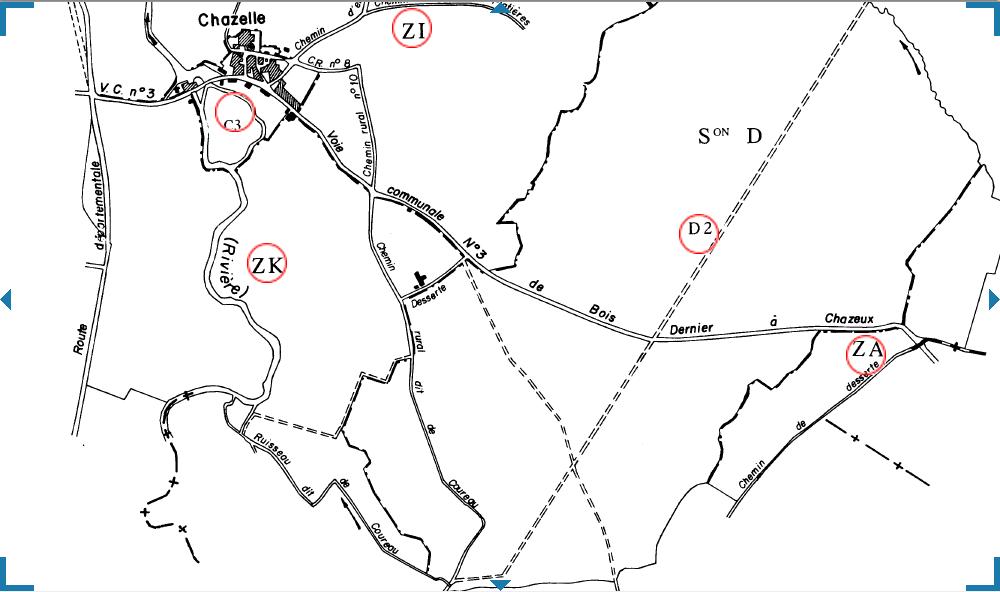
Everybody who has travelled in France knows the most common French road types; N for Route Nationale, A for Autoroute (often toll roads) and D for Route Départementale. Not difficult to figure those ones out. Not so common are the Routes or Voies Communales, often small roads, managed by the Communes themselves. The C-roads are generally indicated on detailed maps, like the Michelin road maps or the detailed IGN-maps; for obvious reasons the road numbers are often omitted on those maps. They are however certainly mentioned on the Cadastre maps. As an example: our house is located on the side of a path called “Chemin de desserte” (connecting path) between another path, called Chemin rural dit de Coureau (the name of a farm and a brook at the end of the path) and the “main” road between Bois Dernier and Chazeux through Chazelle, the Voie Communale no. 3 de Bois Dernier à Chazeux. Needless to say, that a sign indicating C3 is nowhere to be found.
On one of our trips through the neighbourhood we stumbled upon an old road sign. Since I like those archaic things, we stopped to take some pictures. The sign displayed a type of road I had never heard of, a Chemin vicinale ordinaire, indicated on another sign as V1. The dictionary gives for Chemin vicinale as meaning local road, byroad. I have not been able to trace back the age of the sign, but given the state of the sign and the rarity of it, it would not surprise me if they go back to the time before the war. Cormatin, as far as I know, has only one sign like this, Cluny has a few more. They are normally fixed on the walls of houses at street sign height, often on a street corner.


In the more recent system the road has been rechristened as C1, which is shown on a road sign opposite the former one. Funnily enough, the spelling of the place names does not give much of a hint to the age either. On the old signs the place is called Rimont; on the (possibly) newer sign it says Rimond, and on another, brand new sign the place name is back to where it started: Rimont!
Still anybody there who can follow me?

For our own website click here.

Sunday, 17 July 2011

Guitares en Cormatinois – Poulet and Saraglou

So far I have not mentioned the concert of Adèle Bracco – vocals and Thierry Moncheny – guitar. Unfortunately the concert was planned on one of the few rainy days of the last weeks, hence the venue was moved from Saint-Hippolyte to the church of Bonnay. The concert was announced as “Vocal Jazz – Viva Brasil!”, and since I am not terribly keen on Brazilian music, and to me a jazz evening is something more than 2 hours filled with bossa novas and sambas, I will not further elaborate on it. I am sure that someone who is more interested in the dancing side of music would have had a wonderful evening.
Yesterday however there was a concert in the romanesque church of Chazelle by Gérard Poulet – violin and Dimitris Saraglou – piano.
One of the short comings of the programs for these concerts I always find the description: this is often non-descriptive. “Le violon virtuose” could have described a primas of a gipsy orchestra, forcing a singing canary from his instrument, or Stéphane Grapelly performing an up-tempo jazz classic, or a classical violinist playing de Sarasate’s Zigeunerweisen without a flaw. “Sonatas of Mozart, Beethoven and Brahms” makes taking a decision on attending or not attending a lot easier.
Anyway, for whatever reason I had a feeling that this could well become a very good concert. Both musicians are well known, and both teach at established institutions, the one in Japan, the other in Belgium. The program looked promising as well, with Beethoven’s Kreutzer sonata (one of my favourites) prominently there. The church of Chazelle turned out to have far better acoustics than those of Bonnay and Cormatin. The duo started off with an excellent rendition of Mozart’s sonata no. 13 KV 454, followed by a superb interpretation of the Kreutzer sonata. The last piece on the program, Brahms sonata no. 3 was played equally well, but being a great admirer of Beethoven’s work I would have preferred that to be played last (as was originally programmed). For me a concert is perfect when the best piece is kept for last. Having said that, a Brahms lover might be very happy with the change in the play order.
The two received a well deserved standing ovation at the end of the concert, and the French way of asking for an encore (applauding, gradually changing into rhythmic handclapping) was rewarded twice by the musicians. And even though it was not easy to discover any connection in the programming with guitars in general, the consensus of most people present was that this was by far the best concert in the series “Guitares en Cormatinois”.

For our own website click here.

Saturday, 9 July 2011

Jogging

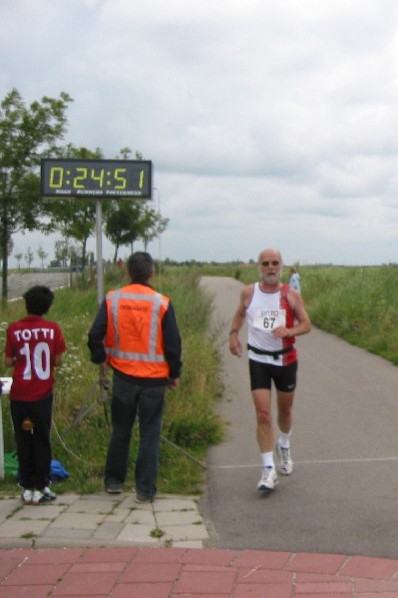
When I was still living in the Netherlands, I was quite a keen jogger. Not that I was material for championships, but I was a member of one of the hundreds of informal jogging clubs in the Netherlands. Most of these clubs however have qualified trainers, and they knew what your limitations were.
I have spent a long time running twice a week, and since these sort of clubs heavily emphasize social contacts, the training evenings were spent nattering away whilst running. Also outside training evenings there was social contact between the members; trips were organised to various runs in the Netherlands, barbecues were held, in short, we did a lot more than just training for a 10 km run or half a marathon. Only training for the full marathon I did on my own. My tempo was considerably lower than that of the group that trained together for the Rotterdam marathon.
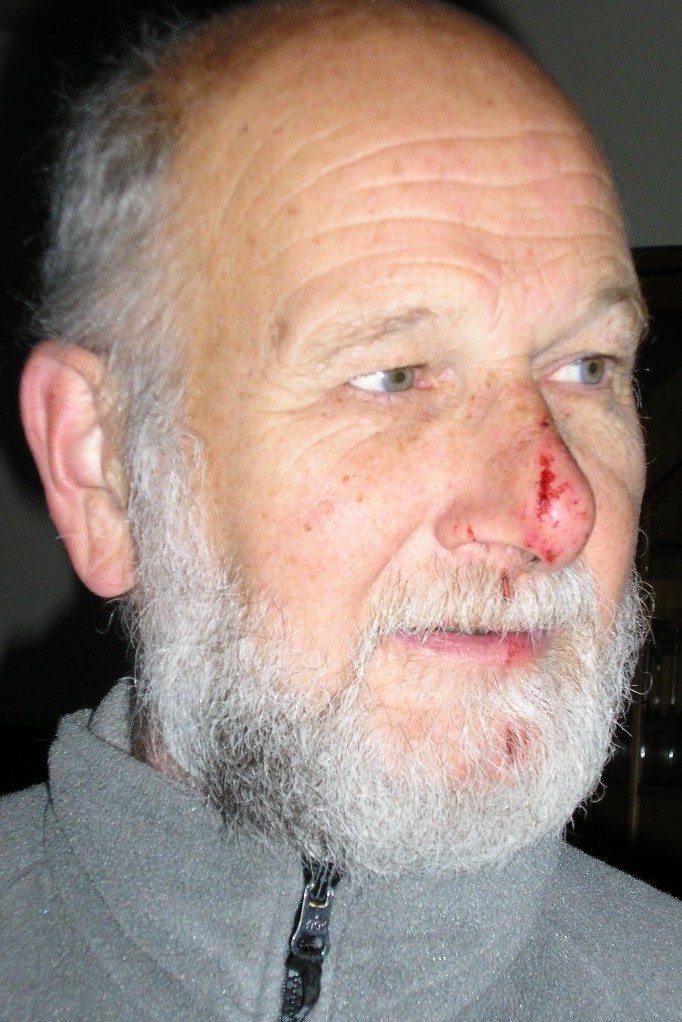
After I arrived in France I discovered that running in a group as a social event was not very well known here. Hence I trained on my own, did minimal 10 km a week, including running up a steep hill, and occasionally ran with some of our campers who had brought their running shoes with them. Finally I decided to post the question “Is there some running club around here?” on a number of forums. A guy from an athletics club in Tournus, about 30 km from here, answered and one Monday evening around 7h00 I reported for duty. There was a very small group, which was split up in even smaller units. My “group” consisted of one guy with a torch mounted on his head and myself. And off we went, on a dark late autumn evening, into a pitch black forest. I am night blind, but nevertheless I got back in one piece. My second run was less fortunate. Almost back, near the stadium where we gathered, I hit a tree root with my foot and fell flat on my face. My “buddy” waited till I was back on my feet again, but never said a mumbling word. In the dresser rooms (there were no mirrors!) I rinsed my hands, said to the coach “See you next time” and went to my car.
Only there I saw how much damage there was. My nose was severely damaged, it looked like a tooth had gone through my lip, my face had blood all over it, in short, I looked like a cowboy coming back from a nice brawl in the local saloon.
Once home, my wounds were tended, and only then I realised that this could not have happened with my Dutch running group. When somebody fell, another runner would turn back to the club house with the victim, look after him or her, and bring him or her to the first aid post if necessary, or home. And after that, one or more members would stay in contact with the victim, to hear how everything was developing, and when the trainings would be attended again.
One can draw the conclusion from the story above, that despite a few emails from me, I never heard anything from the club in Tournus. And I have left it at that. For a while I have tried to keep up running on my own, but the fun diminished further and further. And my condition has dropped to zero after having undergone 3 operations, all involving a pacemaker.
But, recently I have made up my mind again: I have got to do something to get back in some sort of shape. So presently, in the morning, I am very carefully running my 1.6 km from home to the edge of the village, hoping to build up in time to a 10 km run.
And who knows, I might be able one day to do the Classic “2 km de Cormatin” in a respectable 10 minutes....

For our own website click here.

Sunday, 3 July 2011

Guitares en Cormatinois – Emmanuel Rossfelder

Last Saturday was the second concert in the series “Guitares en Cormatinois”, given by guitarist Emmanuel Rossfelder and the Italian flute ensemble Toscanini. The concert was held in the open air, i.e. in the old deanery of Saint-Hippolyte. Rossfelder is one of the mainstays of the festival, the ensemble was an amateur group of 18 (most of them female) flute players, and the gigantic tower of the deanery is a landmark visible for miles around. The pièce de résistance of the evening had to be Rodrigo’s Concerto d’Aranjuez, and I would like to make a note about this in particular.
In the past I once started collecting all sort of renditions of Mussogsky’s “Pictures at an exhibition” (originally written for piano). Well known are Ravel’s orchestration and Emerson, Lake & Palmer’s rendition, but there are also renditions written performed by a brass band, brass band and carillon, street organ, etc. Most of these pieces are more a curiosum than serious music, although very often fun to listen to once.
The same went for Rodrigo’s piece. Some of the flute players had problems hitting the right note every so often, the piccolos sounded like one of the males had just pinched one of the females in the bottom, and the arrangement was or was played very blandly. Rossfelder gave the impression he did not really take the piece or the whole concert seriously. The rest of the evening followed the same pattern. The ensemble played a.o. Pachelbel’s Canon and the allegro from Mozart’s Symphonie no. 40, pieces which are too well known to stand up after being treated this way. Rossfelder’s routine and craftsmanship could save neither Vivaldi’s concerto in D major nor
Tarrega's variations on Carnival of Venice. All in all, this concert was not of the standard we are used to of this festival, which is a pity. It could certainly not be blamed on the ambiance, which was stunning!

For our own website click here.